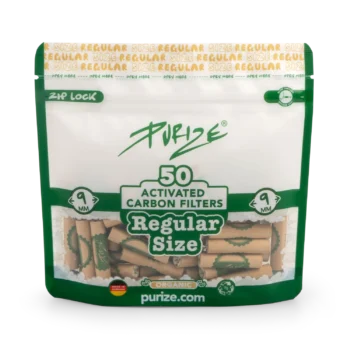
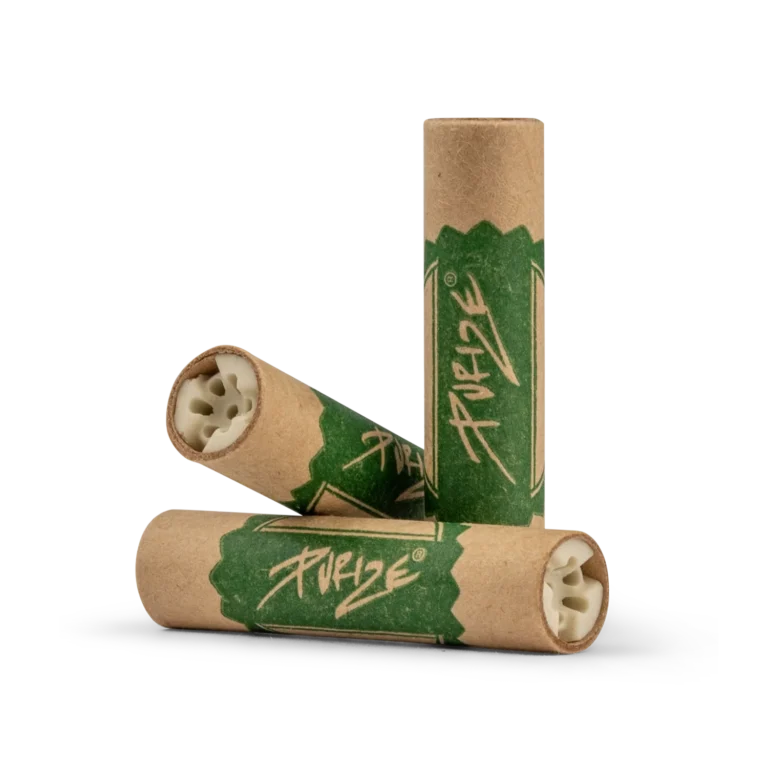
An activated carbon filter sits in the mouthpiece of a joint and traps some of the substances in the smoke before it reaches your mouth. Many people choose one because the smoke feels cooler and smoother while the aromas stay intact. Below you can read how the filter works, what studies have measured and how to pick the right size.
At a glance
- Activated carbon has a highly porous structure with a large internal surface.
- Substances in the smoke stick to the surface of the carbon through a process called adsorption.
- Studies on cigarettes show large reductions in some gaseous substances but a much smaller effect on tar.
- A carbon filter does not make smoking risk-free.
- The filter is designed for single use.
What is activated carbon?
Activated carbon is usually made from coconut shells or wood that is first charred and then activated with steam or chemicals. The treatment opens up a network of tiny pores, giving a single gram of carbon an internal surface of several hundred square metres. That is why activated carbon is used in everything from water filters and cooker hoods to gas masks.
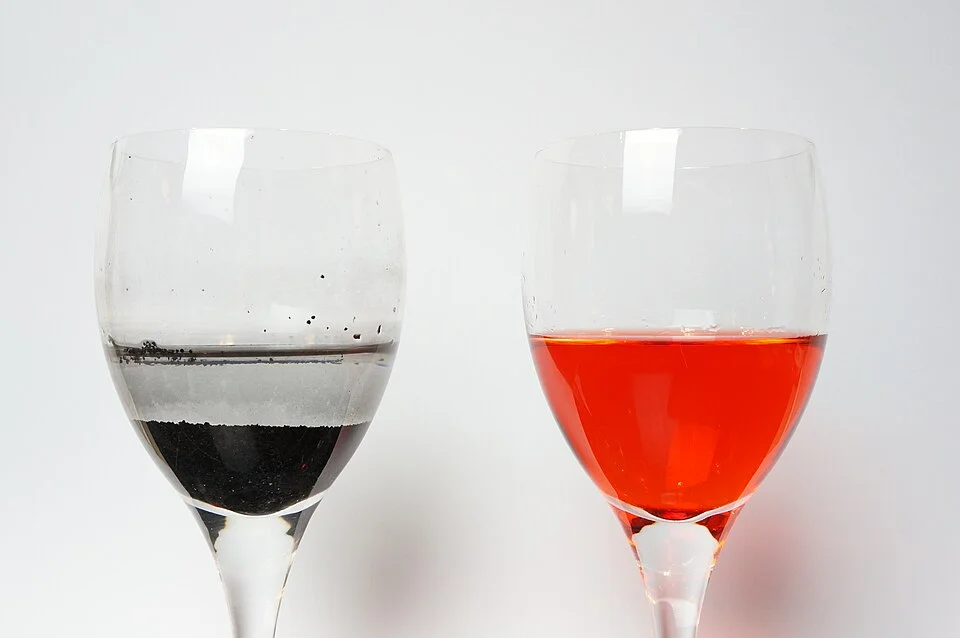
How does a carbon filter work in a joint?
When you draw smoke through the filter, it passes through carbon granules held between two end caps, often made of ceramic. Gases and volatile compounds stick to the surface of the carbon, a process known as adsorption. The smoke also cools slightly on its way through the filter. The result is usually described as cooler, smoother smoke with the aromas still there.
The carbon gradually becomes saturated, which is why the filter is made to be used once.
What does the research say about carbon filters?
Most studies on carbon filters look at cigarettes rather than herbal blends, so the results cannot be transferred directly. They still give a picture of what carbon can and cannot capture.
In a 2018 study from Pennsylvania State University, cigarettes with charcoal filters produced around 40 percent fewer free radicals in the gas phase of the smoke than cigarettes with regular filters. For radicals in the particulate phase, the difference was not statistically significant.
In a 2017 study by the US FDA and CDC, researchers built different amounts of carbon into cigarette filters. At the highest amounts, carbonyls such as formaldehyde and acrolein fell by almost 99 percent. Tar and nicotine, however, fell only modestly, by less than 20 percent, and a lot of carbon also made the cigarettes harder to draw on.
In short, activated carbon is good at capturing some gaseous substances but much less effective against tar and particles. A carbon filter can change how the smoke feels, but it does not make smoking risk-free.
Carbon filter or a regular tip?
A regular cardboard tip gives a joint its shape and keeps plant material out of your mouth, but it filters almost nothing. A carbon filter does the same job and also contains carbon that captures part of the smoke. It is slightly denser, so the draw is a little tighter than with a tip.
Regular or XTRA Slim?
Carbon filters come in different diameters to fit different rolling papers. We stock filters from Purize, a German brand that makes its filters in Brandenburg using coconut shell carbon and ceramic caps on both ends. You can read more about the brand in our article on Purize filters.
- Regular Size (9 mm): for wider papers and cones, with an airy draw.
- XTRA Slim (about 6 mm): for slim papers and anyone who prefers a thinner joint.
The filters come in several versions, including XTRA Slim in unbleached organic paper. You can find the full range among our activated carbon filters.
How to use a carbon filter
- Choose a filter that matches the width of your paper.
- Place the filter at one end of the rolling paper, just as you would a regular tip.
- Fill with your herbal blend and roll as usual.
- Throw the filter away after use.
With ceramic caps on both ends, it does not matter which way round the filter goes.
Does a carbon filter remove all the tar?
No. Studies on cigarettes show that carbon reduces tar fairly little, while some gaseous substances are reduced much more.
Does a carbon filter affect the taste?
Many people find the smoke smoother. The aromas remain, although the carbon captures some of them.
Can you reuse a carbon filter?
No. The carbon becomes saturated during use, so the filter is made for one use only.
Which carbon filter size should I choose?
Regular Size suits wider papers and cones, while XTRA Slim suits slim papers.
Sources
- Goel R, Bitzer ZT, Reilly SM et al. (2018). Effect of Charcoal in Cigarette Filters on Free Radicals in Mainstream Smoke. Chemical Research in Toxicology, 31(8), 745–751.
- Morabito JA, Holman MR, Ding YS et al. (2017). The use of charcoal in modified cigarette filters for mainstream smoke carbonyl reduction. Regulatory Toxicology and Pharmacology, 86, 117–127.
- Purize. About Purize and its products.