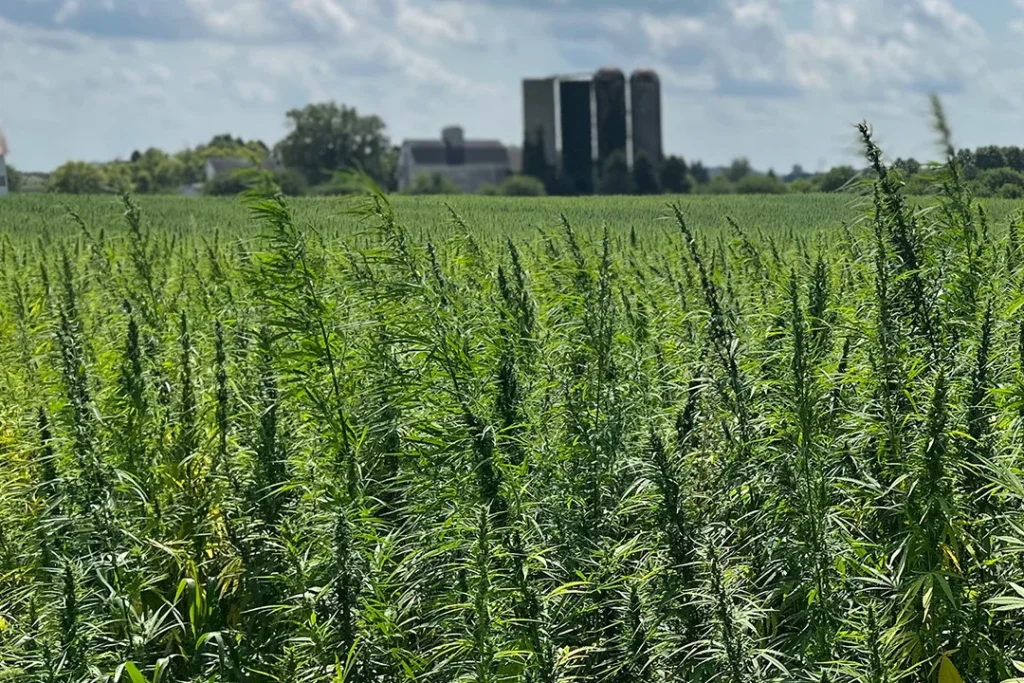
CBD oil is sold openly in most of Europe, but there is no single European law that makes it legal everywhere. Whether a particular oil is legal depends on the country you are in, how much THC it contains and how it is marketed. This guide goes through the rules at EU level, what usually decides the question and how countries handle it differently.
At a glance
- CBD itself is not a controlled substance under the UN drug conventions or EU law. THC is.
- The THC content is usually what decides whether a CBD oil is legal.
- Hemp grown in the EU must come from approved varieties with no more than 0.3% THC.
- Products sold with claims about preventing or treating disease are regulated as medicines.
- National rules differ, from zero tolerance for THC in Sweden to fixed limits in countries such as Denmark.
What CBD oil is
CBD oil is an extract from hemp mixed with a carrier oil such as MCT oil or hemp seed oil. CBD (cannabidiol) is one of more than a hundred cannabinoids in the plant. Unlike THC, it does not cause a high. A broad-spectrum oil also keeps other cannabinoids such as CBG and CBN, which may work together with CBD in what is known as the entourage effect.
What the EU decides
The EU does not have a common law on CBD products. What it does regulate is hemp farming. Under the Common Agricultural Policy, farmers may only grow hemp varieties from the EU catalogue, and since 2023 the limit for those varieties is 0.3% THC. That limit applies to the plants in the field, not to finished products.

The most important ruling came in 2020. In the Kanavape case (C-663/18), the Court of Justice of the European Union found that CBD extracted from the whole hemp plant is not a narcotic drug under the UN Single Convention. A member state may therefore not ban the sale of CBD that has been lawfully produced in another member state, unless the ban can be justified to protect public health and goes no further than necessary.
Why THC decides the question
THC is controlled under the UN conventions, and every European country regulates it. Because oils are made from hemp, many of them contain small amounts of THC unless it has been removed. How much THC a country accepts in a finished product is therefore what usually separates a legal CBD oil from an illegal one. The 0.3% farming limit does not automatically carry over to oils and extracts.
Medicine, cosmetic or something else
How a CBD product is classified depends on how it is presented and what it is meant for. A product sold with claims that it prevents or treats disease counts as a medicine everywhere in the EU and needs a marketing authorisation. The only CBD medicine authorised across the EU is Epidyolex, which is prescription-only. Many national medicines agencies also assess CBD products case by case, so serious sellers make no health claims about their oils.
How the rules differ across Europe
There is no common EU limit for THC in finished CBD products, so each country sets its own rules. Some treat any THC in an extract as a controlled substance. Others accept small amounts, as long as the product is not sold for intoxication.
The rules also change. Several countries have had court rulings or new laws on hemp and CBD in recent years, so check the current rules with the national authorities before you buy or travel.
A few national examples
- Sweden: CBD oil must be completely free of THC. The Supreme Court ruled in 2019 that a CBD oil containing THC is a narcotic, even when it is made from legal industrial hemp.
- Denmark: since 2018, products with no more than 0.2% THC fall outside the narcotics rules.
- Germany: industrial hemp with no more than 0.3% THC is exempt from the Consumer Cannabis Act, provided it is sold for commercial or scientific purposes that rule out use for intoxication.
- France: products from approved hemp varieties with no more than 0.3% THC are allowed. The Conseil d’État annulled the ban on selling raw hemp flowers in 2022.
- Netherlands: CBD is not listed in the Opium Act, but hemp oil and preparations that contain THC are, and the law sets no THC threshold.
- Finland: the medicines agency Fimea treats preparations containing CBD as prescription medicines, although the Supreme Administrative Court has ruled that each product needs its own classification decision.
- Switzerland: cannabis products with less than 1% THC are not covered by the Narcotics Act.
Buying across borders
When you order CBD oil from another country, the law of the country where it is delivered applies. An oil that is legal where it was made can still be stopped by customs if it contains more THC than the destination country accepts. The Kanavape ruling limits outright bans on CBD, but it does not remove national rules on THC.
The same applies when you travel. The law of the country you are in decides what you can bring and use. We go through this in more detail in our guide to traveling with CBD.
Why THC-free oil is the simplest choice
A THC-free oil avoids most of the differences between countries. It is also the safer choice if you are tested for drugs, since standard tests look for THC and not CBD. For athletes, WADA removed CBD from the prohibited list in 2018, while other cannabinoids, including THC, are still banned in competition.
Labels are not always accurate, though. When researchers analysed 84 CBD products sold online, they found THC in 21% of them. That is why a lab report matters.
How to check an oil
- Ask for a current lab report, a certificate of analysis, for the batch you are buying.
- Check that THC is reported as not detected and which detection limit the lab used.
- Make sure the report comes from an independent lab and that the batch number matches the bottle.
- Compare the THC content with the rules in the country where you live.
All our CBD oils are THC-free and tested by an independent lab. You will find the lab reports collected in one place, and we cover the legal status of the plant itself in our article on whether hemp is legal.
Is CBD oil legal in Europe?
CBD oil is legal in most European countries, but there is no common EU law for finished products. The THC content and how the oil is marketed usually decide whether it is legal, and the rules differ between countries.
What is the THC limit for CBD oil in the EU?
There is no common limit for finished products. The 0.3% limit applies to the hemp varieties that may be grown. Each country decides how much THC it accepts in oils and extracts, from zero in Sweden to 0.2% in Denmark and more in some other countries.
Can I order CBD oil from another EU country?
Usually yes, but the law of the country where it is delivered applies. If the oil contains more THC than that country accepts, customs can seize it.
Can CBD oil show up on a drug test?
Drug tests look for THC, not CBD, so a THC-free oil should not give a positive result. Mislabelled products can still contain THC, so choose an oil with a lab report.
Is CBD oil legal where I live?
That depends on the country. Check how much THC the national rules accept in finished products, whether the authorities treat CBD products as medicines and how the products may be marketed. In most countries, a THC-free oil with a lab report is the safest choice.
This article summarises the law as of September 2026 and is not legal advice.
Sources
- Court of Justice of the European Union (2020). Case C-663/18, Kanavape, press release 141/20.
- European Union (2021). Regulation (EU) 2021/2115 on CAP Strategic Plans.
- European Medicines Agency. Epidyolex.
- Swedish Supreme Court (2019). Case B 177-19.
- Danish Medicines Agency. Ændringen af THC-grænsen fra 1. juli 2018.
- Federal Ministry of Justice, Germany. § 1 KCanG, definitions.
- Conseil d’État (2022). CBD: annulation de l’arrêté interdisant la vente des fleurs et feuilles.
- Dutch government. Opiumwet.
- Fimea. Cannabidiol (CBD) is controlled as a medicine in Finland.
- Federal Office of Public Health FOPH. Cannabis.
- WADA. Prohibited List.
- Bonn-Miller MO et al. (2017). Labeling Accuracy of Cannabidiol Extracts Sold Online. JAMA, 318(17), 1708–1709.