

Make Your Own CBD Oil: A Complete Guide to Using Isolate, Distillate and Terpenes
Creating your own CBD oil at home can be a simple and rewarding process when you know what to focus on. It gives you full control over ingredients, potency, and cannabinoid balance, allowing you to tailor the oil to your own needs and preferences. In this guide, we’ll walk through the essentials of choosing a carrier oil, the differences between isolate and distillate, how to calculate potency, and how to add terpenes for aroma and profile – all while keeping things safe, precise, and compliant with EU standards.

Before You Start
Before mixing your first batch, take a moment to plan properly. Always make sure the raw materials come from certified industrial hemp with less than 0.2% THC, as required by EU law.
The oil you create is not a medicine, but a personal wellness preparation – so keep expectations realistic and focus on quality and transparency. When preparing, work in a clean space using glass or stainless steel tools instead of plastic, as plastics can release unwanted compounds when heated.
Keep children and pets away from the workspace and label every batch for traceability. You’ll need a precision scale (to 0.01g accuracy), heat-resistant glass containers, dark glass bottles with droppers, a thermometer, and a clean stirrer.
Choosing the Right Carrier Oil
The carrier oil is what distributes the cannabinoids evenly and affects both texture and taste. The two most common and effective carrier oils are MCT oil and hemp seed oil. Each has distinct advantages depending on your goal.
MCT oil, derived from coconut, is neutral in taste, stable, and easy to work with. It doesn’t solidify in cool temperatures and gives your final oil a smooth, consistent texture.
Hemp seed oil, on the other hand, has a mild, nutty aroma and contains valuable fatty acids like omega-3 and omega-6. It gives a more earthy character and a closer connection to the hemp plant itself, though it can oxidize a little faster than MCT oil.
Whichever you choose, make sure it’s cold-pressed, organic, and stored in dark glass to preserve freshness.
Distillate vs. Isolate – What’s the Difference?
CBD distillate and CBD isolate are both refined hemp extracts, but they behave quite differently in your formula. A THC-free CBD distillate is broad-spectrum, meaning it contains CBD along with other naturally occurring cannabinoids and terpenes, while being completely free from THC.
It delivers a more complex cannabinoid profile and takes advantage of what’s known as the entourage effect – the theory that cannabinoids and terpenes work better together than alone. CBD isolate, by contrast, is 99% pure CBD in crystalline form, free from all other compounds. It’s ideal if you want total precision and a neutral result without taste or aroma.
In short, use distillate if you want a plant-like, rounded oil, and isolate if you prefer exact control and a cleaner base.
- €22,71Betygsatt 5.00 av 5(1)
- €22,71 – €71,97Prisintervall: €22,71 till €71,97Betygsatt 5.00 av 5(23)
-
- 5 g
- 10 g
- 20 g
-
- €45,52 – €123,05Prisintervall: €45,52 till €123,05Betygsatt 4.80 av 5(5)
-
- 3 g
- 5 g
- 10 g
-
- €27,27
-
- Biscotti
- Lemon Cherry Gelato
- Zkittles
-


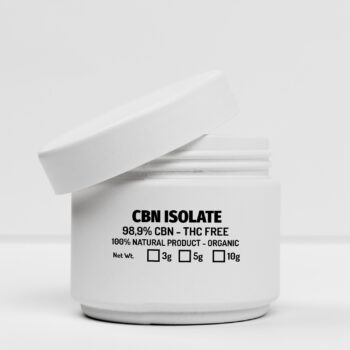

How to Make CBD Oil Step by Step
Once you have your ingredients ready, the process is straightforward. First, weigh your isolate or distillate carefully using a precision scale. Measure your chosen carrier oil – usually between 10 and 30 ml depending on the desired strength – in a clean glass beaker. Place the container in a warm water bath, keeping the temperature around 50–60°C (122–140°F).
Never let it boil. Stir slowly until the concentrate is fully dissolved and the liquid appears clear and uniform. Once the mixture is perfectly blended, remove it from the water bath and allow it to cool slightly before pouring it into a dark glass dropper bottle. Label your bottle with the date, cannabinoid content, and total volume so you can easily track future batches.
Calculating Potency
Knowing the strength of your CBD oil is key to consistency. The formula is simple: divide the total milligrams of cannabinoids by the total milliliters of oil. For example, if you use 5,000 mg of CBD in 30 ml of oil, the concentration equals 166.7 mg per ml. Since a standard dropper delivers about 20 drops per milliliter, each drop will contain roughly 8.3 mg of CBD.
Writing this information on your label ensures you always know the approximate amount per drop. Once you understand this calculation, you can easily adjust your recipes by adding more or less CBD, or by combining it with other cannabinoids like CBN or CBG.
Example Formulas
1. THC-Free CBD Distillate Oil
Combine 5,000 mg of broad-spectrum CBD distillate with 30 ml of MCT oil. Gently warm and mix until fully dissolved. The result is a clean, balanced CBD oil containing approximately 166.7 mg per ml (8.3 mg per drop), ideal as a base for further customization.
2. CBD + CBN Blend
For a more complex cannabinoid profile, mix 5,000 mg of CBD distillate with 3,000 mg of CBN isolate in 30 ml of MCT oil. The finished blend will contain around 166.7 mg of CBD and 100 mg of CBN per ml, or approximately 8.3 mg and 5 mg per drop, respectively. The process is identical — a gentle water bath and thorough stirring are all it takes to achieve a homogenous result.
3. CBD + CBG Blend
If you prefer a more uplifting formulation, swap the CBN isolate for 3,000 mg of CBG isolate. You’ll maintain the same ratio, resulting in an oil with 166.7 mg of CBD and 100 mg of CBG per ml, giving a distinct cannabinoid balance while staying fully THC-free.
Learn more about CBG.
Adding Terpenes
Terpenes are the aromatic compounds that give cannabis and other plants their unique scent and flavor. Adding small amounts of terpenes to your CBD oil doesn’t just enhance aroma – it can help fine-tune the character of your blend.
Popular terpene choices include limonene (fresh citrus), myrcene (earthy and calming), and pinene (pine-like and refreshing). Because terpenes are highly concentrated, dosing must be precise. Start very small, around 0.5% to 1% of total volume – for example, 0.15 ml of terpene for a 30 ml bottle – and never exceed 2%.
Add them after your oil has cooled slightly, stir gently, and test aroma strength before sealing. Overdoing it can overpower the oil, so moderation is key.


Storage and Quality Control
Proper storage preserves both potency and flavor. Always keep your oil in dark glass bottles, tightly sealed, away from sunlight and heat. Label clearly with batch number, date, and cannabinoid content for transparency and traceability.
Whenever possible, source your distillate and isolate from suppliers who provide a verified Certificate of Analysis (COA). These lab reports confirm cannabinoid concentrations and check for solvents, heavy metals, or other residues – crucial for safety and compliance. If you make several small batches, store them in a cool, dark cupboard and avoid refrigeration, which can sometimes cause clouding.
Final Thoughts
Making your own CBD oil is as much about understanding the process as it is about experimenting with balance and taste. Start small, document each step, and adjust gradually until you find the profile that works for you. Whether you keep it simple with pure CBD or build a more complex blend using CBN, CBG, and selected terpenes, the key lies in precision, patience, and clean ingredients.
With a steady hand and good materials, you can produce a THC-free, lab-grade oil that reflects both quality and craftsmanship.


