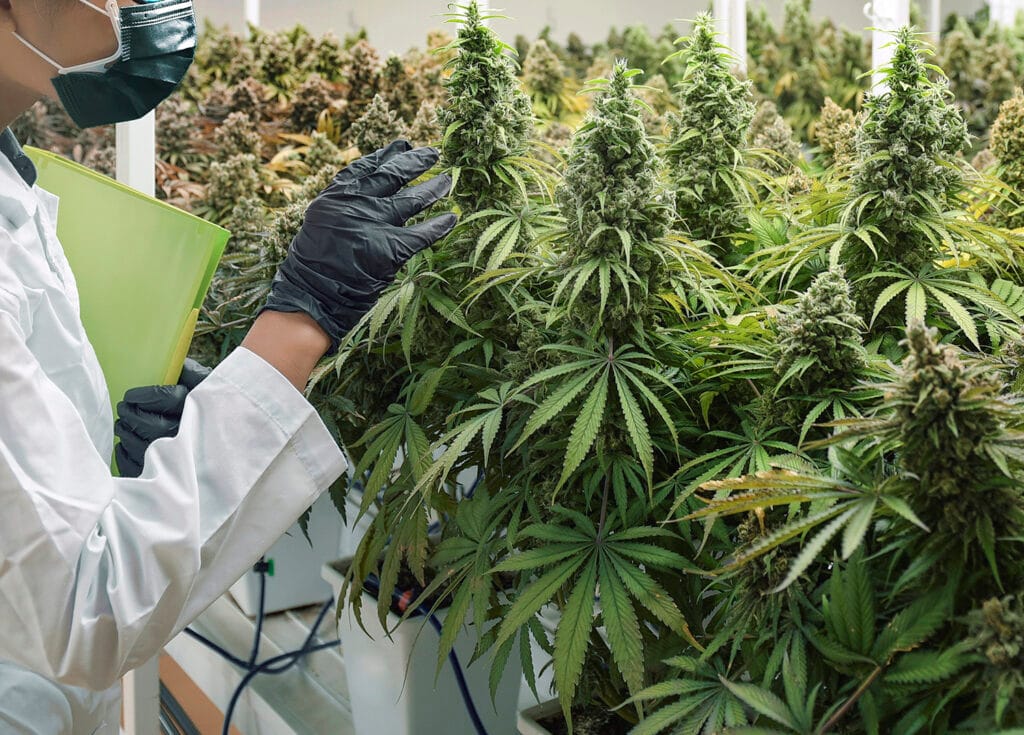
CBG in brief
- CBG stands for cannabigerol, one of more than a hundred cannabinoids found in hemp and cannabis.
- The plant first makes CBGA, which is then converted into THCA, CBDA and other cannabinoids. That is why CBG is often called the mother cannabinoid.
- CBG does not get you high. The first placebo-controlled study of CBG in humans was published in 2024.
What is CBG?
CBG is short for cannabigerol, one of the more than a hundred cannabinoids that have been found in hemp and cannabis. It was first described in 1964 by the Israeli researchers Yehiel Gaoni and Raphael Mechoulam, the same year they mapped THC.
CBG is often called the mother cannabinoid. That is because the hemp plant first makes the acid form CBGA, and the better-known cannabinoids are then created from it. By the time the flowers are harvested, most of the CBGA has already been converted, which is why an ordinary plant usually contains only a little CBG.
Like CBD, CBG is not intoxicating. That makes it interesting both for researchers and for anyone who wants to try a cannabinoid other than CBD.
How is CBG made in the hemp plant?
CBGA is made in the plant’s trichomes, the tiny glittering hairs on the flowers. Different enzymes then take over and turn CBGA into new cannabinoids:
- THCA synthase turns CBGA into THCA, which becomes THC.
- CBDA synthase turns CBGA into CBDA, which becomes CBD.
- CBCA synthase turns CBGA into CBCA, which becomes CBC.
The acid forms are converted into their neutral forms, such as THC, CBD and CBG, when they are heated or stored for a long time. The process is called decarboxylation.
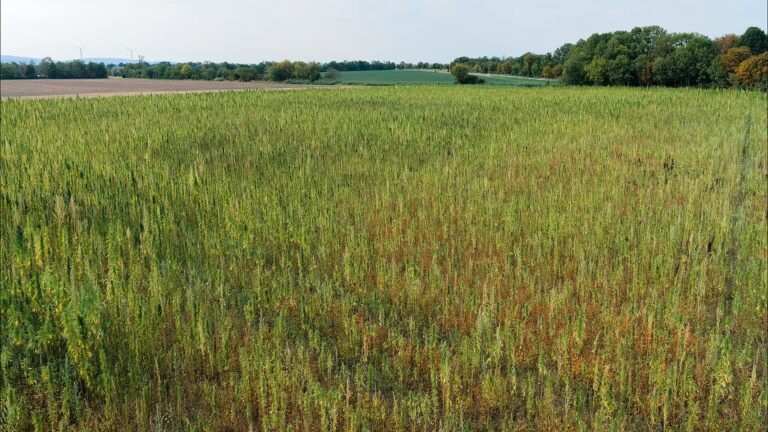
Which cannabinoid dominates is therefore largely down to the plant’s genes. In 2005, plant breeders Etienne de Meijer and Kathy Hammond showed that plants lacking a working enzyme for the next step build up CBGA instead. This is how today’s CBG-rich strains were developed. A well-known example is the French industrial hemp variety Santhica, which makes almost nothing but CBG.
CBG vs CBD vs THC: the differences
CBG, CBD and THC all come from the same starting compound but differ in how common they are and how they act in the body.
| CBG | CBD | THC | |
|---|---|---|---|
| Intoxicating | No | No | Yes |
| Made from | CBGA directly | CBGA via CBDA | CBGA via THCA |
| Content in ordinary hemp | Low | High in CBD strains | Max 0.3 per cent in EU-approved industrial hemp |
| Acts mainly via | Alpha-2 receptors and 5-HT1A, weakly on CB1 and CB2 | Many different receptors, weakly on CB1 and CB2 | The CB1 receptor in the brain |
| Research in humans | Few studies so far | Many studies | Extensive |
If you want to know more about other cannabinoids, we have a separate guide to cannabinoids.
How does CBG work in the body?
The body has its own signalling system, the endocannabinoid system, with receptors called CB1 and CB2. THC binds strongly to the CB1 receptors in the brain, which is why THC gets you high. CBG binds only weakly to CB1 and CB2, which explains why CBG is not intoxicating.
Instead, lab studies have shown that CBG acts elsewhere. In 2010, a British research group showed that CBG strongly activates what are known as alpha-2 adrenergic receptors and blocks the serotonin receptor 5-HT1A. CBG also affects several TRP channels, which are involved in how we sense heat, cold and pain.
This sets CBG apart from CBD, which also acts on many receptors but partly in different ways. How these differences play out in people is not yet clear.
CBG effects: what does the research say?
Research on CBG is younger than research on CBD, and most of it has so far been done in the lab and on animals. That has started to change in recent years.
The first placebo-controlled study
In 2024, the first double-blind, placebo-controlled study of CBG in humans was published. On two separate occasions, 34 healthy adults were given either 20 mg of CBG or a placebo. After CBG, participants rated their anxiety and stress lower than after the placebo, and they did better on a test of verbal memory. No one felt intoxicated, and the tests showed no impairment of motor skills or reaction time.
The study was small and the participants were experienced cannabis users, so the results need to be confirmed in larger studies. But it shows that CBG can be studied in people and that it does not get you high.
How users describe CBG
In 2022, the same research group published a survey of 127 people who used products high in CBG. Most used CBG for anxiety, chronic pain, low mood or sleep, and a majority felt it helped. The most common side effects were dry mouth, sleepiness, increased appetite and dry eyes, and 44 per cent had not noticed any side effects at all. A survey without a control group, however, says more about how CBG is used than about how well it works.
Animal and lab studies
In animal studies, CBG has been examined in several contexts. In rats, CBG increased appetite, and in mice with gut inflammation, CBG reduced the inflammation. In the lab, CBG has also shown antibacterial activity, including against MRSA. Results from animals and test tubes cannot be transferred directly to humans, but they explain why interest in CBG has grown.
CBG and CBD together
Because CBG and CBD act in partly different ways, they are often combined in the same product. The idea builds on the entourage effect, the notion that the plant’s compounds work together and produce a fuller whole than each one on its own. We write more about it in our article on terpenes and the entourage effect.
That is also why our CBG oils contain both CBD and CBG.
What CBG products are there?
- CBG oil. CBG dissolved in a carrier oil, often together with CBD. We sell CBG + CBD oil in 10, 20 and 40 per cent strengths.
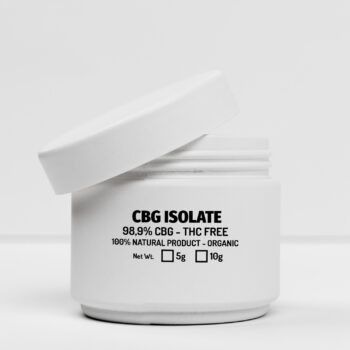
- CBG isolate. Pure CBG in powder form, around 99 per cent. Suited to anyone who wants to dose it themselves or make their own products. See our CBG isolate.
- CBG flowers and CBG hash. Flowers from CBG-rich strains, or hash made from them. The range varies with the harvests.
Whichever product you choose, it should come with an up-to-date lab report from an independent lab showing the levels of CBG and THC. We explain how to read a lab report.
Is CBG legal?
CBG itself is not listed in the UN drug conventions. In most European countries, what decides whether a hemp product is legal is its THC content, and the limits vary from country to country. Check the rules that apply where you live.
Frequently asked questions about CBG
What does CBG stand for?
CBG stands for cannabigerol, a cannabinoid that occurs naturally in hemp and cannabis.
Does CBG get you high?
No. CBG binds only weakly to the CB1 receptors in the brain and does not get you high. In the 2024 placebo-controlled study, none of the participants felt intoxicated.
What is the difference between CBD and CBG?
Both are non-intoxicating cannabinoids, but they act partly via different receptors. CBG is made directly from CBGA, while CBD is made via CBDA. CBD has been studied far more.
Is CBG better than CBD?
Neither is better across the board. They are related but act partly via different receptors, and CBD has been studied far more. That is why many people choose a product that contains both.
Does CBG have side effects?
In the 2024 study, 20 mg of CBG caused no intoxication and no impairment. In the 2022 survey, the most commonly reported side effects were dry mouth, sleepiness, increased appetite and dry eyes. If you take medication, talk to your doctor before using cannabinoids.
Why is CBG more expensive than CBD?
Most hemp plants contain only small amounts of CBG. It therefore takes special strains or more plant material to produce the same amount.
Can you combine CBG and CBD?
Yes. Many products contain both, and they are often used together based on the idea of the entourage effect.
Can CBG show up on a drug test?
Pure CBG is not THC. Products made from the whole plant can, however, contain traces of THC, so always check the lab report.
Is CBG legal?
CBG is not listed in the UN drug conventions. What usually decides whether a product is legal is that it does not contain more THC than local rules allow.
Sources
- Appendino, G. et al. (2008). Antibacterial cannabinoids from Cannabis sativa: a structure–activity study. Journal of Natural Products, 71(8), 1427–1430.
- Borrelli, F. et al. (2013). Beneficial effect of the non-psychotropic plant cannabinoid cannabigerol on experimental inflammatory bowel disease. Biochemical Pharmacology, 85(9), 1306–1316.
- Brierley, D. I. et al. (2016). Cannabigerol is a novel, well-tolerated appetite stimulant in pre-satiated rats. Psychopharmacology, 233(19–20), 3603–3613.
- Cascio, M. G. et al. (2010). Evidence that the plant cannabinoid cannabigerol is a highly potent α2-adrenoceptor agonist and moderately potent 5HT1A receptor antagonist. British Journal of Pharmacology, 159(1), 129–141.
- Cuttler, C. et al. (2024). Acute effects of cannabigerol on anxiety, stress, and mood: a double-blind, placebo-controlled, crossover, field trial. Scientific Reports, 14, 16163.
- de Meijer, E. P. M. & Hammond, K. M. (2005). The inheritance of chemical phenotype in Cannabis sativa L. (II): Cannabigerol predominant plants. Euphytica, 145, 189–198.
- Gaoni, Y. & Mechoulam, R. (1964). Structure and synthesis of cannabigerol, a new hashish constituent. Proceedings of the Chemical Society, 82.
- Li, S. et al. (2024). Cannabigerol (CBG): a comprehensive review of its molecular mechanisms and therapeutic potential. Molecules, 29(22), 5471.
- Nachnani, R., Raup-Konsavage, W. M. & Vrana, K. E. (2021). The pharmacological case for cannabigerol. Journal of Pharmacology and Experimental Therapeutics, 376(2), 204–212.
- Russo, E. B. et al. (2022). Survey of patients employing cannabigerol-predominant cannabis preparations: perceived medical effects, adverse events, and withdrawal symptoms. Cannabis and Cannabinoid Research, 7(5), 706–716.