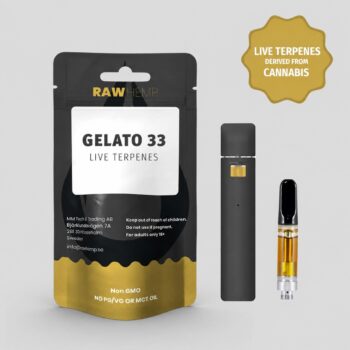
When you open a jar of fresh cannabis, you are met by a distinct aroma. It might be fresh and citrusy, earthy and spicy, or sweet and fruity. Terpenes create that experience, and the same terpenes decide how a vape tastes.
But terpenes can come from different sources, and you can tell. In Europe it is still rare to find vapes with terpenes taken straight from the cannabis plant, known as cannabis-derived terpenes (CDT). Here we explain what CDT are, how they differ from botanical terpenes and why they are so uncommon on the European market.
At a glance
- CDT, cannabis-derived terpenes, are extracted directly from the cannabis plant.
- Botanical terpenes come from other plants, such as citrus, lavender and pine.
- Researchers have found more than 200 volatile compounds in different cannabis strains.
- The light monoterpenes decrease when the flower is dried, which is why live terpenes are extracted from fresh material.
- Our CDT vapes contain terpenes from fresh cannabis grown in California.
The European vape market: a limited palette
Look at the European range of CBD vapes and you will find a common denominator: botanical terpenes dominate. That is understandable. Botanical terpenes are easy to source, cost-effective to produce and give consistent quality from batch to batch.
The result is a market where vapes often taste fresh and fruity, but rarely like cannabis. Many consumers simply have never had anything to compare with.
Two routes to flavour, two different results
In the vape industry there are two main ways to give a product flavour and aroma: botanical terpenes and cannabis-derived terpenes.
Botanical terpenes are extracted from citrus fruit, lavender, pine and other plants. Many of the compounds are also found in cannabis, such as limonene, myrcene and linalool. The manufacturer blends individual terpenes to imitate a certain strain. This gives clean, clear flavours that many people enjoy, especially those who do not want their vape to smell of cannabis.
Cannabis-derived terpenes are extracted directly from the cannabis plant. That is the key difference: CDT do not just taste similar to cannabis, they taste like the strain the terpenes come from. If you want the authentic flavour, CDT are what to look for.
Why is CDT so rare in Europe?
There are several reasons why cannabis-derived terpenes are scarce on the European market.
- Cost and availability: CDT are considerably more expensive to produce than botanical terpenes. Extraction requires fresh, high-quality cannabis, fast handling after harvest and specialised equipment.
- Logistics: The best CDT are made where there is large-scale, legal cannabis cultivation, mainly in North America. Bringing them into Europe means regulations, costs and complexity that many manufacturers choose to avoid.
- Market standard: When almost everyone uses botanical terpenes, that becomes the norm. Consumers then lack a reference point for how authentic cannabis flavour can be.
But once people have tried CDT and noticed the difference, they rarely want to go back.
From California to Europe
The CDT we use come from fresh cannabis grown in California, one of the world’s leading regions for cannabis cultivation. Timing is crucial. The terpenes are extracted shortly after harvest, before the volatile compounds have time to evaporate. That is why they are called live terpenes.
When cannabis is dried and cured, some of the light monoterpenes disappear, and they are often responsible for the most distinctive aromas. In a 2020 study, the share of monoterpenes fell clearly when the buds were air-dried, while the heavier sesquiterpenes made up a larger part of the profile. Working with fresh material captures the terpene profile in a more complete form.
Why CDT tastes different
According to a review in the journal Molecules, researchers have found more than 200 volatile compounds in different cannabis strains. When terpenes are extracted from the plant, they come along in roughly the same proportions as in the flower. Botanical terpenes instead rely on blending individual compounds from different sources to imitate a profile.
Take our Lemon Cherry Gelato as an example. The main features are easy to recognise: citrus notes often associated with limonene, sweet and fruity notes and a spicy touch often linked to caryophyllene. With botanical terpenes you can blend something that resembles it.
But a real flower also contains small amounts of dozens of other terpenes and terpenoids. These minor components, and the balance between them, give the strain its character. With CDT from genuine Lemon Cherry Gelato you get all of this. The result is not an interpretation of the strain, it is the strain itself.
Strain-specific authenticity
Every cannabis strain has been bred, sometimes over decades, to have certain traits. The terpene profile is a central part of that identity.
- Biscotti is usually described as sweet and cookie-like with hints of nuts and spices.
- Zkittlez is known for its fruity, tangy profile reminiscent of candy.
- Sherbanger offers a mix of sweet, citrusy and earthy notes.
- Gelato 33 is usually described as creamy and sweet with hints of berries.
With genuine CDT from these strains you get the same aroma and flavour as in the flower, the profile growers have spent years refining. Botanical terpenes can offer pleasant flavours inspired by the same strains, but without the full complexity.
Botanical terpenes or CDT?
Both options have their place, and we offer both. Botanical terpenes suit you if you want a wide choice of fresh flavours and a discreet aroma. CDT suit you if you want the authentic flavour of a specific cannabis strain. We compare them in more detail in our guide to botanical vs live terpenes.
If you have never tried CDT, we can promise one thing: the difference is bigger than you think. You will find the full range among our CBD vapes, and in our overview of the best CBD vapes in 2026.
What does CDT stand for?
CDT stands for cannabis-derived terpenes, meaning terpenes extracted directly from the cannabis plant rather than from other plants.
What is the difference between live terpenes and CDT?
Live terpenes are CDT extracted from fresh material shortly after harvest. This means more of the volatile monoterpenes are retained than if the flower had been dried first.
Are botanical terpenes worse than CDT?
No, they serve different purposes. Botanical terpenes give clean, clear flavours, while CDT recreate the flavour of a specific cannabis strain.
Why are CDT vapes more expensive?
Extraction requires fresh, high-quality cannabis, fast handling and specialised equipment. On top of that, bringing CDT into Europe is more complicated.
Do the terpenes contain any cannabinoids?
No, terpenes are aroma compounds, not cannabinoids. What each vape contains is shown on the product page and in the lab report.
Sources
- Sommano SR, Chittasupho C, Ruksiriwanich W, Jantrawut P. (2020). The Cannabis Terpenes. Molecules, 25(24), 5792.
- Wanas AS, Radwan MM, Chandra S et al. (2020). Chemical Composition of Volatile Oils of Fresh and Air-Dried Buds of Cannabis Chemovars. Natural Product Communications, 15(5).
- Booth JK, Bohlmann J. (2019). Terpenes in Cannabis sativa: From plant genome to humans. Plant Science, 284, 67-72.