If you are looking for terpenes or thinking about how to add flavour to your CBD products, you have probably come across two terms: botanical terpenes and live terpenes. Both give aroma and flavour to distillates, oils and vapes, but they are not the same thing.
The difference is about more than where the terpenes come from. It affects the aroma, how consistent each batch is, the price and how close you get to the real cannabis plant. Here we look at how the two types are made, what research says about the aroma of cannabis and how to choose the right one for what you want to do.
Key facts
- Botanical terpenes are extracted from plants other than cannabis, such as citrus, pine and lavender, and blended into different profiles.
- Live terpenes are extracted from fresh or frozen cannabis and keep the same proportions as the strain they come from.
- Researchers have found more than 200 volatile compounds in cannabis. Part of its typical aroma comes from sulfur compounds and other substances that are not terpenes.
- Botanical terpenes are cheaper and more consistent from batch to batch. Live terpenes give the authentic aroma of a specific strain.
- Terpenes that are heated strongly can form degradation products, so temperature and quality matter for both types.
What are terpenes?
Terpenes are aromatic compounds that plants produce, among other things to attract pollinators and protect themselves from insects. Terpenes are what make lavender smell floral, citrus smell fresh and a pine forest smell like a pine forest. Cannabis contains many different terpenes, which is one reason why different strains smell so different. If you want to go deeper, see our guide to terpenes in cannabis.
The key point here is that terpenes are not unique to cannabis. The limonene in a citrus-scented cannabis strain is the same molecule as the limonene in lemon peel. That means terpenes can be extracted either directly from cannabis or from other plants that contain the same compounds, and that is where the split into botanical terpenes and live terpenes comes from.
Botanical terpenes: clean, consistent and affordable
Botanical terpenes are extracted from plants that are not cannabis, such as citrus fruit, pine, lavender, eucalyptus, hops and black pepper. They are usually extracted by steam distillation or cold pressing, the same methods used to make essential oils. Limonene can come from orange peel, for example, myrcene from hops and beta-caryophyllene from black pepper.
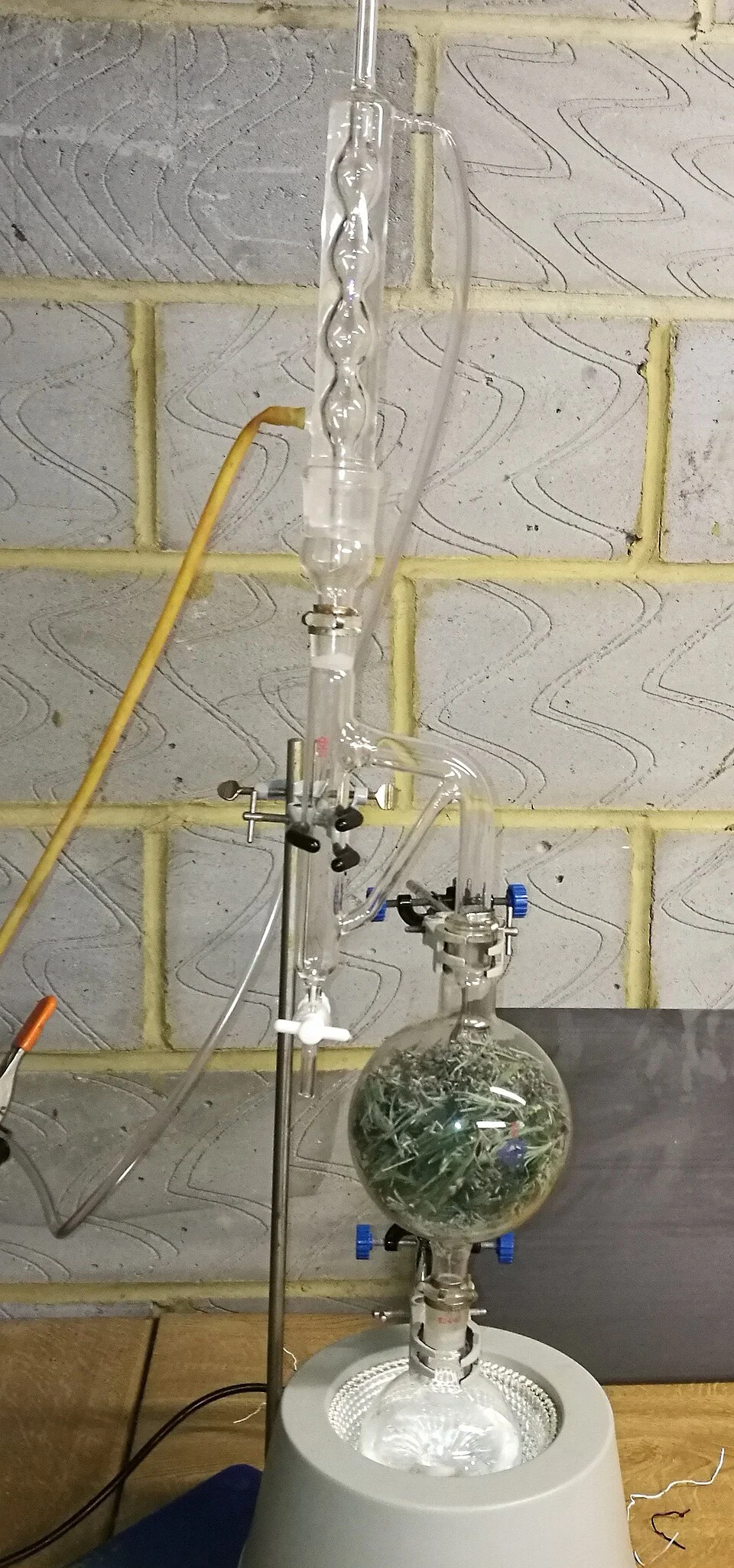
The manufacturer then blends the individual terpenes in set proportions. Often the aim is to mimic a well-known cannabis strain, but there are also completely original profiles, from fruity and sweet to earthy and spicy.
- Consistent quality: Because the blend is made from known compounds in set proportions, every batch is more or less identical.
- Lower price: The raw materials are grown on a large scale and are easy to source, which makes botanical terpenes much cheaper than terpenes from cannabis.
- Clear flavours: The profiles are often bright and easy to recognise, such as a distinct citrus or a fresh pine note.
- Plenty of choice: There are countless ready-made blends, and they can be combined with each other.
- Easy to handle: Because they come from common plants, they are treated as ordinary aroma compounds.
The drawback is that a botanical blend rarely smells exactly like cannabis. It can come close, but something is missing, and research has started to explain why.
Live terpenes and CDT: the aroma of the plant itself
Live terpenes are extracted directly from cannabis plants, usually fresh or frozen right after harvest. The word live refers to the fact that the material has not been dried and cured before extraction.
The terms are often used interchangeably, but they are not exactly the same. CDT, cannabis-derived terpenes, is a broader term for all terpenes that come from cannabis, whether the plant was fresh or dried. Live terpenes are therefore one type of CDT. We cover how CDT is used in vapes and why it is so rare in Europe in our article on cannabis-derived terpenes in vapes.
Using fresh material matters. When the flower is dried and cured, some of the lightest terpenes, the monoterpenes, are lost. An older study found that drying did not change which compounds were present in the volatile oil, but later analyses have shown that the share of monoterpenes drops as the flower dries. Extracting the terpenes from fresh material preserves more of the original profile.
- Strain-specific aroma: Live terpenes from a particular strain smell like that strain, because that is where they come from.
- More compounds: Besides the most common terpenes, many minor compounds come along in their natural proportions.
- Higher price: Extraction requires high-quality fresh cannabis, fast handling after harvest and specialised equipment.
- Limited availability: Production mainly takes place in markets where cannabis cultivation is allowed, such as California, which makes logistics to Europe expensive.
- Some variation: The profile can differ slightly between harvests, just like the flower itself.
Why botanical terpenes rarely smell like cannabis
For a long time it was assumed that the aroma of cannabis came mainly from the dominant terpenes, such as myrcene, limonene, beta-caryophyllene and terpinolene. Newer research shows that the picture is more complicated.
In 2021, American researchers identified a new group of sulfur compounds in cannabis. The compound 3-methyl-2-butene-1-thiol turned out to be the main source of the typical skunk-like aroma. Its level rose sharply during the last weeks of flowering, peaked during curing and then dropped after just one week of storage.
In a follow-up study from 2023, the same research group compared strains with very different aromas. The terpene profiles were surprisingly similar, while a number of minor compounds that are not terpenes were clearly linked to the sweet, fruity or more chemical aromas. The researchers concluded that the importance of terpenes for the aroma of cannabis has been overemphasised.
For you as a buyer, this means that a blend of a few well-known terpenes can give a pleasant and clear aroma, but it rarely captures the full character of a specific strain. Terpenes extracted from cannabis have a better chance of doing that, because more of the plant’s own compounds come along.
Botanical terpenes and live terpenes side by side
| Botanical terpenes | Live terpenes | |
|---|---|---|
| Source | Citrus, pine, lavender, hops and other plants | Fresh or frozen cannabis |
| Production | Steam distillation or cold pressing, then blending | Extraction from fresh material, profile preserved |
| Aroma | Clean and clear, rarely like cannabis | Like the strain they come from |
| Batch-to-batch variation | Very small | Some, depending on the harvest |
| Price | Lower | Much higher |
| Availability | Good, available everywhere | Limited in Europe |
| Customisation | Easy to create your own blends | Used as they are |
Temperature and quality matter
Whatever the type, terpenes are concentrated substances that should be handled with care. Pure terpenes should never be used undiluted, and they can irritate the skin and mucous membranes.
When terpenes are heated strongly, they can also break down. In a 2019 study, researchers looked at what forms when cannabis extracts are vaporised in vapes or dabbed. They found methacrolein, benzene and isoprene among other compounds, and added terpenes led to higher levels of these degradation products than the extract alone. At the same time, the levels were much lower than in cannabis smoke.
The takeaway is that it pays to choose good-quality terpenes and hardware and to avoid unnecessarily high temperatures. That applies to both botanical terpenes and live terpenes. We explain how to use terpenes safely in our guide on how to use terpenes.
What about the entourage effect?
An argument often made for terpenes is the entourage effect, the theory that cannabinoids and terpenes interact and influence each other. The theory was put forward by researchers in the 1990s and has become widely known, but it is still just a theory. Studies are few, and there is no solid evidence that either botanical terpenes or live terpenes change how a product works. The difference you can be sure of is the aroma and flavour.
Which should you choose?
There is no answer that suits everyone. It depends on what you want to achieve.
Choose botanical terpenes if you:
- want the same aroma and flavour every time
- want to keep costs down
- prefer clean, fresh flavours without a cannabis note
- want a discreet aroma that does not remind anyone of cannabis
- want to experiment with your own blends
Choose live terpenes if you:
- want the authentic aroma and flavour of cannabis
- appreciate complex profiles with lots of nuance
- have a favourite strain you want to experience in a vape or distillate
- are willing to pay more for authenticity
Many people use both. Botanical terpenes for everyday use and their own experiments, and live terpenes when the aroma of a specific strain matters most. If you want to try the authentic version, you will find live terpenes in several of our CBD vapes.
What is the difference between botanical terpenes and live terpenes?
Botanical terpenes are extracted from plants other than cannabis and blended into different profiles. Live terpenes are extracted from fresh or frozen cannabis and keep the profile of the strain they come from.
Are live terpenes and CDT the same thing?
Almost. CDT, cannabis-derived terpenes, covers all terpenes extracted from cannabis. Live terpenes are CDT extracted from fresh or frozen material.
Do live terpenes contain THC?
Properly produced live terpenes should only contain aroma compounds and no cannabinoids. Always check the supplier’s lab report to make sure the product is free from THC.
Why are live terpenes so much more expensive?
They require high-quality fresh cannabis, fast handling after harvest and specialised equipment. Production also mainly takes place where cannabis cultivation is allowed, which makes transport to Europe expensive.
Can botanical terpenes smell exactly like a cannabis strain?
Rarely all the way. A botanical blend can mimic the main features, but research shows that part of the aroma of cannabis comes from sulfur compounds and other substances that are not terpenes.
Can you mix botanical terpenes and live terpenes?
Technically yes, but the live terpenes lose some of their authenticity and the botanical blend becomes less predictable. Most people use them separately.
This article is general information about terpenes and their aroma and flavour. It makes no claims that terpenes or CBD have medical effects.
Sources
- Oswald IWH, Ojeda MA, Pobanz RJ et al. (2021). Identification of a New Family of Prenylated Volatile Sulfur Compounds in Cannabis Revealed by Comprehensive Two-Dimensional Gas Chromatography. ACS Omega, 6(47), 31667-31676.
- Oswald IWH, Paryani TR, Sosa ME et al. (2023). Minor, Nonterpenoid Volatile Compounds Drive the Aroma Differences of Exotic Cannabis. ACS Omega, 8(42), 39203-39216.
- Ross SA, ElSohly MA. (1996). The Volatile Oil Composition of Fresh and Air-Dried Buds of Cannabis sativa. Journal of Natural Products, 59(1), 49-51.
- Wanas AS, Radwan MM, Chandra S et al. (2020). Chemical Composition of Volatile Oils of Fresh and Air-Dried Buds of Cannabis Chemovars. Natural Product Communications, 15(5).
- Meehan-Atrash J, Luo W, McWhirter KJ, Strongin RM. (2019). Aerosol Gas-Phase Components from Cannabis E-Cigarettes and Dabbing: Mechanistic Insight and Quantitative Risk Analysis. ACS Omega, 4(14), 16111-16120.
- Booth JK, Bohlmann J. (2019). Terpenes in Cannabis sativa: From plant genome to humans. Plant Science, 284, 67-72.
- Russo EB. (2011). Taming THC: potential cannabis synergy and phytocannabinoid-terpenoid entourage effects. British Journal of Pharmacology, 163(7), 1344-1364.