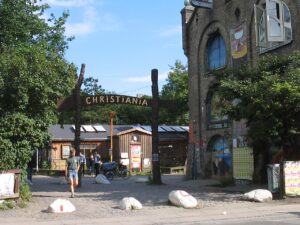
In the autumn of 1971, a group of neighbours climbed the fence of an abandoned military barracks in the middle of Copenhagen. A few weeks later, Freetown Christiania was proclaimed, and for more than fifty years it has been Europe’s best-known free zone, with its own rules, self-built houses and a street where hash was sold openly. In April 2024, residents and police dug up Pusher Street. This is the story of Christiania, from the occupation to today.
At a glance
- Christiania sits on the former Bådsmandsstræde Barracks in the Christianshavn district of Copenhagen.
- On 26 September 1971, journalist Jacob Ludvigsen proclaimed the area a free town in the newspaper Hovedbladet.
- In 1972 Christiania was given status as a social experiment, and in 1989 a law recognised the free town.
- In 2011 the Freetown Christiania Foundation was formed and bought the area from the state with the help of so-called people’s shares.
- For decades Pusher Street was where hash was sold openly. After a fatal shooting in a gang conflict in 2023, residents voted to close the street, and on 6 April 2024 it was dug up.
- Around 850 to 1,000 people live in Christiania, and the area has around half a million visitors a year.
- In February 2026 residents approved a plan for 10,000 square metres of public housing, including around the old Pusher Street.
The barracks that became a free town
Bådsmandsstræde Barracks had been used by the Danish armed forces for generations. The area lies by the old ramparts of Christianshavn, built under King Christian IV in the 17th century, and includes gunpowder stores and buildings from the 18th century. When the military left the barracks in 1970 and 1971, most of it stood empty.
In September 1971, people from the surrounding neighbourhood broke down the fence and young people began moving in. On 26 September, journalist Jacob Ludvigsen published an article in the newspaper Hovedbladet proclaiming the area a free town, open to everyone. Christiania was born.
It was the same time that thousands of young Europeans were travelling overland towards Kabul and Kathmandu on the hippie trail. The dream of living differently, outside society’s rules, could be found both on the road east and in the occupied barracks. Christiania became a place where those ideas took shape in everyday life.
A social experiment and the fight over the land
As early as 1972, the government and Christiania agreed that the area could remain as a social experiment. In return, residents would pay for water and electricity and follow the laws of the land. The agreement saved the free town, but the question of who owned the land was far from settled.
In 1976 the Ministry of Defence took Christiania to court, and in 1978 the Supreme Court ruled that the area should be cleared. Parliament decided instead that a plan should be drawn up first. In 1989 a law was passed that legalised Christiania, and in 2004 a new law aimed to normalise the area, with demands that illegally built houses be demolished.
The struggle only ended in 2011, when the Freetown Christiania Foundation was formed and bought the area from the state. According to the Danish encyclopaedia Den Store Danske, the foundation issued people’s shares worth 76 million Danish kroner to finance the purchase. The shares were certificates that anyone could buy to support the free town.
A community with its own rules
Christiania is run by direct democracy. The most important decisions are made at the common meeting, Fællesmødet, which is open to all residents. Decisions are reached by consensus rather than by vote. The area is also divided into 15 smaller areas, each holding its own monthly meeting on matters such as maintenance and who gets to move in.
A few rules apply to everyone: no hard drugs, no biker colours, no weapons and no violence. Christiania is also car-free. The rules say a lot about how residents saw their community. Hash was sold openly for decades, but hard drugs, weapons and the criminal groups that come with them were to be kept out.
The free town has also long taken a stand on drug policy. In 1989 a yellow line was painted on Pusher Street to mark where the hash trade could take place, and in 1994 the street held a five-day hash strike in protest against Danish drug policy.
Pusher Street and the hash trade
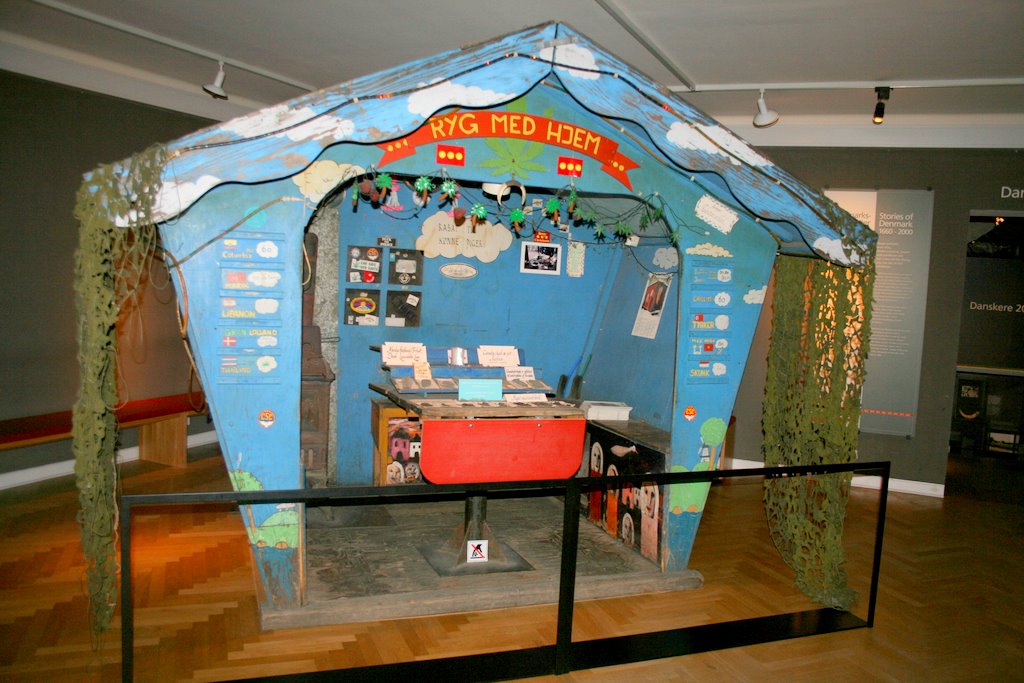
Pusher Street quickly became the most famous street in Christiania. Along it stood stalls where hash and marijuana were sold completely openly, in later years often under camouflage netting and with signs saying photography was forbidden. The trade was never legal under Danish law, but for a long time the authorities let it carry on more or less undisturbed.
The free town drew a line against harder drugs early on. After ten overdose deaths in a single year, residents launched the so-called junk blockade in 1979, which lasted 40 days and nights. The aim was to drive out heroin and other hard drugs, and since then hard drugs have been banned under Christiania’s own rules.
The trade also attracted criminals. By the mid-1980s the motorcycle club Bullshit had taken control of sales after clashes with Hells Angels, until the club was thrown out of the area in 1987. From 2002 the government tried to make the trade less visible, and in 2004 police raided the stalls on Pusher Street. Sales still came back.
The violence and the end of Pusher Street
Through the 2000s and 2010s the violence around the trade grew worse. In 2009 five people were injured when a hand grenade was thrown into Café Nemoland. On 31 August 2016 a man shot two police officers and a civilian on Pusher Street. Two days later the residents themselves tore down the stalls, but the trade soon moved back.
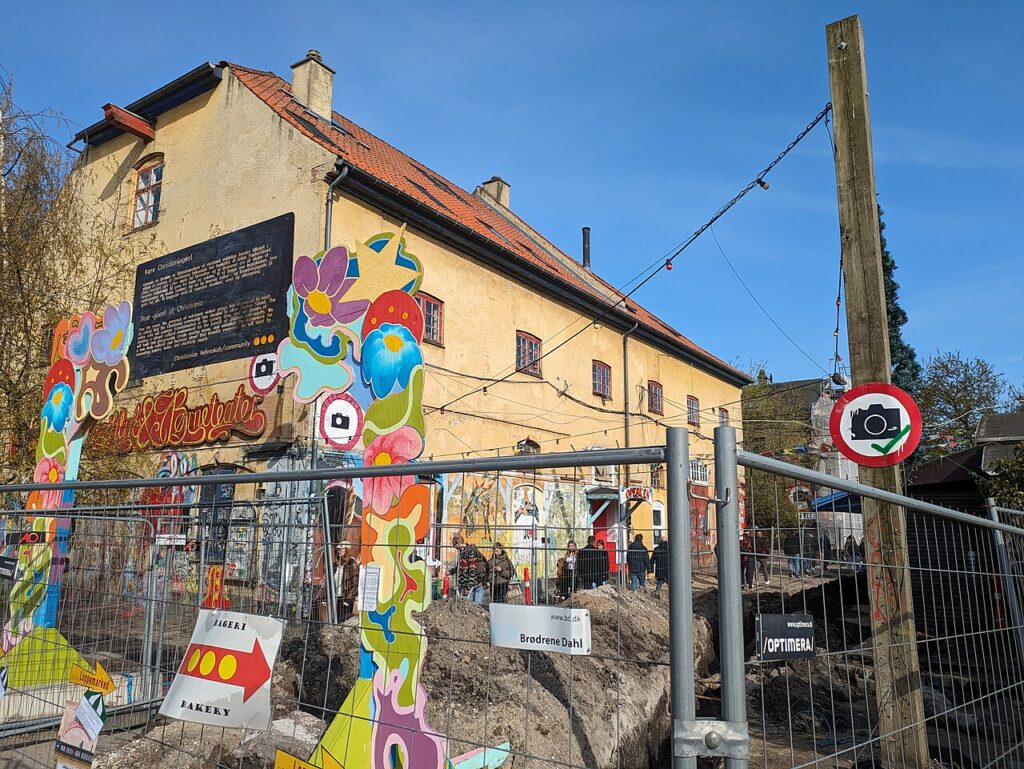
On 26 August 2023 a 30-year-old man was killed and four others injured when two masked men opened fire on the street in a dispute between criminal gangs. After that, residents voted to close Pusher Street. On 6 April 2024 residents and police dug up the street together, to make it impossible to rebuild the stalls.
It was the gangs, not cannabis, that closed the street
It is easy to read the closure as Christiania turning against cannabis, but that is not what residents said. What they wanted to get rid of were the criminal networks that had taken over the trade. “We don’t want the gangsters any more,” said Hulda Mader, who had lived in Christiania for 40 years, when the street was dug up in April 2024. When residents decided to close Pusher Street in August 2023, they also wrote that they had neither the resources nor the power to close the street and keep it closed on their own.
Their view of cannabis itself has not changed. Every year Copenhagen’s Global Marijuana March sets off from Christiania, with thousands of people calling for legalisation.
Behind the violence was a market that could not be regulated. Because sales were illegal, they ended up with those prepared to defend them with violence, first motorcycle clubs such as Bullshit and Hells Angels and later other gangs as well. The police raid in 2004 did not solve the problem. According to research summarised by the Transnational Institute, sales instead spread to hash clubs and couriers all over Copenhagen, and new youth gangs entered the market. The profits did not go to Christiania but to the gangs, something residents themselves pointed out in 2023.
Copenhagen wanted to regulate, the government said no
Many in Copenhagen have reached the same conclusion. In 2012 the city council applied to trial legal sales of cannabis in state-run shops. Council member Lars Aslan Rasmussen argued that it would limit the gang conflict, and deputy mayor Mikkel Warming estimated that criminals were earning around two billion Danish kroner a year from the trade. Justice Minister Morten Bødskov said no, arguing that availability and use would increase.
In 2014 a more detailed application followed: a three-year trial with five or six municipal outlets, cannabis grown in Denmark, an age limit of 18, a maximum of five grams a day and the profits going to prevention and treatment. That too was rejected, and the issue has come back to the city council several times since. Without a legal market, the trade stayed with the gangs, and it was that trade that in the end cost lives on Pusher Street.
Christiania today
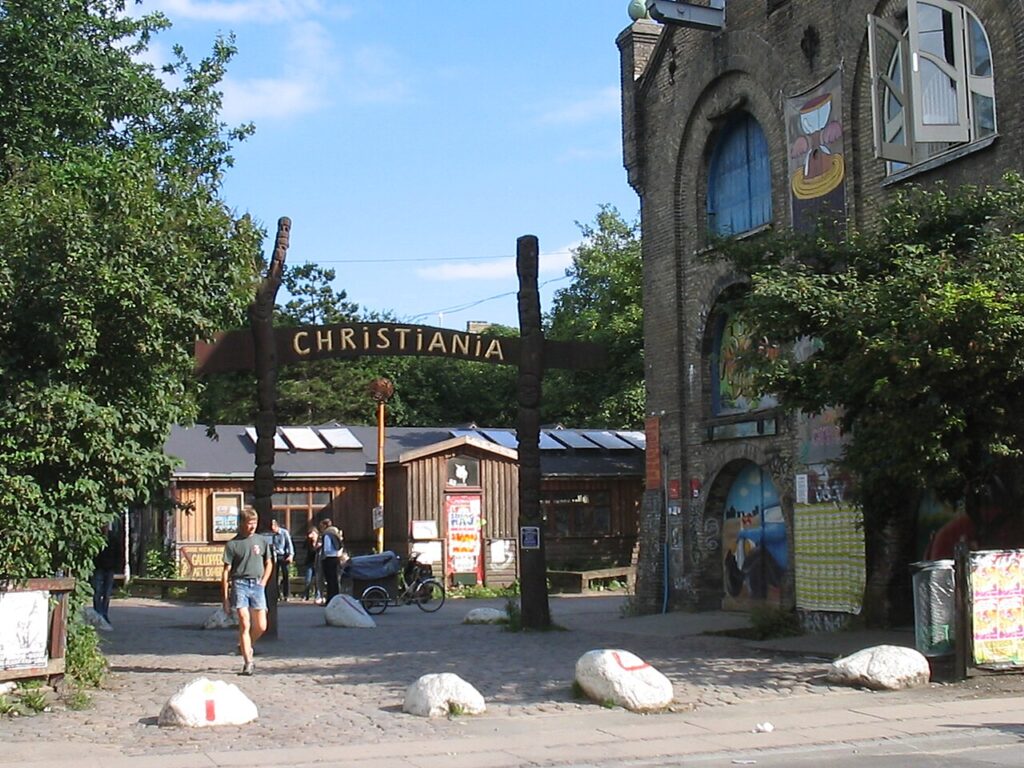
Christiania is still open to visitors and has around half a million visitors a year. It is counted among Copenhagen’s biggest attractions. Around 850 to 1,000 people live here, often in houses they built themselves, and the area is still car-free. There are concert venues such as Den Grå Hal, cafés, workshops and galleries.
The development continues. In February 2026 residents approved a plan for 10,000 square metres of public housing, including around the old Pusher Street. The plan is part of an agreement with the state, and the goal is a Christiania without the serious crime that grew up around the hash trade.
Christiania and cannabis culture
For many, Christiania became a symbol of a freer attitude to cannabis, and the place has inspired people far beyond Denmark. At the same time, its history shows how an illegal market attracts crime when it cannot be regulated. It is part of the same story as in the countries that have now chosen to regulate, from the Netherlands to Germany.
Christiania belongs to the same history as the people and places we have written about in our series on the hippie trail and in our portraits of pioneers such as Ben Dronkers and Jack Herer. Read more here:
- The Hippie Trail: The Overland Road to Kabul and Kathmandu
- The Legacy of the Hippie Trail: Seed Banks, Smugglers and the Fight for Hemp
- Ben Dronkers: The Man Behind Sensi Seeds and the Hash Museum in Amsterdam
- Jack Herer: The Hemperor Who Wrote the Hemp Bible
Is Christiania closed?
No. Christiania is open to visitors. What was closed was Pusher Street, where hash was sold openly. The street was dug up on 6 April 2024.
What happened to Pusher Street?
After a fatal shooting in August 2023, in a conflict between criminal gangs, residents voted to close the street. It was the gangs they wanted to get rid of, not cannabis. On 6 April 2024 residents and police dug up Pusher Street together, and in February 2026 a plan for new housing in the area was approved.
When was Christiania founded?
Christiania was founded in September 1971, when the abandoned military barracks was occupied. On 26 September 1971, journalist Jacob Ludvigsen proclaimed the area a free town.
How many people live in Christiania?
Around 850 to 1,000 people live in Christiania.
Is cannabis legal in Christiania?
No. Christiania follows Danish law, and selling cannabis has never been legal there, even though the trade went on openly on Pusher Street for a long time.
Sources
- Wikipedia. Freetown Christiania.
- Den Store Danske. Christiania.
- TV 2 Kosmopol. To år efter lukning: nu er planen for nye boliger på Pusher Street klar.
- The Copenhagen Post (2026). Christiania approves plan for 10,000 sqm of public housing.
- Malay Mail/AFP (2024). Denmark shuts down cannabis street in Christiania hippie enclave.
- South China Morning Post (2024). Copenhagen’s hippie oasis Christiania ‘don’t want gangsters any more’.
- Euronews (2023). Denmark’s hippie paradise asks authorities to shut down its Pusher Street.
- Transnational Institute (2019). Cannabis regulation in Denmark, country report.
- The Copenhagen Post (2012). Legal cannabis rejected by government.
- Christiania. Christiania Guide.