You cannot see, smell or taste how much CBD an oil contains, or whether it contains THC. The only way to know is a laboratory analysis. That is why reputable CBD products come with a lab report, known as a certificate of analysis or COA. Here we explain what a COA is, why it matters and how to read it line by line.
At a glance
- COA stands for certificate of analysis, a document from a laboratory that shows what a sample actually contains.
- Studies of CBD oils in Europe and the US show that a large share of products, often half or more, do not contain the amount of CBD stated on the label.
- The most important things to check are that the batch number matches, that the analysis is recent and that the laboratory is accredited to ISO/IEC 17025.
- < LOQ means the compound is below the level the laboratory can reliably measure, not that it is guaranteed to be absent.
What is a COA?
A COA, or certificate of analysis, is a document in which a laboratory reports the results of an analysis of a sample. For CBD products, the key part is the cannabinoid profile, meaning how much CBD, THC and other cannabinoids the sample contains. A more comprehensive lab report can also show terpenes and whether the product contains contaminants such as heavy metals, pesticides or residual solvents.
The report applies to one specific sample from one specific production run, or batch. Two bottles of the same product can come from different batches with slightly different contents, so the report should always be traceable to the batch you have bought.
Why lab reports matter
The CBD market has grown quickly, and oversight has not kept up. Researchers who have bought products and analysed them independently have repeatedly found large gaps between label and content. In a US study published in JAMA in 2017, 84 CBD products sold online were analysed. Only 31 per cent contained the amount of CBD stated, within a ten per cent margin, and roughly one in five contained THC.
Europe does not look much better. When Italian researchers analysed 14 CBD oils from the European market in 2018, only five matched the stated content. A Czech study published in 2026, which followed 186 CBD oils sold in Europe over roughly ten years, found that 49 per cent did not contain the declared amount of CBD. A lab report is not a formality. It is the only way to check that you are getting what you pay for.
How to read a lab report, step by step
Lab reports look different depending on the laboratory, but the content is broadly the same. Go through it in this order.
1. The header: who, what and when
At the top you will find the name of the laboratory, the client, the sample and a batch or lot number, along with the dates of sampling and analysis. Check that the product name and batch number match the packaging and that the analysis is not several years old. A report without a batch number cannot be linked to your particular bottle.
2. The cannabinoid profile
The core of the report is a list of cannabinoids with a concentration for each. Concentrations are usually given as a percentage by weight, % w/w, or in milligrams per gram. One per cent equals 10 milligrams per gram. The image below shows the cannabinoid profile of one of our CBD oils.
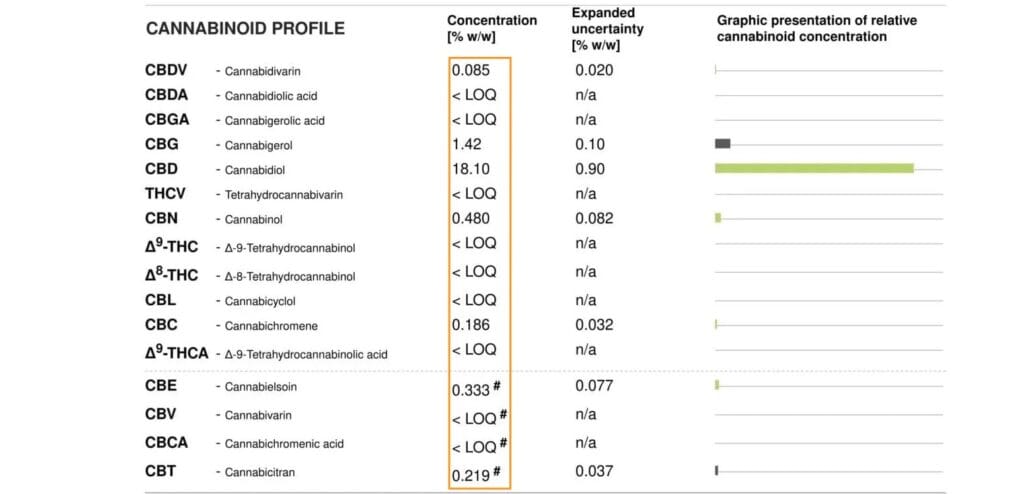
Here the oil contains 18.10 per cent CBD, 1.42 per cent CBG, 0.48 per cent CBN and small amounts of CBC, CBDV and others, adding up to just under 21 per cent cannabinoids. Δ9-THC, Δ8-THC and THCA are all listed as < LOQ.
3. LOD, LOQ and < LOQ
LOD, the limit of detection, is the lowest level at which the laboratory can tell that a compound is present. LOQ, the limit of quantification, is the lowest level that can be measured reliably enough to be given as a number. If the report says < LOQ, the compound is below that limit. It may be completely absent, but it may also be present in an amount too small to measure reliably. ND, not detected, means the compound could not be detected at all. So also check what LOQ the laboratory uses, which is often stated in the method description or a footnote.
4. Measurement uncertainty
Every measurement comes with some uncertainty. Many laboratories report it in a separate column, often labelled expanded uncertainty. If a report shows 18.10 per cent CBD with an uncertainty of 0.90, the true value lies between 17.2 and 19.0 per cent with roughly 95 per cent probability. A small difference between the label and the lab report is therefore normal, but a large one is not.
5. Acid forms and total CBD
In the living plant, cannabinoids exist mainly as acids, such as CBDA, CBGA and THCA. When heated, they release carbon dioxide and turn into CBD, CBG and THC, a process called decarboxylation. Modern laboratories usually use liquid chromatography, HPLC, which does not heat the sample, so the acids and the neutral forms appear on separate lines.
To calculate the total amount of CBD available, multiply the acid form by 0.877 and add the neutral form. The factor comes from the difference in molecular weight, because roughly twelve per cent of the acid’s weight is lost as carbon dioxide. The same formula applies to THC: total THC = THC + 0.877 × THCA.
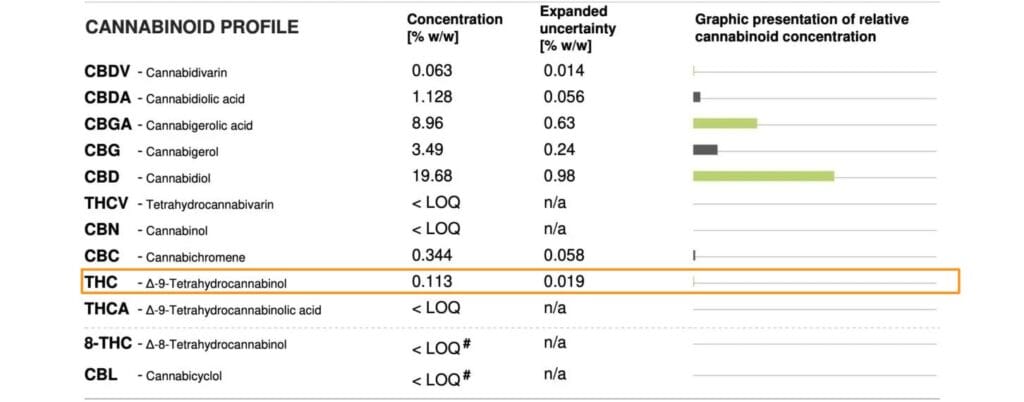
In the example above, CBD is 19.68 per cent and CBDA is 1.128 per cent. Total CBD is therefore 19.68 + 0.877 × 1.128, or about 20.7 per cent. The sample also contains a lot of CBGA, 8.96 per cent, which shows that it comes from plant material that has not been heated.
6. Contaminants
A full analysis can also cover heavy metals such as lead, cadmium, mercury and arsenic, pesticide and solvent residues, mycotoxins and microbiology. Hemp is good at taking up substances from the soil, so this matters. Not every lab report includes these tests, and a report that only shows cannabinoids tells you nothing about contaminants.
7. The laboratory and its accreditation
At the bottom there is usually a signature, a reference to the analytical method and information about the laboratory’s accreditation. The international standard for testing laboratories is ISO/IEC 17025. Accreditation means that a national accreditation body has assessed that the laboratory is competent and that its methods give reliable results. It is worth checking that the cannabinoid analysis itself is covered by the accreditation.
Warning signs in a lab report
- The report has no batch number or date, or is several years old.
- The laboratory’s name or contact details are missing, so the report cannot be verified.
- The content on the label differs clearly from the report, by more than the measurement uncertainty explains.
- The report is a blurry screenshot where the figures cannot be read.
- The product is marketed as THC-free, but the report shows measurable levels of THC.
If you are unsure, contact the laboratory and ask whether the report is genuine. Many laboratories put a code or QR code on their reports so that you can check them directly.
Full spectrum, broad spectrum and isolate in the lab report
The cannabinoid profile also shows what type of product you have. A product made from isolate contains almost nothing but CBD, and the other lines read < LOQ. A broad-spectrum extract contains several cannabinoids but has had the THC removed. A full-spectrum extract contains the plant’s whole profile of cannabinoids and terpenes.
The difference matters because of the entourage effect, the theory that the plant’s compounds reinforce and balance each other so that the whole becomes more than the sum of its parts. That is why many people prefer extracts with a broad profile of cannabinoids and terpenes over pure isolate. The lab report is what shows whether a product really has that profile. Read more in our article What are cannabinoids? CBD, THC, CBG, CBN and the endocannabinoid system.
THC limits and what they mean
The limit of 0.3 per cent THC that is often mentioned applies to growing industrial hemp in the EU. Limits for finished products are set by each country and vary widely. Some countries apply 0.3 per cent, others 0.2 per cent, and in some any THC in an extract can be a problem.
That is why the THC lines in the lab report are so important. Check whether the limit where you live refers to THC alone or to total THC including THCA, and remember that a laboratory with a lower limit of quantification may find traces that another does not. If you want to avoid THC altogether, choose a product in which both THC and THCA are below the LOQ.
Where to find our lab reports
We publish lab reports for our products so that you can see exactly what they contain. You will find them all on our lab reports page.
Many of our products are analysed by Pharma Hemp Laboratories in Slovenia, a laboratory that has been accredited to ISO/IEC 17025 for cannabinoid analysis since 2020. This means that both its competence and its analytical methods are regularly assessed by an accreditation body.
You can also read more about how we test our oils in Lab-tested CBD oil: how we test for cannabinoids, heavy metals and solvents.
If you want to compare for yourself, a good place to start is our range of CBD oils.
What does COA mean?
COA stands for certificate of analysis. It is a document from a laboratory that shows the results of an analysis of a sample, for example how much CBD and THC a product contains.
What does < LOQ mean in a lab report?
It means the compound is below the laboratory’s limit of quantification, the lowest level that can be measured reliably. It does not necessarily mean the compound is completely absent.
How do you calculate total THC or total CBD?
Multiply the acid form by 0.877 and add the neutral form. Total THC = THC + 0.877 × THCA, and total CBD = CBD + 0.877 × CBDA.
How do I know a lab report is genuine?
Check that the batch number matches the packaging, that the laboratory’s name and contact details are included and that the laboratory is accredited to ISO/IEC 17025. If in doubt, contact the laboratory directly.
How much THC may a CBD product contain?
It depends on the country. The EU limit of 0.3 per cent applies to growing industrial hemp, while limits for finished products are set nationally and range from 0.3 per cent to none at all.
Sources
- Bonn-Miller, M. O. et al. (2017). Labeling Accuracy of Cannabidiol Extracts Sold Online. JAMA, 318(17), 1708–1709.
- Pavlovic, R. et al. (2018). Quality Traits of “Cannabidiol Oils”: Cannabinoids Content, Terpene Fingerprint and Oxidation Stability of European Commercially Available Preparations. Molecules, 23(5), 1230.
- Liebling, J. P. et al. (2022). An Analysis of Over-the-Counter Cannabidiol Products in the United Kingdom. Cannabis and Cannabinoid Research, 7(2).
- Binova, Z. et al. (2026). Poorly labeled CBD and related cannabinoid oils marketed in Europe: a hidden risk for consumers? Analytical and Bioanalytical Chemistry.
- International Organization for Standardization. ISO/IEC 17025:2017 General requirements for the competence of testing and calibration laboratories.
- Confidence Analytics. Why 0.877?
- PharmaHemp. Pharmahemp laboratories is now accredited under ISO 17025 standard.