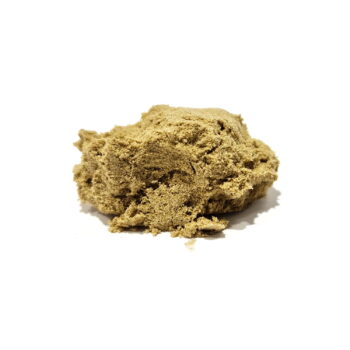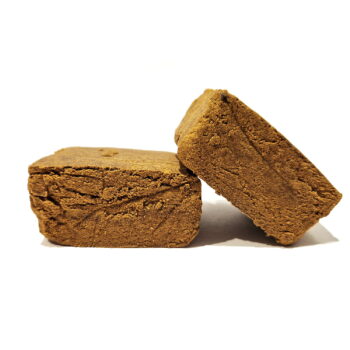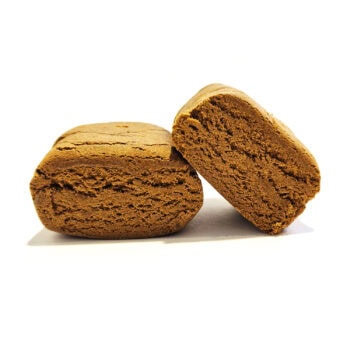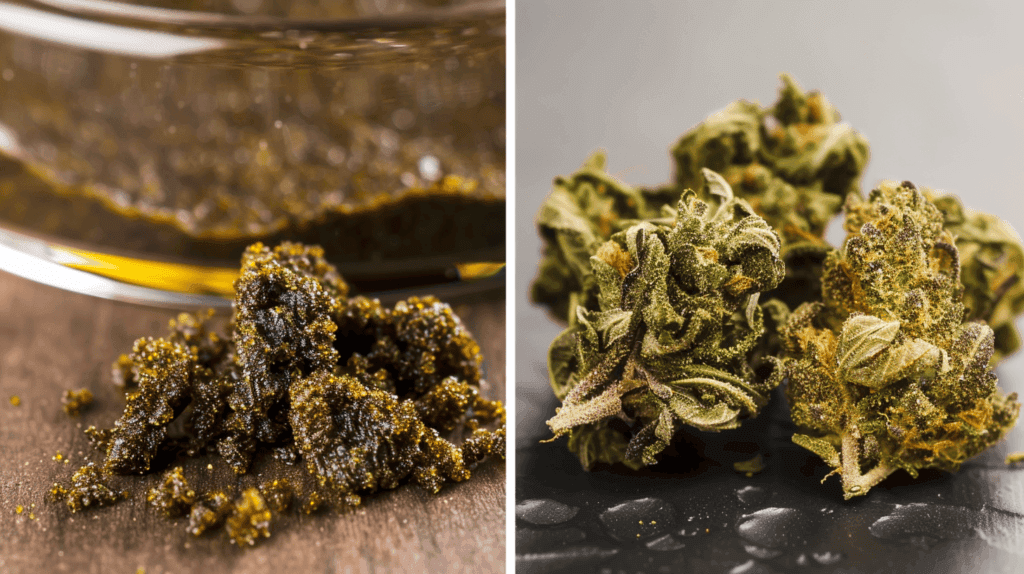
Hash and flower come from the same plant and contain the same compounds, but they look completely different and are experienced differently. Flower, or buds, are the dried blossoms, just as they grew. Hash is what sits on the very outside of those blossoms, the sticky resin, separated from the plant material and pressed together. So the difference is not about different plants but about which part of the plant you get and how it has been processed. Here is what sets them apart and what to consider when choosing.
At a glance
- Buds are dried female hemp flowers. Hash is resin from the glandular hairs on the flowers, pressed into a solid mass.
- Almost all the CBD and terpenes in the plant are made in these tiny glandular hairs, the trichomes.
- Because hash is concentrated resin, it often contains more cannabinoids per gram than flower.
- Hash is traditionally made by sieving, by rubbing the flowers between the hands or with ice water.
- A compact piece of hash protects its interior from air and light better than loose flowers.
The same resin in two forms
Look at a hemp flower under magnification and you will see that it is covered in tiny glittering hairs. These are trichomes, sometimes called the plant’s little factories. Research has shown that the stalked glandular hairs on female flowers are where cannabinoids and terpenes are made. That is where almost all the CBD is found, along with the compounds that give each strain its aroma.
Buds are whole flowers with the trichomes still attached to the plant material. Hash is the trichomes themselves, separated from the flowers and pressed into a solid mass. You could say that flower is the whole and hash is the essence.
How hash is made
There are several traditional ways to make hash, and the UN Office on Drugs and Crime (UNODC) describes the most common ones in its manual on cannabis analysis. What they all have in common is that the resin has to come loose from the rest of the plant.
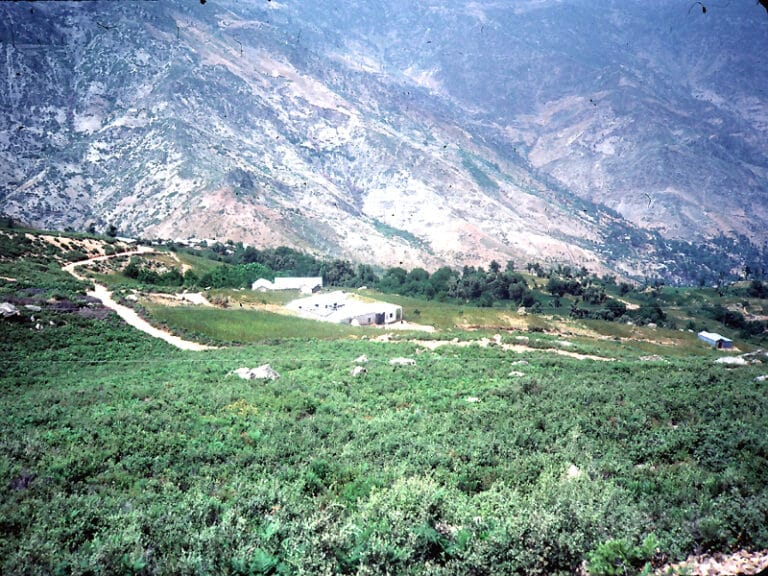
- Dry sieving. In the countries around the Mediterranean and in North Africa, dried plants are beaten against a surface so that the resin glands come loose. The powder is then sifted through ever finer cloths and pressed into slabs. This is how Moroccan hash is made, for example.
- Hand rubbing. In South and South-West Asia, fresh flowers are rubbed between the palms so that the resin sticks to the hands. The resin is scraped off and shaped into balls or sticks. This type is often called charas.
- Ice water. The plant material is stirred in ice-cold water so that the frozen trichomes become brittle and break off. The water is then filtered through bags with ever finer mesh. The result is called ice hash or bubble hash.
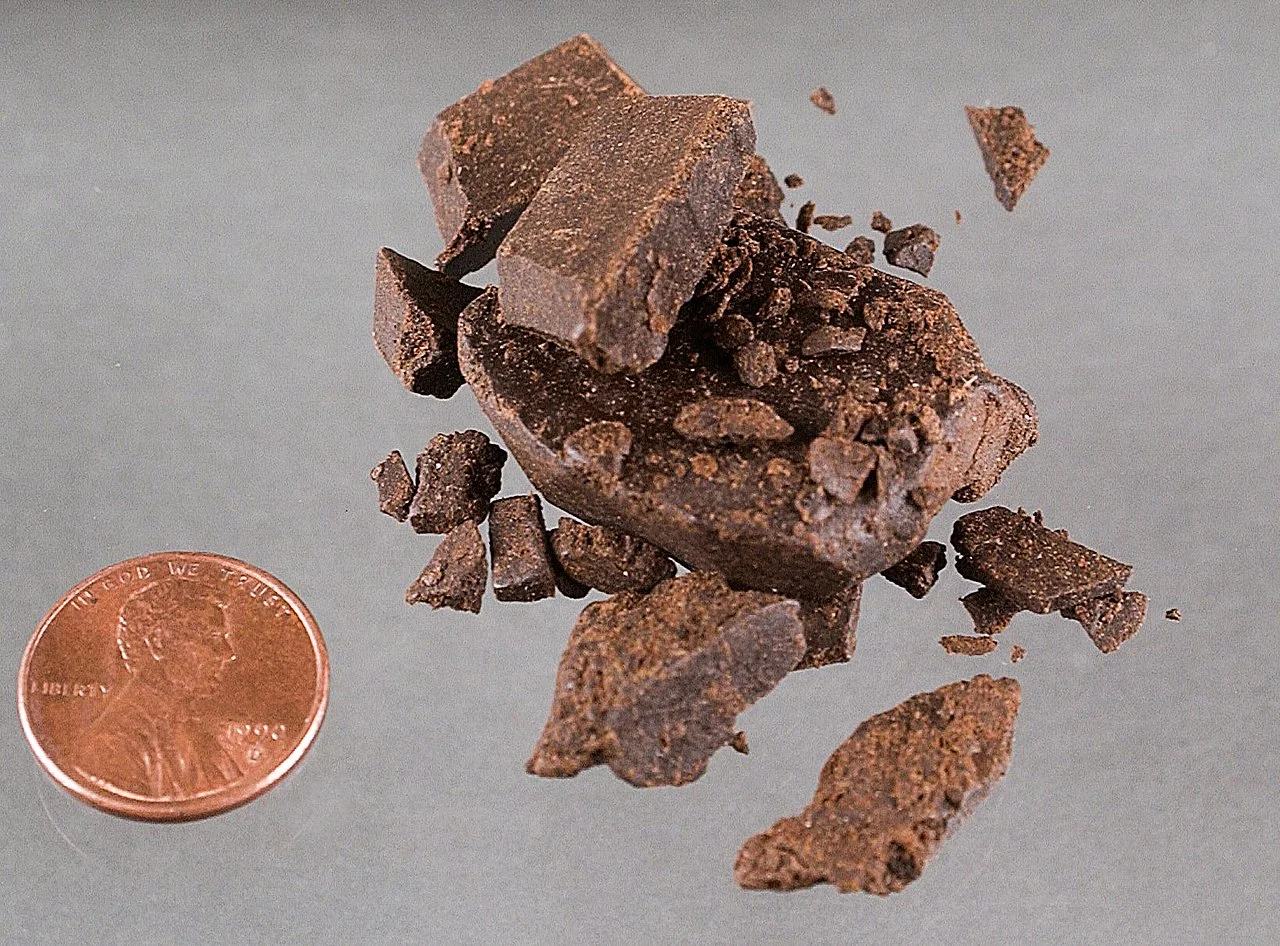
Flower needs less processing. The blossoms are harvested when the trichomes are mature, dried slowly and then cured for a while so that the aroma can develop. If you want to know more about the different kinds of hash and how they differ, we have written about it in our article on the types of CBD hash.
Potency and concentration
Since hash is essentially concentrated trichomes, it often contains more cannabinoids per gram than the flowers it comes from. This shows clearly in the statistics on cannabis in Europe from the EU Drugs Agency (EUDA). In 2023, the average THC content of cannabis resin was 23 percent, more than twice that of herbal cannabis at 11 percent. The gap has also widened over the past ten years.
The same principle applies to CBD products. A CBD hash made from hemp with a high CBD content is often stronger than the flowers. But levels vary a lot between products, so the only reliable way to know what you are buying is to read the lab report. It shows how much CBD, CBDA and other cannabinoids the product contains.
Aroma, terpenes and the entourage effect
Terpenes are the compounds that give hemp its aroma, from citrus and pine to earth and spice. They are made in the same glandular hairs as the cannabinoids. Research on trichomes has shown that the large, stalked glandular hairs on mature flowers are dominated by monoterpenes, the light and volatile compounds behind the fresh, fruity notes.
Flower keeps the whole structure of the blossom, which is why it is often easier to tell different strains apart. Hash instead has a denser, deeper and often spicier aroma. Some of the lightest terpenes can be lost when the resin is processed and pressed, while the heavier compounds remain.
Both hash and flower are full-spectrum products. They contain not only CBD but also other cannabinoids and terpenes from the plant. This is where the entourage effect comes in, the idea that the plant’s compounds work better together than on their own. That is exactly why many people prefer natural flowers and hash to products made with isolated CBD.
Shelf life and storage
Cannabinoids and terpenes are slowly broken down by oxygen, light and heat. Here hash has an advantage. The Swedish National Forensic Centre (NFC) followed how cannabis resin changes over four years under different conditions. Light barely affected the inside of the pieces, since it only reached the surface. Air was the most important factor, as many of the changes were caused by oxidation.
Flower has a much larger surface exposed to air and dries out more easily, which means some of the aroma is lost. An Austrian study also showed that high temperatures speed up the breakdown of cannabinoid acids in flowers, while they barely changed in the freezer. Whether you choose hash or flower, the advice is the same: keep it in an airtight jar, somewhere dark and cool. Read more in our article on CBD packaging.
Hash and flower compared
| Hash | Flower | |
|---|---|---|
| What it is | Pressed resin from the trichomes | Whole dried female flowers |
| Production | Sieving, hand rubbing or ice water | Drying and curing |
| Cannabinoids per gram | Often higher | Often lower |
| Aroma | Dense, deep and spicy | Clear strain character |
| Shelf life | Good, the inside is protected | Shorter, dries out more easily |
Hash or flower: which suits you?
There is no right or wrong. Flower suits you if you want to experience the differences between strains and appreciate blossoms in their natural form. Hash suits you if you want a dense, concentrated product with a deeper aroma, or if you are curious about the long hash traditions of Morocco, Lebanon and the Himalayas. You can read more about those traditions in our article on the history of cannabis.
Every product in our shop comes with a lab report, so you can see exactly what it contains. If you want to compare for yourself, you will find our range under CBD hash and CBD flowers.
What is the difference between hash and flower?
Flower, or buds, are the dried blossoms of the hemp plant. Hash is the resin from the glandular hairs on the flowers, the trichomes, separated from the plant material and pressed into a solid mass.
Is hash stronger than flower?
Often, because hash is made of concentrated trichomes, where the cannabinoids are produced. But levels vary between products, so read the lab report to see exactly how much CBD a product contains.
How is CBD hash made?
The resin is separated from the flowers by dry sieving, by rubbing the flowers between the hands or with ice water and fine-mesh bags. The resin is then pressed into a solid mass.
Which keeps longer, hash or flower?
Hash usually keeps better, because the compact mass protects the inside from air and light. Flower dries out more easily. Store both in an airtight jar, somewhere dark and cool.
Do hash and flower contain the same compounds?
Yes, basically the same cannabinoids and terpenes, since hash is made from the resin of the flowers. The proportions can differ, and some of the lightest terpenes can be lost when hash is made.
Sources
- Livingston, S. J. et al. (2020). Cannabis glandular trichomes alter morphology and metabolite content during flower maturation. The Plant Journal, 101, 37–56.
- Tanney, C. A. S. et al. (2021). Cannabis Glandular Trichomes: A Cellular Metabolite Factory. Frontiers in Plant Science, 12, 721986.
- UNODC (2022). Recommended Methods for the Identification and Analysis of Cannabis and Cannabis Products.
- EUDA (2025). European Drug Report 2025: Cannabis.
- Grafström, K. et al. (2019). Effects of long term storage on secondary metabolite profiles of cannabis resin. Forensic Science International, 301, 331–340.
- Taschwer, M. and Schmid, M. G. (2015). Determination of the relative percentage distribution of THCA and Δ9-THC in herbal cannabis seized in Austria. Forensic Science International, 254, 167–171.
- Russo, E. B. (2011). Taming THC: potential cannabis synergy and phytocannabinoid-terpenoid entourage effects. British Journal of Pharmacology, 163, 1344–1364.