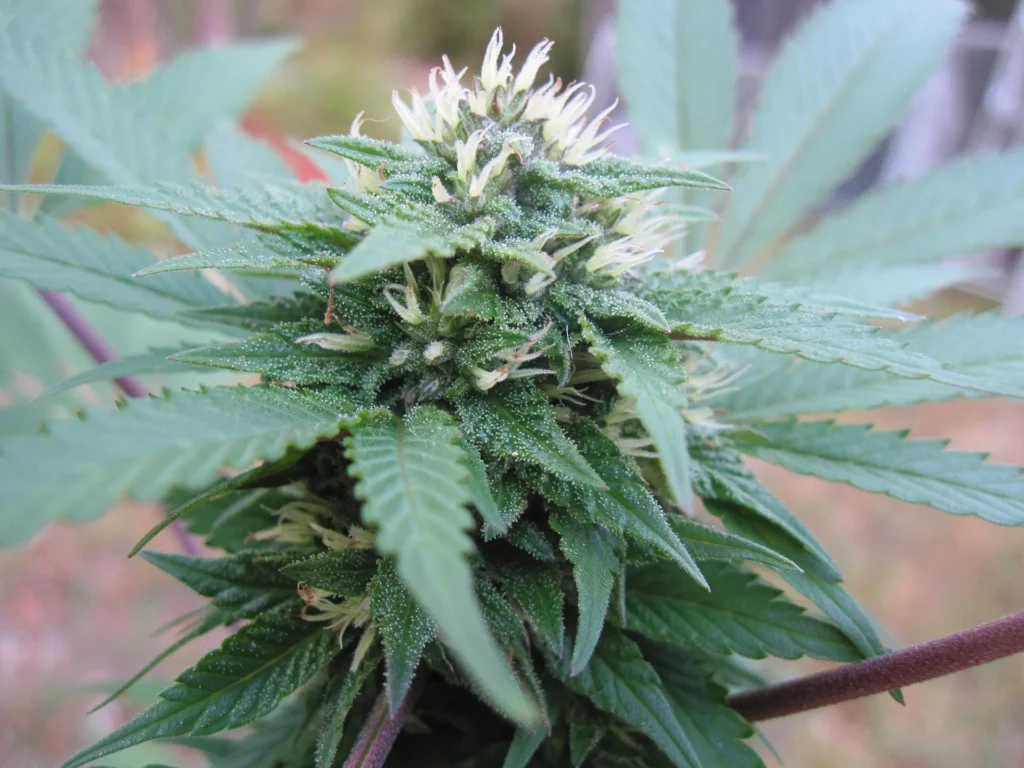
CBD and THC are the two best-known compounds in the cannabis plant, and they are often mixed up. That is hardly surprising. They are made in the same plant, from the same starting material, and they share exactly the same chemical formula. Yet only one of them produces the high cannabis is known for. The difference lies in how the atoms are arranged, and that small detail has big consequences for how the compounds affect the body. Here is what the research actually says.
At a glance
- CBD (cannabidiol) and THC (tetrahydrocannabinol) share the formula C21H30O2, but their atoms are arranged differently.
- THC activates the CB1 receptors in the brain and causes a high. CBD does not, and does not get you high.
- Both are made in the plant from the same compound, CBGA. Genetics decide whether a plant is rich in THC or CBD.
- CBD and THC work together with terpenes and other cannabinoids, something known as the entourage effect.
- In Europe there are approved medicines containing both THC and CBD, and one containing pure CBD.
Same plant, same origin
The cannabis plant makes more than a hundred different cannabinoids, but CBD and THC are the most abundant. Both start out as the same molecule, cannabigerolic acid (CBGA), sometimes called the mother compound. Enzymes in the glandular hairs of the plant convert CBGA further. The enzyme THCA synthase turns it into THCA, and the enzyme CBDA synthase turns it into CBDA.
In the living plant, the compounds therefore exist as acids, THCA and CBDA. Only when the material is heated, for example by smoking, vaporising or baking, does a carboxyl group split off and the acids become THC and CBD. The process is called decarboxylation. That is why raw cannabis does not have the same effect as heated cannabis.
The result is two molecules with the same formula: 21 carbon atoms, 30 hydrogen atoms and 2 oxygen atoms. The difference is that THC has a closed ring where CBD has an open ring and an extra hydroxyl group. It sounds like a minor detail, but the shape decides which receptors in the body the molecule fits.
Why some plants make CBD and others THC
Whether a plant becomes rich in THC or CBD is largely down to genetics. The Dutch researcher Etienne de Meijer and his colleagues showed in 2003 that a single gene locus decides the matter. A plant that inherits the THC variant from both parents becomes THC-dominant, a plant with the CBD variant from both becomes CBD-dominant, and a plant with one of each ends up somewhere in between.
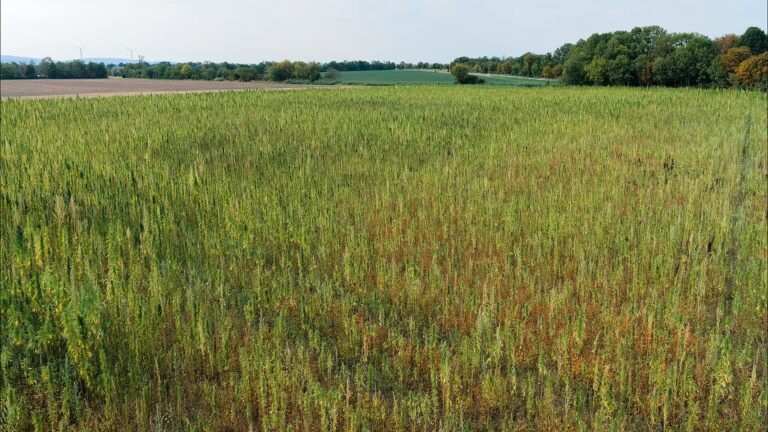
This difference is behind the split between hemp and drug-type cannabis. Industrial hemp is bred for fibre, seeds and CBD and has a very low THC content. In the EU, only hemp varieties listed in the EU common catalogue may be grown with farm subsidies, and they may contain no more than 0.3 percent THC. The division into sativa and indica does not say much about CBD and THC levels, however.
Historically, CBD was actually discovered first. The American chemist Roger Adams isolated CBD in 1940 from wild hemp growing in Minnesota. THC was not isolated until 1964, by Yechiel Gaoni and Raphael Mechoulam in Israel. You can read more about the plant’s long past in our article on the history of cannabis.
How CBD and THC work in the body
The body has its own system for cannabinoids, the endocannabinoid system. It consists of receptors, mainly CB1 and CB2, and of the body’s own compounds that bind to them. CB1 receptors are abundant in the brain and nervous system, while CB2 is found mainly in the immune system.
THC: activates CB1
THC has a shape that fits the CB1 receptor and activates it, much like the body’s own cannabinoids but more strongly and for longer. That is what causes the high: an altered sense of time, euphoria, increased appetite and sometimes anxiety or impaired short-term memory.
CBD: works in other ways
CBD does not activate CB1 in the same way and therefore does not get you high. Instead, it affects several other systems. Laboratory studies on cells suggest that CBD can act as a so-called negative allosteric modulator of CB1. This means CBD binds to a different site on the receptor and makes it less responsive to compounds like THC. How much this matters in the human body is not yet fully understood.
You sometimes read that CBD is completely non-psychoactive. That is not quite right. CBD does affect the brain and can cause tiredness, for example, but it does not produce a high, and the World Health Organization concluded in 2018 that CBD shows no signs of abuse or dependence potential in humans.
When CBD and THC work together
Perhaps the most interesting thing about CBD and THC is how they affect each other. A British study from 2013 gave healthy volunteers CBD before a dose of THC. The group that received CBD experienced less paranoia and fewer memory problems than the group that received a placebo.
A follow-up study from the same research group in 2023 painted a more nuanced picture. Here, 46 people were given cannabis with different ratios of CBD to THC, at levels common in cannabis. This time, CBD did not dampen the acute effects of THC. The conclusion is that ratios and amounts matter, and that you cannot count on a little CBD taking the edge off a lot of THC.
This is where the entourage effect comes in. The term describes the idea that the plant’s compounds work better together than on their own. The pharmacologist Ethan Russo has described how CBD, other cannabinoids such as CBN and terpenes such as myrcene, limonene and pinene can enhance and balance each other. It is one reason why many people prefer full-spectrum products to pure isolated CBD. Research in the field is growing, but much remains to be studied in controlled human trials.
CBD and THC compared
| CBD | THC | |
|---|---|---|
| Full name | Cannabidiol | Tetrahydrocannabinol |
| Chemical formula | C21H30O2 | C21H30O2 |
| Precursor in the plant | CBDA | THCA |
| Causes a high | No | Yes |
| Effect on CB1 | Does not activate, may dampen | Activates |
| Dependence potential | No signs according to WHO | Yes |
| Most common in | Industrial hemp | Drug-type cannabis |
Approved medicines
Both CBD and THC are used in approved medicines. Sativex is a mouth spray with roughly equal parts THC and CBD, used for spasticity in people with MS and approved in several European countries. Epidyolex contains purified CBD and was approved by the European Medicines Agency (EMA) in 2019 for certain severe, rare forms of epilepsy. These medicines are prescribed by specialist doctors and are something entirely different from the CBD products sold over the counter.
Good to know
Drug tests. Standard drug tests look for breakdown products of THC, not CBD, and cannot tell hemp products apart from other cannabis. In an American study, 60 people took CBD oil with different small amounts of THC twice a day for two weeks. Positive urine tests occurred in every group where the oil contained THC, even though the amounts were too small to cause any impairment. One sample in the group that received only CBD also tested positive. Anyone who is tested at work or on the road should therefore be careful.
Medicines and side effects. CBD is broken down in the liver by the same enzymes as many medicines, and the WHO notes that it can affect how other drugs work. In clinical trials with high doses, tiredness, stomach upset and changes in appetite were the most common side effects. If you take medication, it is wise to talk to a doctor or pharmacist first.
Rules. 0.3 percent is the limit for which hemp varieties may be grown in the EU. It does not by itself determine what applies to finished products, and the rules differ between countries.
If you want to see what we offer, you will find it under CBD oil in our shop.
What is the difference between CBD and THC?
CBD and THC have the same chemical formula but a different structure. THC activates the CB1 receptors in the brain and causes a high. CBD does not and does not get you high, but it affects the body in other ways.
Does CBD get you high?
No. CBD does not produce a high. It does affect the brain and can cause tiredness, for example, but the WHO has concluded that CBD shows no signs of dependence potential in humans.
Do CBD and THC come from the same plant?
Yes. Both are made in the cannabis plant from the same starting compound, CBGA. Genetics decide whether a plant is rich in THC or CBD. Industrial hemp is bred to contain very little THC.
Can CBD show up on a drug test?
Drug tests look for THC, not CBD. But many CBD products contain small amounts of THC, and studies have shown that such products can lead to positive tests.
What is the entourage effect?
It is the idea that cannabinoids like CBD and THC work together with terpenes and other compounds in the plant, so that the whole acts differently from the individual parts. It is one reason why many people prefer full-spectrum products.
Sources
- PubChem. Cannabidiol and Dronabinol (THC).
- Gülck, T. and Møller, B. L. (2020). Phytocannabinoids: Origins and Biosynthesis. Trends in Plant Science, 25, 985–1004.
- de Meijer, E. P. M. et al. (2003). The inheritance of chemical phenotype in Cannabis sativa L. Genetics, 163, 335–346.
- Adams, R., Hunt, M. and Clark, J. H. (1940). Structure of Cannabidiol, a Product Isolated from the Marihuana Extract of Minnesota Wild Hemp. Journal of the American Chemical Society, 62, 196–200.
- Gaoni, Y. and Mechoulam, R. (1964). Isolation, Structure, and Partial Synthesis of an Active Constituent of Hashish. Journal of the American Chemical Society, 86, 1646–1647.
- Laprairie, R. B. et al. (2015). Cannabidiol is a negative allosteric modulator of the cannabinoid CB1 receptor. British Journal of Pharmacology, 172, 4790–4805.
- Englund, A. et al. (2013). Cannabidiol inhibits THC-elicited paranoid symptoms and hippocampal-dependent memory impairment. Journal of Psychopharmacology, 27, 19–27.
- Englund, A. et al. (2023). Does cannabidiol make cannabis safer? A randomised, double-blind, cross-over trial of cannabis with four different CBD:THC ratios. Neuropsychopharmacology, 48, 869–876.
- Russo, E. B. (2011). Taming THC: potential cannabis synergy and phytocannabinoid-terpenoid entourage effects. British Journal of Pharmacology, 163, 1344–1364.
- Huestis, M. A. et al. (2019). Cannabidiol Adverse Effects and Toxicity. Current Neuropharmacology, 17, 974–989.
- WHO Expert Committee on Drug Dependence (2018). Cannabidiol (CBD): Critical Review Report.
- Wolinsky, D. et al. (2026). The acute and chronic pharmacokinetics and pharmacodynamics of oral cannabidiol with and without low doses of delta-9-tetrahydrocannabinol. Journal of Analytical Toxicology, 50, bkaf075.
- EMA. Epidyolex.
- European Union. Regulation (EU) 2021/2115 (Article 4).