Cannabis is one of the first plants humans ever cultivated. It has given us rope, sails, paper, food, medicine and intoxication, and it has travelled along trade routes, into graves and on board warships. A Viking woman was buried with cannabis seeds, the Swedish warship Vasa was rigged with hemp, and it was a Swede who gave the plant its scientific name. This is the history of cannabis, from the first fields in East Asia to the laws of today.
Key facts
- Genetic studies show that cannabis was first cultivated in East Asia around 12,000 years ago.
- The oldest firm evidence of cannabis being smoked for its effects is about 2,500 years old and comes from the Pamir Mountains.
- For thousands of years hemp was above all a useful crop for rope, sails, cloth and paper.
- Carl Linnaeus gave the plant the name Cannabis sativa in 1753.
- The international ban took shape during the 20th century, and since the 2010s more and more countries have started to regulate instead of prohibit.
Where it all began: East Asia 12,000 years ago
For a long time, researchers believed cannabis came from Central Asia. In 2021 a large genetic study was published in which researchers analysed the genomes of 110 cannabis plants from around the world. The conclusion was that the plant was domesticated in East Asia as early as the early Stone Age, around 12,000 years ago, and that all of today’s varieties, both hemp and the types grown for their flowers, descend from a shared gene pool that survives today in wild plants and landraces in China.
The first growers were probably more interested in the fibres and seeds than in any high. Hemp fibres are long and strong and early on became the raw material for rope, nets and cloth. The seeds are nutritious and could be eaten or pressed into oil. When paper was invented in China in the first centuries of the common era, hemp was one of the raw materials.
The same study also showed that people began breeding the plant in two different directions. Around 4,000 years ago the paths split: one branch was bred for long, unbranched stems and good fibres, the other for heavily branched plants with lots of flowers and resin.
The first traces of intoxication
Nobody knows exactly when people discovered that cannabis can also affect the mind, but archaeology offers some clear clues. In a grave at Yanghai in north-western China, researchers found the remains of a man buried around 2,700 years ago, probably a shaman. Next to him lay 789 grams of cannabis. Analyses showed that the plant material contained THC, and the researchers concluded that the cannabis had probably been grown and selected precisely for its effects.
The oldest firm evidence that cannabis was actually smoked comes from the Jirzankal cemetery in the Pamir Mountains, in what is now western China. There, archaeologists found wooden braziers with burnt stones, around 2,500 years old. Chemical traces on the braziers showed cannabis with a higher THC content than wild plants. The researchers believe the plant was burned at funeral ceremonies, perhaps to communicate with the dead.
Around the same time, the Greek historian Herodotus wrote about the Scythians, a horse-riding people on the steppe north of the Black Sea. According to him, they threw hemp seeds onto red-hot stones inside small felt tents and howled with pleasure as the smoke filled the tent. It is one of the oldest written descriptions of cannabis smoke, and it fits well with the archaeological finds.
Cannabis was also used further west. In a shrine at Tel Arad in present-day Israel, dating from the 8th century BCE, researchers found cannabis residue on one of two small altars. The cannabis had been mixed with animal dung so that it would burn at the right temperature. Frankincense was burned on the other altar.
India: bhang, ganja and a sacred plant
In India, cannabis holds a special place. The plant is mentioned in the Atharvaveda, one of the oldest Hindu scriptures, as one of five sacred plants. It was associated early on with the god Shiva, and the drink bhang, made from leaves and flowers mixed with milk and spices, is still drunk during the spring festival of Holi. India also gave the world several of the words we still use today, such as ganja for the flowers and charas for hand-rubbed hash.
Hashish in the Arab world
During the Middle Ages, hashish spread across the Islamic world, from Persia to Egypt. From the 12th and 13th centuries there are several sources on how hashish was used, including in certain Sufi circles, and on how scholars debated whether it was permitted.
This is also the source of one of the most persistent myths about cannabis, the legend of the Assassins. According to the story, spread in Europe partly through Marco Polo, a secret sect drugged its killers with hashish. The leading scholar in the field, Farhad Daftary, has shown that the story was essentially invented. The word hashishi was used as an insult, and Europeans then built a whole legend around it. The word assassin nevertheless lives on in several languages.
The Vikings, Vasa and Linnaeus
Cannabis reached Scandinavia long ago. When two women were buried in the Oseberg ship in Norway in the year 834, they were given a small leather pouch of cannabis seeds. Researchers disagree about why. Perhaps they were meant to grow hemp in the afterlife, but since no hemp textiles were found on board, many believe the seeds were used in rituals, and that one of the women may have been a völva, a seeress.
Hemp has been grown in Sweden at least since the Middle Ages, mainly to make rope. Demand was enormous in the 17th century, when Sweden was a great power. When the warship Vasa set sail in 1628, it carried around twelve kilometres of rope, and the rope was made of hemp.
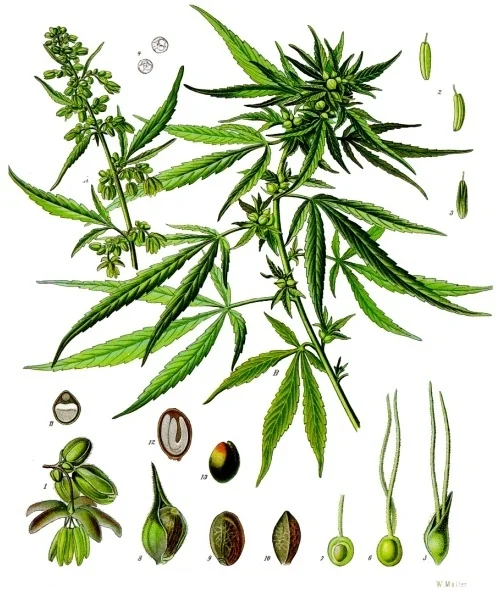
It was also a Swede who gave the plant its scientific name. In his great work Species Plantarum from 1753, Carl Linnaeus called it Cannabis sativa, where sativa means cultivated. Just over thirty years later, the Frenchman Jean-Baptiste de Lamarck described another type from India as Cannabis indica, and that is where the division into sativa and indica that survives today comes from.
Rope, sails and canvas: the golden age of hemp
For several hundred years, hemp was a strategic raw material in Europe. Sailing ships needed enormous amounts of rope and sailcloth, and hemp withstood salt water better than most other fibres. No hemp meant no navy, and no navy meant no trade or colonies. Several European states therefore encouraged or required farmers to grow it.
The traces remain in the language. The English word canvas, which today means heavy cloth or painting canvas, comes via French from the Latin cannabis. When hemp later faced competition from cotton, jute and finally synthetic fibres, cultivation fell quickly during the 19th and 20th centuries.
Cannabis becomes medicine in the West
The fact that cannabis became a common medicine in Europe is largely down to an Irish doctor in India. William Brooke O’Shaughnessy worked in Calcutta and in 1839 published an extensive study in which he had tested Indian hemp, first on animals and then on patients with conditions such as tetanus, rheumatism and cholera. He brought the knowledge back to Britain, and in the second half of the 19th century cannabis extracts and tinctures were sold in pharmacies in both Europe and the US.
In 1890, John Russell Reynolds, one of Queen Victoria’s physicians, wrote in the medical journal The Lancet that cannabis, used correctly, was “one of the most valuable medicines we possess”. But the medicines were hard to dose because the strength varied from batch to batch, and when new drugs such as aspirin arrived around 1900, use declined.
The ban takes shape
The international ban on cannabis began at a conference in Geneva. When the Opium Convention was negotiated in 1924 and 1925, the Egyptian delegate pushed for hashish to be included as well, and as a result Indian hemp was brought under international control.
In the US, Harry J. Anslinger, head of the Federal Bureau of Narcotics, led a campaign that resulted in the Marihuana Tax Act of 1937. We have written more about this in our article on cannabis rescheduling in the US. The ban became global in 1961, when the UN Single Convention on Narcotic Drugs placed cannabis in the same strictest category as heroin.
In Europe, most countries built their drug laws on the international conventions. From the 1960s cannabis use spread with the new youth culture, and many countries tightened their laws. Since the turn of the millennium, several have instead moved in the other direction. Portugal, for example, decriminalised the possession of small amounts of all drugs for personal use in 2001.
Science catches up
Strangely enough, nobody knew exactly which substances in cannabis produced its effects until the 1960s. The Israeli chemist Raphael Mechoulam mapped the structure of CBD in 1963, and the following year he and Yechiel Gaoni isolated THC. Since then researchers have found more than a hundred other cannabinoids, including CBN.
The next breakthrough came in 1988, when researchers found a receptor in the brain that THC binds to. Four years later, Mechoulam’s group discovered that the body itself makes a substance that fits the same receptor. They named it anandamide, after the Sanskrit word ananda, meaning bliss. It was now clear that humans have their own endocannabinoid system, and that cannabis acts on a system that already exists in the body.
From prohibition to reform
The counter-movement started early. The Netherlands opened the door to coffeeshops as early as 1976, and the 1970s counterculture also gave us the code 420. In California, medical cannabis became legal in 1996, and since then more and more countries and states have followed.
In 2013, Uruguay became the first country in the world to regulate the whole chain from cultivation to sale. Canada followed in 2018. In December 2020, the UN Commission on Narcotic Drugs voted to remove cannabis from the strictest list of the 1961 convention, by 27 votes to 25. Malta legalised in 2021, and Germany allowed personal use and home growing in April 2024. Read more in our articles on Germany’s cannabis law and the Dutch wietexperiment.
The history of cannabis at a glance
- About 12,000 years agoCannabis is first cultivated in East Asia
- About 2,700 years agoA shaman is buried with 789 grams of cannabis at Yanghai in China
- 8th century BCECannabis is burned on an altar at Tel Arad
- About 2,500 years agoCannabis is smoked at funerals in the Pamir Mountains
- 5th century BCEHerodotus describes the Scythians’ hemp baths
- 834Cannabis seeds are placed in the Oseberg grave in Norway
- 1628Vasa sets sail with kilometres of hemp rope
- 1753Linnaeus names the plant Cannabis sativa
- 1839O’Shaughnessy introduces cannabis to Western medicine
- 1925Indian hemp is brought under international control
- 1961The UN Single Convention makes the ban global
- 1964THC is isolated by Gaoni and Mechoulam
- 2013Uruguay becomes the first country to legalise
- 2020The UN removes cannabis from the strictest list
- 2024Germany allows personal use and home growing
Some of the most important events in the history of cannabis.
And today?
After thousands of years as a useful crop, nearly a century of prohibition and a few decades of research, cannabis has entered a new phase. Hemp is grown again across Europe, using approved varieties with low THC levels, and CBD has become a product category of its own. At the same time, more and more countries are rethinking how to deal with the rest of the plant. Seen over 12,000 years, prohibition is a brief parenthesis, and the story is far from over.
Where does cannabis come from?
Genetic studies show that cannabis was domesticated in East Asia around 12,000 years ago. All of today’s varieties descend from a shared gene pool that survives today in wild plants and landraces in China.
When did people start smoking cannabis?
The oldest firm evidence of cannabis smoke comes from Jirzankal in the Pamir Mountains and is around 2,500 years old. There, cannabis was burned in wooden braziers at funerals.
When did cannabis become illegal?
Indian hemp was brought under international control by the Geneva Opium Convention of 1925. The US passed the Marihuana Tax Act in 1937, and in 1961 the UN Single Convention made the ban global.
Who gave cannabis its scientific name?
The Swedish botanist Carl Linnaeus named the plant Cannabis sativa in Species Plantarum in 1753. The name Cannabis indica came from the Frenchman Lamarck just over thirty years later.
Sources
- Ren, G. et al. (2021). Large-scale whole-genome resequencing unravels the domestication history of Cannabis sativa. Science Advances, 7, eabg2286.
- Russo, E. B. et al. (2008). Phytochemical and genetic analyses of ancient cannabis from Central Asia. Journal of Experimental Botany, 59, 4171–4182.
- Ren, M. et al. (2019). The origins of cannabis smoking: Chemical residue evidence from the first millennium BCE in the Pamirs. Science Advances, 5, eaaw1391.
- Arie, E., Rosen, B. and Namdar, D. (2020). Cannabis and Frankincense at the Judahite Shrine of Arad. Tel Aviv, 47, 5–28.
- Touw, M. (1981). The Religious and Medicinal Uses of Cannabis in China, India and Tibet. Journal of Psychoactive Drugs, 13, 23–34.
- Daftary, F. The Institute of Ismaili Studies. Introduction to The Assassin Legends.
- The Norwegian American. Viking ship cannabis conundrum.
- Vasamuseet. Fira påsk med skelett och hampa på Vasamuseet.
- Online Etymology Dictionary. Canvas.
- The Public Domain Review. W. B. O’Shaughnessy and the Introduction of Cannabis to Modern Western Medicine.
- Reynolds, J. R. (1890). On the therapeutical uses and toxic effects of Cannabis indica. The Lancet, 135, 637–638.
- UNODC (2008). A Century of International Drug Control.
- EMCDDA (2011). Drug policy profiles: Portugal.
- Gaoni, Y. and Mechoulam, R. (1964). Isolation, Structure, and Partial Synthesis of an Active Constituent of Hashish. Journal of the American Chemical Society, 86, 1646–1647.
- Devane, W. A. et al. (1992). Isolation and Structure of a Brain Constituent That Binds to the Cannabinoid Receptor. Science, 258, 1946–1949.
- United Nations (2020). UN commission reclassifies cannabis, yet still considered harmful.