CBN and CBD sound almost the same, but they are two very different compounds with different origins, different ways of acting in the body and a very different amount of research behind them. CBD is formed directly in the hemp plant and is the most studied cannabinoid after THC. CBN only forms when THC ages and was long seen as a by-product, but in recent years it has become one of the most talked-about cannabinoids. Here we look at what sets them apart, what the studies actually show about CBN and why the combination of cannabinoids is so interesting.
This article is for information only and summarises research on the cannabinoids CBN and CBD. It is not about our products, and nothing in it should be read as a claim about what any product does. It does not replace advice from a doctor or other healthcare professional.
Key facts
- CBD is formed in the plant, while CBN forms when THC is slowly broken down by air, light and heat.
- CBN was the first cannabinoid ever isolated, back in the 1890s. The structure of CBD was only mapped in 1963.
- CBN binds weakly to the body’s CB1 receptors and somewhat more strongly to CB2. CBD barely binds at all and affects CB1 indirectly.
- Sleep is the most studied area for CBN, with interesting but mixed results.
- Most of the research on CBN has been done on animals or in the laboratory, so much remains to be explored.
What is CBN?
CBN, cannabinol, is a cannabinoid that is barely present in a fresh plant. Instead, it forms as THC ages. The plant first produces THCA, which turns into THC when it is heated or dried. When THC is then exposed to oxygen, light and heat over a long period, the molecule gradually oxidises into CBN. That is why old cannabis and hash that has been stored for a long time contain more CBN than fresh material, and the CBN level is sometimes used as a measure of how old a sample is.
This is also why CBN is often associated with hash. Hash is stored and pressed, and some traditional varieties are left to mature for months. If you want to know more about how different types of hash are made, we have written about it in
CBD hash: types, origins and how to choose.
The first cannabinoid ever discovered
CBN has a special place in the history of cannabis research. In the 1890s, the British chemists Thomas Barlow Wood, W. T. Newton Spivey and Thomas Hill Easterfield at Cambridge managed to isolate a compound from charas, Indian hand-rubbed hash. They called it cannabinol, and it became the first cannabinoid ever isolated from the plant. For a long time, cannabinol was believed to be what lay behind the effects of hash.
Working out its exact chemical structure took much longer. The British chemist Robert Sidney Cahn proposed a structure in the early 1930s, and around 1940 it was confirmed when research groups led by Roger Adams in the US and Alexander Todd in the UK managed to produce CBN synthetically. The work on CBN laid much of the groundwork for the chemistry later used to understand both THC and CBD.
What is CBD?
CBD, cannabidiol, is formed directly in the plant’s trichomes, the small resin glands on the flowers. Just like THC, it is first produced in its acidic form, CBDA, which turns into CBD when heated. CBD is the dominant cannabinoid in EU-certified industrial hemp and by far the most researched of the cannabinoids that do not cause a high.
CBD was isolated in 1940, but its structure was only determined in 1963 by Raphael Mechoulam and Yuval Shvo in Israel. It was one of the pieces of work that kicked off modern cannabinoid research. In 2018, the World Health Organization reviewed the research on CBD and concluded that it shows no signs of being addictive and is generally well tolerated.
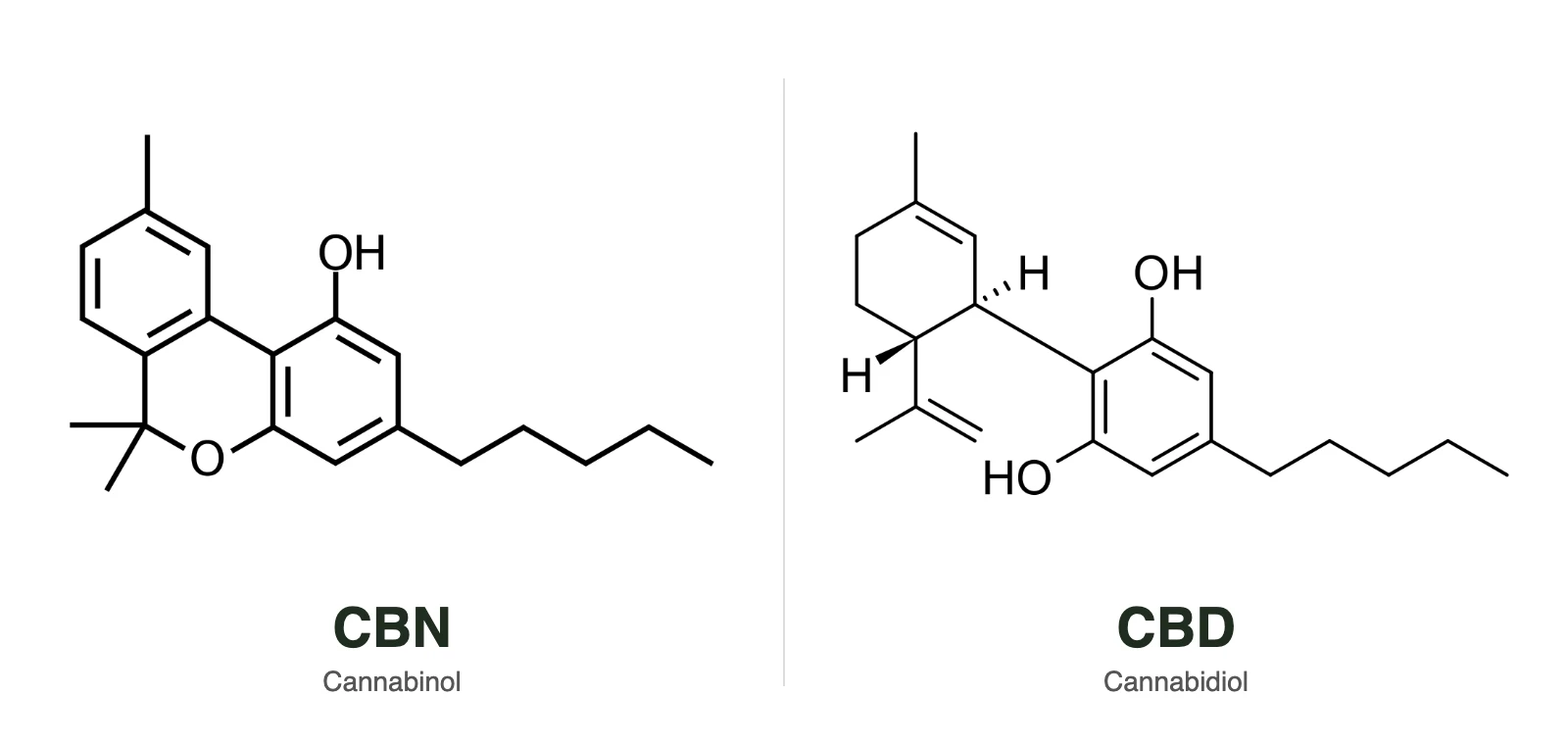
CBN vs CBD: the key differences
Although the names are similar, CBN and CBD differ on almost every point. The table sums up the most important differences.
| CBN | CBD | |
|---|---|---|
| How it forms | When THC oxidises over time | Directly in the plant, via CBDA |
| Discovered | Isolated in the 1890s | Isolated in 1940, structure in 1963 |
| Amount in a fresh plant | Very small | Large in industrial hemp |
| Chemical relative | Closely related to THC | Open ring structure, a group of its own |
| CB1 receptor | Binds weakly, much more weakly than THC | Barely binds, acts indirectly |
| CB2 receptor | Binds somewhat more strongly than to CB1 | Binds weakly |
| Intoxication | No high on its own in studies | No high |
| Most studied for | Sleep | Many areas |
| State of research | Early, mostly animal and lab studies | Extensive, including many human studies |
How do CBN and CBD act in the body?
Both compounds interact with the endocannabinoid system, the body’s own signalling system, which includes the CB1 and CB2 receptors. CB1 is found mainly in the brain and nervous system, CB2 mainly in the immune system.
CBN has a chemical structure similar to THC and therefore binds to CB1, but much more weakly. In an older human study from 1975, CBN on its own caused no feeling of being high, while THC did. At the same time, newer research has revealed something unexpected. When rats were given CBN, part of it was converted in the body into 11-hydroxy-CBN, and in the laboratory that metabolite was roughly as active at CB1 as THC. How this affects humans has not yet been mapped.
CBD works in a completely different way. It barely binds to CB1 or CB2, but instead changes how the CB1 receptor responds to other compounds. Researchers call it a negative allosteric modulator. Put simply, CBD dampens the receptor rather than activating it. That is one of the reasons CBD does not cause a high. CBD also affects a range of other targets in the body, which is one reason it has been studied in so many areas. You can read more about the endocannabinoid system and other cannabinoids in
What are cannabinoids? CBD, THC, CBG, CBN and the endocannabinoid system.
What does research say about CBN?
Interest in CBN has grown sharply in recent years, and several new studies have been published. The table gives an overview of some of the most interesting ones. Note that most were done on animals or cells, so the results cannot be transferred directly to humans.
| Area | Type of study | What the researchers saw |
|---|---|---|
| Sleep | Humans, 2024 | Fewer awakenings during the night compared with placebo |
| Sleep | People with insomnia, 2026 | Slightly faster sleep onset at the higher dose, but no difference in time awake during the night |
| Sleep | Rats, 2025 | Longer total sleep, more deep sleep and more REM sleep |
| Appetite | Rats, 2012 | CBN increased appetite, while CBD reduced it |
| Muscle soreness | Rats, 2019 | Both CBN and CBD reduced soreness, the combination lasted longer |
| Nerve cells | Laboratory, 2022 | CBN protected nerve cells from oxidative damage via the mitochondria |
| Bacteria | Laboratory, 2008 | CBN and CBD were active against antibiotic-resistant staphylococci |
Sleep: the most studied area
CBN is often sold as a sleep aid, and that is also where research has come furthest. A study from the University of Sydney, published in 2025, was the first to measure CBN’s effect on sleep objectively, using the same kind of measurements as in a sleep lab. The rats given CBN slept longer and had both more deep sleep and more REM sleep. The effect on deep sleep was on a par with the prescription sleep medication zolpidem.
In humans the picture is more mixed. In a US study from 2024, just over 300 adults who slept poorly were given either CBN, CBN combined with different amounts of CBD, or placebo for seven nights. Those who received CBN alone woke up fewer times per night and reported less sleep disturbance than the placebo group, but they did not fall asleep faster. An Australian study of 20 people with diagnosed insomnia, published in 2026, found no difference in its main measure, how long participants lay awake during the night. The higher dose did, however, lead to slightly faster sleep onset and better perceived sleep quality, without noticeably affecting driving ability the next day.
Taken together, there are signs that CBN can affect sleep, but the human studies are few and small. We have gone through the sleep research in more detail in
CBN and sleep: what the latest research shows.
Appetite: where CBN and CBD go in opposite directions
One of the clearest differences between CBN and CBD comes from a British study from 2012. The researchers gave well-fed rats different cannabinoids and measured how much they ate. CBN made the rats start eating sooner and eat more, and the effect went through the CB1 receptor. CBD did the opposite and reduced the total amount of food. It is a good example of how two cannabinoids with almost the same name can have exactly opposite effects.
Muscle soreness
In a Canadian study from 2019, researchers examined whether CBN and CBD could reduce soreness in the jaw muscle of rats. Both CBN and CBD reduced sensitivity when given directly into the muscle, without affecting movement. The combination of the two gave a longer-lasting effect than either compound alone, but when the share of CBD became too high the effect was shorter. The researchers take this to mean that the ratio between the cannabinoids matters.
Nerve cells
Researchers at the Salk Institute in the US have studied how CBN affects nerve cells in the laboratory. In a 2022 study, they showed that CBN protected nerve cells from a type of cell death caused by oxidative stress. The protection appeared to work through the cells’ mitochondria and was independent of the cannabinoid receptors. It is basic research on cells, but it explains why CBN attracts interest in research on the ageing brain.
Bacteria
Back in 2008, Italian and British researchers tested five of the most common cannabinoids against MRSA, staphylococci that are resistant to common antibiotics. All five, including CBN and CBD, were highly effective against the bacteria in test tubes. The result has led to further research, but there is a long way to go before we know whether it has any practical significance.
CBN and CBD together
Cannabinoids and terpenes never occur alone in the plant, and many researchers believe they influence each other. This interplay is called the entourage effect, and it is one of the reasons whole flowers, hash and full-spectrum products are so interesting. The CBN studies show that the interplay is not always as simple as more being better. In the muscle study the combination extended the effect, but only up to a certain share of CBD. In the 2024 sleep study, adding CBD did not strengthen the effect of CBN. And in the 1975 study, CBN slightly strengthened some of the effects of THC.
The conclusion is that the whole picture matters. How much of each cannabinoid a product contains, and which terpenes are present, shapes its character. We have written more about terpenes in
What are terpenes? The most common terpenes in cannabis.
Good to know about CBN
Cannabinoids can affect the liver enzymes that break down medicines. This is well known for CBD, and an Australian animal study from 2025 showed that CBN does it too. When mice were given CBN together with melatonin, the level of melatonin in the blood became about four times higher. That is interesting because CBN is often sold in combination with melatonin. If you take medication, it is therefore wise to talk to your doctor before starting products that contain cannabinoids.
CBN and CBD in products
Because a fresh plant contains so little CBN, most CBN today is produced by converting CBD or other cannabinoids in the laboratory. CBN also occurs naturally in hash that has been left to mature. How much of each cannabinoid a product contains is shown in the lab report, which lists the full cannabinoid profile. Here is how to read one:
How to read a CBD lab report (COA), step by step.
What is the difference between CBN and CBD?
CBD is formed directly in the hemp plant, while CBN forms when THC is broken down by air, light and heat. CBN binds weakly to the body’s CB1 receptors, while CBD barely binds at all and instead affects the receptor indirectly. CBD is also far more researched.
Is CBN psychoactive?
CBN binds much more weakly to the CB1 receptor than THC, and in an older human study CBN alone caused no high. However, a metabolite of CBN is active at CB1 in the laboratory, and how this affects humans has not been mapped.
How is CBN formed?
CBN forms when THC oxidises over time. That is why old cannabis and stored hash contain more CBN than fresh material. Most of the CBN used in products today is produced in the laboratory.
What does research say about CBN and sleep?
Animal studies show that CBN leads to longer sleep and more deep sleep. In humans there are only a few studies with mixed results, including fewer awakenings in a study from 2024. More research is needed.
Does CBD strengthen the effect of CBN?
Not necessarily. In a sleep study from 2024, CBD did not strengthen the effect of CBN, while an animal study on muscle soreness showed that the combination lasted longer up to a certain share of CBD.
Sources
- Maioli, C. et al. (2022). Cannabinol: History, Syntheses, and Biological Profile of the Greatest “Minor” Cannabinoid. Plants, 11(21), 2896.
- Walsh, K. B., McKinney, A. E. and Holmes, A. E. (2021). Minor Cannabinoids: Biosynthesis, Molecular Pharmacology and Potential Therapeutic Uses. Frontiers in Pharmacology, 12, 777804.
- Mechoulam, R. and Shvo, Y. (1963). Hashish. I. The structure of cannabidiol. Tetrahedron, 19(12), 2073–2078.
- Laprairie, R. B. et al. (2015). Cannabidiol is a negative allosteric modulator of the cannabinoid CB1 receptor. British Journal of Pharmacology, 172(20), 4790–4805.
- WHO Expert Committee on Drug Dependence (2018). Cannabidiol (CBD) Critical Review Report.
- Karniol, I. G. et al. (1975). Effects of Δ9-tetrahydrocannabinol and cannabinol in man. Pharmacology, 13(6), 502–512.
- Arnold, J. C. et al. (2025). A sleepy cannabis constituent: cannabinol and its active metabolite influence sleep architecture in rats. Neuropsychopharmacology, 50, 586–595.
- Bonn-Miller, M. O. et al. (2024). A double-blind, randomized, placebo-controlled study of the safety and effects of CBN with and without CBD on sleep quality. Experimental and Clinical Psychopharmacology, 32(3), 277–284.
- Lavender, I. G. et al. (2026). Cannabinol for Acute Treatment of Insomnia Disorder in a Randomized Placebo-Controlled Crossover Trial. Journal of Sleep Research.
- Farrimond, J. A., Whalley, B. J. and Williams, C. M. (2012). Cannabinol and cannabidiol exert opposing effects on rat feeding patterns. Psychopharmacology, 223, 117–129.
- Wong, H. and Cairns, B. E. (2019). Cannabidiol, cannabinol and their combinations act as peripheral analgesics in a rat model of myofascial pain. Archives of Oral Biology, 104, 33–39.
- Liang, Z. et al. (2022). Cannabinol inhibits oxytosis/ferroptosis by directly targeting mitochondria independently of cannabinoid receptors. Free Radical Biology and Medicine, 180, 33–51.
- Appendino, G. et al. (2008). Antibacterial cannabinoids from Cannabis sativa: a structure-activity study. Journal of Natural Products, 71(8), 1427–1430.
- Anderson, L. L. et al. (2025). Preclinical Evidence for a Drug-Drug Interaction Between Cannabinol and Melatonin. Basic & Clinical Pharmacology & Toxicology, 136, e14120.
- Russo, E. B. (2011). Taming THC: potential cannabis synergy and phytocannabinoid-terpenoid entourage effects. British Journal of Pharmacology, 163(7), 1344–1364.