Making your own CBD oil is easier than many people think. With CBD isolate or CBD distillate, a carrier oil and a digital scale, you can mix an oil with exactly the strength and composition you want. Here we go through what you need, how to work out the strength, a couple of recipes and how to build on the oil with more cannabinoids and terpenes.
At a glance
- A homemade CBD oil has two parts: a carrier oil and a CBD raw material, usually isolate or distillate.
- MCT oil has a neutral scent and a long shelf life. Hemp seed oil has a mild, nutty note.
- Isolate is almost pure CBD. Distillate also contains other cannabinoids, which gives a broader profile.
- You work out the strength by dividing the amount of CBD in milligrams by the total volume of oil in millilitres.
- Making oil from CBD flowers is harder, and the THC in the flowers ends up concentrated in the oil.
What you need
- A digital scale that weighs to a hundredth of a gram, since small differences in weight make a big difference to strength.
- Carrier oil, for example MCT oil or hemp seed oil.
- CBD isolate or CBD distillate.
- A glass beaker or jar and something to stir with.
- A saucepan for a water bath, since distillate and isolate dissolve more easily in warm oil.
- Dark glass bottles with droppers and labels.
Keep everything clean and dry. Wash the equipment thoroughly and let it dry completely before you start.
Choose a carrier oil
The carrier oil is the base of your oil and makes up almost all of the volume. The two most common choices are:
- MCT oil. Usually made from coconut oil and consisting of medium-chain fatty acids. It is clear, almost scentless and keeps for a long time. It is also easy to work with, which makes it the most common choice.
- Hemp seed oil. Pressed from hemp seeds and contains no CBD on its own. It has a mild, nutty scent and a greenish colour. Hemp seed oil is high in polyunsaturated fat and therefore goes rancid faster than MCT oil.
Isolate or distillate?
The raw material you choose decides what kind of oil you end up with.
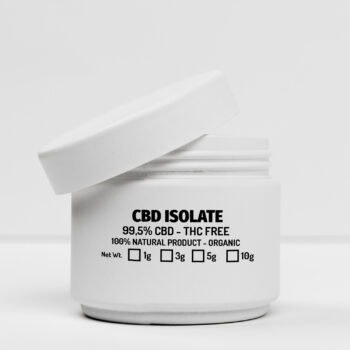
- CBD isolate is a white, crystalline powder with more than 99% CBD. It has no hemp scent or taste and gives a pure CBD oil.
- CBD distillate is a thick extract. Our distillate has around 90% cannabinoids, of which just over 80% is CBD and the rest includes CBG and CBN. It is THC-free and gives a broad-spectrum oil.
The distillate has a broader profile thanks to the other cannabinoids. Many people prefer it for exactly that reason, since the compounds in hemp may work together in what is known as the entourage effect. Isolate is the better choice when you want full control over exactly what the oil contains.
How to work out the strength
The strength of a CBD oil is usually given in milligrams of CBD per millilitre or as a percentage. You work it out in two steps:
- Amount of CBD: weight of the raw material in grams × CBD content × 1,000 = milligrams of CBD.
- Strength: milligrams of CBD ÷ total volume of oil in millilitres = milligrams per millilitre.
An example: 3 grams of distillate with 81% CBD contains 3 × 0.81 × 1,000 = 2,430 mg of CBD. Mixed into 30 ml of oil, the strength is 81 mg per ml, or roughly 8%. Always check the CBD content in the raw material’s lab report so that you calculate with the right figure.
Keep in mind that the raw material also takes up space. Weigh out the CBD first and then top up with carrier oil until you reach the total volume you calculated with, rather than pouring in all the oil at once.

Two recipes
Pure CBD oil with isolate, 30 ml at about 5%
- Weigh out 1.5 g of CBD isolate in a clean glass beaker. That gives about 1,490 mg of CBD.
- Pour in about 25 ml of MCT oil.
- Warm the beaker gently in a water bath and stir until the powder has dissolved completely and the oil is clear. The oil should get warm, not boil.
- Top up with MCT oil to 30 ml and stir again.
- Let it cool and pour it into a dark glass bottle.
The result is about 50 mg of CBD per ml.
Broad-spectrum oil with distillate, 30 ml at about 8%
- Warm the jar of distillate in hot water so it is easier to handle.
- Weigh out 3 g of distillate in a glass beaker. At 81% CBD, that is about 2,430 mg of CBD.
- Add about 25 ml of carrier oil, warm in a water bath and stir until the mixture is completely even.
- Top up with carrier oil to 30 ml, stir and let it cool.
- Pour it into a dark glass bottle.
The result is about 81 mg of CBD per ml. The oil gets a golden colour and a clearer hemp scent than an isolate oil.
Build on it with CBG and CBN
If you want a broader cannabinoid profile, you can mix in isolates of other cannabinoids. The method is the same: weigh out the isolate, dissolve it in the oil together with the CBD and work out the content of each cannabinoid separately.
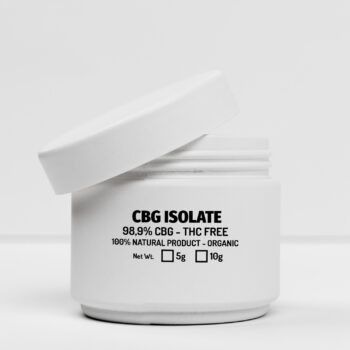
- CBG isolate. CBG is the cannabinoid that other cannabinoids are formed from in the plant. Read more in our article on what CBG is.
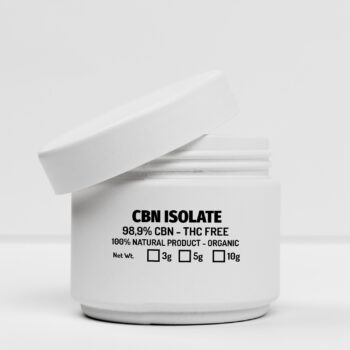
- CBN isolate. CBN forms when THC breaks down over time. We go through how it differs from CBD in CBN vs CBD.
An example: if you add 1 g of CBN isolate to the distillate recipe, you get about 33 mg of CBN per ml in a 30 ml bottle on top of the CBD.
Give the oil a scent with terpenes
Terpenes are the compounds that give hemp and other plants their scent. An isolate oil is practically scentless, and a few drops of terpenes can give it character. Terpenes are also part of the idea behind the entourage effect, where cannabinoids and terpenes together create a more complete whole than they do on their own.
- Myrcene has an earthy, musky scent and is common in many hemp strains.
- Limonene smells of fresh citrus.
- Pinene is reminiscent of pine forest.
Terpenes are very concentrated. Start with one or two drops in a 30 ml bottle, stir and check before adding more. Only use terpenes intended for the purpose you have in mind and follow the manufacturer’s instructions. We have a selection in our terpenes category.
Can you make CBD oil from flowers?
You can extract CBD from flowers by first heating them, so that CBDA is converted to CBD, and then drawing the compounds out into oil. But the result is hard to control. You do not know how strong the oil is without sending it for analysis, and chlorophyll and plant material give a bitter, green oil.
There is also the question of THC. CBD flowers contain small amounts of THC, and when you extract them, the THC ends up in the oil as well. Depending on where you live, that can mean the oil exceeds the permitted THC limit. With THC-free isolate or distillate, you avoid that problem.
Storage and shelf life
- Store the oil in dark glass bottles, somewhere cool and away from light.
- Write on the bottle what it contains, the strength and the date you made it.
- If the oil turns cloudy or forms crystals, the isolate may have come out of solution. Warm the bottle gently in hot water and shake it, and it usually clears up again.
- Shelf life depends largely on the carrier oil. Go by the carrier oil’s best-before date and throw the oil away if it smells rancid.
If you would rather have a ready-made oil with a lab report, you will find our CBD oils in our shop, and the lab reports are collected in one place.
Which carrier oil is best for homemade CBD oil?
MCT oil is the most common because it is scentless, easy to work with and keeps for a long time. Hemp seed oil also works and has a mild, nutty scent, but goes rancid faster.
How do you work out the strength of a homemade CBD oil?
First work out the amount of CBD: weight of the raw material in grams × CBD content × 1,000. Then divide by the total volume of oil in millilitres to get milligrams of CBD per millilitre.
Is isolate or distillate better?
Isolate gives a pure CBD oil without scent. Distillate also contains other cannabinoids and gives a broad-spectrum oil with a clearer hemp character. Which suits you best depends on what you want.
Why is my CBD oil cloudy?
Usually the CBD isolate has started to crystallise because the oil has been kept cold. Warm the bottle gently in hot water and shake it, and the oil usually clears up again.
Can you make CBD oil from CBD flowers?
You can, but the strength is hard to know and the THC ends up in the oil. Depending on local rules, that can put the oil above the permitted THC limit, so isolate or THC-free distillate is a safer choice.