A grinder is one of the simplest accessories there is, but it makes a big difference. With a good grinder the flower is ground evenly, it burns or vaporises more evenly, and your fingers stay clean. Here we explain how a grinder is built, which types are available, how to use one step by step and what the fine powder at the bottom, kief, actually is.
At a glance
- A grinder breaks flowers down to an even consistency using two toothed parts that are twisted against each other.
- The most common models have two, three or four pieces. A four-piece grinder has a screen that collects kief in a separate chamber.
- Aluminium is the most common material because it is light, durable and lasts a long time.
- Kief is loose trichomes, the tiny hair-like outgrowths on the surface of the flower where the resin with cannabinoids and terpenes is formed.
What is a grinder?
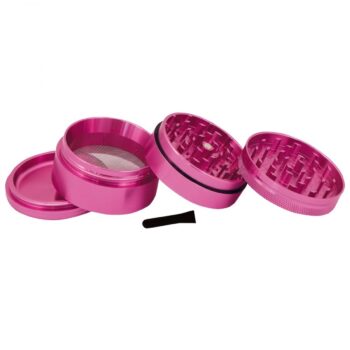
A grinder, sometimes called a herb grinder, is a small cylinder made of several pieces that screw together. The lid and the top chamber are fitted with teeth or pins. When you place the flower between them and twist the lid, the material is cut and torn into an even crumble.
What mainly sets grinders apart is how many pieces they have. A two-piece grinder consists only of a lid and a grinding chamber, and you take the ground material straight out of it. In a three-piece grinder, the ground material falls through holes in the bottom of the grinding chamber into a collection chamber. A four-piece grinder also has a fine screen under the collection chamber. The smallest particles sift through the screen into a fourth chamber, where the kief collects.
Why use a grinder?
The biggest advantage is that the flower is ground evenly. When all the pieces are roughly the same size, a joint burns more evenly and draws better, and in a vaporiser the hot air reaches the material from all sides so that it vaporises evenly. A mix of large and small pieces easily gives an uneven experience, where some parts get too hot and others are barely affected.
A grinder is also gentler on the flower than your fingers. Much of the aroma and effect sits in the trichomes, the tiny hair-like outgrowths on the surface of the flower that produce resin. If you break up the flower by hand, some of the resin sticks to your fingers, whereas a grinder keeps more of it in the material or in the kief chamber. It is also cleaner and quicker.
If you use a dry herb vaporiser, an even grind is especially important. Read more in our guide Dry Herb Vaporizers: everything you need to know about vaporizing herbs.
Grinder materials and types
- Aluminium is the most common material for good-quality grinders. It is light, durable and often anodised, which hardens the surface so that the teeth stay sharp for a long time.
- Zinc is used in many cheaper metal grinders. They feel heavy and solid but are more often cast, and the teeth can go blunt sooner.
- Plastic and acrylic are cheap and light, and handy to carry around. The teeth are less sharp, though, and the material can become static so that ground material sticks to the walls.
- Wood has a natural feel but is harder to clean and rarely has a kief chamber.
- Electric grinders grind at the push of a button and suit people who find twisting difficult, but they cost more and need a battery.
The shape of the teeth also affects the result. Diamond-shaped teeth, common in metal grinders, cut the material efficiently, while the straight pins in plastic grinders tend to tear it instead. For most people, a four-piece aluminium grinder with diamond-shaped teeth is the best choice in the long run.
How to use a grinder, step by step
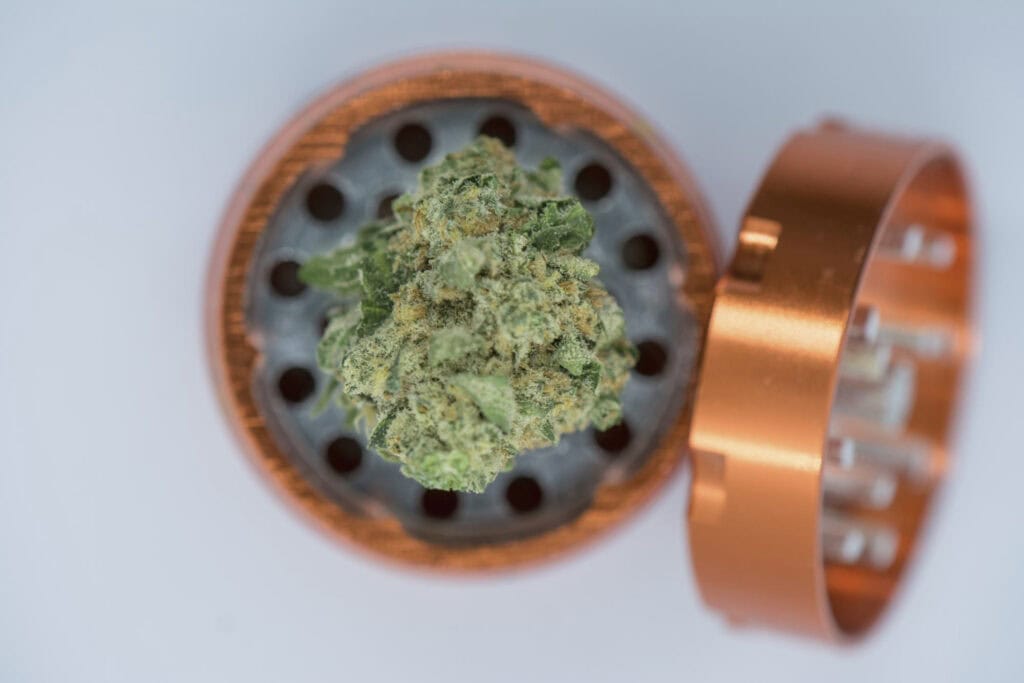
- Open the lid and place the flower between the teeth, around the outer part of the grinding chamber. Avoid the centre, where the magnet or pivot sits.
- Break large flowers into smaller pieces first, so that they fit between the teeth and do not jam.
- Put the lid back on and twist it back and forth ten to fifteen times. Keep the grinder upright so that the ground material falls through the holes.
- Tap gently on the side of the grinder to loosen anything stuck between the teeth.
- Unscrew the grinding chamber and take the ground material out of the collection chamber. It is ready to use.
For a finer grind, twist more times, and for a coarser grind, twist fewer. A fine grind often works well in a vaporiser, while a medium grind gives a joint that draws evenly without being packed too tightly.
What is kief?
Kief is the fine, yellow-green powder that collects in the bottom chamber of a four-piece grinder. It consists of trichomes that have come loose from the flowers during grinding. The trichomes are where the plant produces and stores its cannabinoids and terpenes, which is why kief is more concentrated than the flower itself.
Research on cannabis trichomes shows that their contents change as the flower matures, which is one reason why aroma and profile vary between harvests. Kief builds up slowly in a grinder over time, and many people sprinkle it over their flower or press it into hash. Read more about how hash is made in the article CBD hash: what it is, how it is made and how to choose.
Cleaning and care
Over time a sticky layer of resin builds up on the teeth and the screen, and the grinder gets harder to turn. A simple trick is to put the grinder in the freezer for a while. The resin becomes hard and brittle, and whatever is stuck is easier to brush away. Metal grinders can also be soaked in isopropyl alcohol for a thorough clean, while acrylic grinders should be cleaned with warm water and washing-up liquid, as alcohol can make the plastic crack.
You can find more in our guide How to clean a grinder and how often to do it.
How to choose the right grinder
Think about how and where you will use it. For use at home, a four-piece aluminium grinder of 50 to 60 millimetres is a good choice, as it holds a sensible amount and collects kief. For your pocket or bag, a smaller two-piece grinder in plastic or acrylic works well. Choose a model with a magnetic lid, so it stays closed when you carry it, and with threads that are easy to unscrew.
Further down the page you can see the grinders we have in stock right now. The range is updated regularly, and all models are gathered in the category grinders and mixing trays.
What is a grinder?
A grinder is a small mill with teeth that are twisted against each other to break flowers down to an even consistency. The most common models have two, three or four pieces.
What is the difference between a two-piece and a four-piece grinder?
A two-piece grinder has only a lid and a grinding chamber. A four-piece grinder also has a collection chamber and a screen that sifts kief into a separate chamber at the bottom.
What is kief?
Kief is loose trichomes, the tiny hair-like outgrowths on the surface of the flower where cannabinoids and terpenes are produced. It collects in the bottom chamber of a four-piece grinder.
How do you clean a grinder?
Put it in the freezer so that the resin hardens, then brush away the residue. Metal grinders can be soaked in isopropyl alcohol, while acrylic grinders should be cleaned with warm water and washing-up liquid.
What is the best material for a grinder?
Anodised aluminium is the most common choice for good-quality grinders because it is light, durable and has sharp teeth that last.
Sources
- Livingston, S. J. et al. (2020). Cannabis glandular trichomes alter morphology and metabolite content during flower maturation. The Plant Journal, 101(1), 37–56.
- Tanney, C. A. S. et al. (2021). Cannabis Glandular Trichomes: A Cellular Metabolite Factory. Frontiers in Plant Science, 12, 721986.