A warming liniment and a cooling liniment are usually seen as two different products. You reach for one when your muscles feel stiff and the other when they feel tired and hot after a hard session. But many modern liniments do both: first comes the cool, then a gentle warmth. How does that work, what actually happens in the skin, and where does CBD fit into a CBD muscle rub? Here we look at what the research says about the ingredients, without promising more than it shows.
This article is for information only. Our Muscle & Joint Cream is a cosmetic product, not a medicine, and it is not intended to diagnose, treat or prevent any disease. If you have pain that does not go away, or a fresh injury, talk to a doctor or another healthcare professional.
At a glance
- The cooling and warming feeling of a liniment mainly comes from temperature receptors in the skin, not from the skin actually getting colder or warmer.
- Menthol activates the cold receptor TRPM8. Camphor and methyl salicylate give a warming feeling instead.
- A liniment that combines both usually feels cool first and warm after a while, once the massage and the ingredients have had time to work.
- The skin has its own endocannabinoid system, and topical CBD is being studied, but the research is still at an early stage.
- Our Muscle & Joint Cream is a CBD muscle rub with 250 mg of CBD and seven active ingredients that both cool and warm.
Heat or cold: why both?
Cold and heat have been used for tired and sore muscles for centuries, and they work in different ways. A 2015 review in Postgraduate Medicine describes how cold, such as ice, lowers tissue temperature and reduces local blood flow. Heat does the opposite: blood flow increases and the tissue becomes softer and more flexible. That is why cold is often used straight after hard exertion, while heat is more common when muscles feel stiff.
A liniment is still something different from an ice pack or a heating pad. The ingredients in a liniment do not change the temperature of your muscles in the same way. What you feel is mainly a response in the nerve endings of the skin. The combination gives you both the fresh cool and the soothing warmth in one product, which is a big part of why liniments have stayed popular for so long. If you want to read more about liniments in general, their history and what to keep in mind, we have a separate guide on liniment.
How the ingredients create cool and warmth
The cool: menthol
Menthol comes from peppermint and gives the classic cooling feeling. In 2002, researchers showed in the journal Nature that menthol activates TRPM8, a receptor in the nerve endings that otherwise responds to cold. The brain reads the signal as cold, even though the skin does not get colder. The discovery of the body’s temperature receptors was later awarded the 2021 Nobel Prize in Physiology or Medicine.
The warmth: camphor and methyl salicylate
Camphor gives a feeling of both warmth and cool. Studies in cells and mice have shown that camphor acts on heat-sensitive receptors in the skin, including TRPV3 and TRPV1. Methyl salicylate, the main component of wintergreen oil, gives many liniments their typical scent. It belongs to a group of substances called rubefacients, because they can make the skin slightly red and warm.
How much methyl salicylate does beyond the sensation is less certain. A 2014 Cochrane review looked at the studies on salicylate creams and judged the evidence to be limited and of low quality. It is a good reminder that a liniment is first and foremost about sensation and wellbeing, not about curing anything.
Why the cool comes first
When a liniment contains both menthol and warming ingredients, the cool is usually felt first. Menthol acts quickly on the cold receptors. The warmth builds up over a longer time, as you massage the product in and blood flow in the skin increases. The result is a shift from cool to warm that many people enjoy.
Arnica, devil’s claw and L-glutamine

Many liniments also contain plant extracts that do not give any cooling or warming feeling but have a long tradition in products for muscles and joints. Arnica is a yellow flower from the mountains of Europe that has long been used externally, and the European Medicines Agency (EMA) has its own monograph on arnica flower for external use. Devil’s claw is a plant from southern Africa, and L-glutamine is an amino acid found naturally in the body.
Where does CBD come in?
CBD, or cannabidiol, is one of the most studied cannabinoids in hemp. The skin has its own endocannabinoid system, with receptors and signalling molecules found in skin cells, hair follicles and sebaceous glands, among other places. A 2019 review in the journal Molecules describes how the system is involved in the balance of the skin, which is one of the reasons why interest in CBD in skin products has grown.
Research on topical CBD is still young. Animal studies, such as a 2016 study in rats where CBD was applied as a gel on the skin, have produced interesting results, and there are a few small studies in humans. But more and larger studies are needed before firm conclusions can be drawn. Cannabis research also has the theory of the entourage effect, the idea that the plant’s different compounds may work together. It is still a theory, but it is one of the reasons why CBD is often combined with other plant-based ingredients.
Liniment as part of your recovery
Muscle soreness usually appears one to two days after a workout, especially after unfamiliar training or exercises where the muscles brake a movement, such as running downhill or lowering a heavy weight. According to a review in Sports Medicine, this kind of soreness goes away on its own within a few days, and massage is among the methods that can make the muscles feel better in the meantime.
That is where a liniment fits in. You massage your muscles, get a clear feeling of cool and warmth, and take a moment for recovery. Many people use a liniment in the evening after training, before a session when the body feels stiff, or after a long day at the desk. If you want to know more about the research on recovery, you can read our article on CBD and training.
Muscle & Joint Cream: our warming and cooling liniment
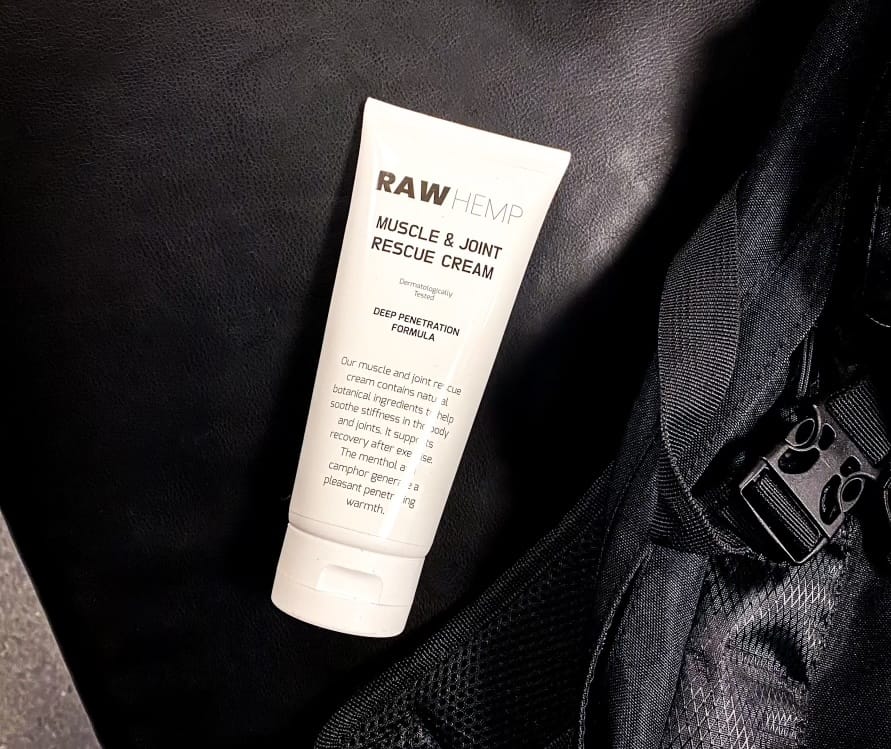
We wanted the best of the classic liniment in a cream that is pleasant to use, and the result is our Muscle & Joint Cream. It contains seven active ingredients: CBD, arnica, devil’s claw, L-glutamine, wintergreen oil, menthol and camphor. Each 200 ml tube contains 250 mg of CBD.
When you massage the cream in, it first feels cool, and after a while the cool turns into a pleasant warmth. It absorbs quickly and is not sticky. The cream is vegan, formulated in Sweden and made by a GMP-certified manufacturer in Europe. It is also dermatologically tested.
One of the people who uses the cream the most is MMA fighter Pannie Kianzad, who has fought several times in the UFC and is a Raw Hemp ambassador. When the body is trained hard every week, recovery is a big part of training, and the cream is part of her routine. You can find the full range among our CBD liniments and muscle rubs.
Tips for using a liniment
- Massage a thin layer into clean, dry skin. It is the massage together with the ingredients that creates the feeling.
- Wash your hands afterwards and avoid the eyes and mucous membranes.
- Do not use a liniment on wounds, grazes or irritated skin.
- Do not put a heating pad or tight bandage on top. A liniment should feel warm or cool, never painful.
- Liniments with methyl salicylate and camphor are not for children. If you take blood thinners or are sensitive to salicylates, talk to a doctor or pharmacist first.
If you get redness, itching or a burning feeling that does not go away, stop using the product. You will find more advice on safe use in our guide on liniment.
Why does a liniment feel cold first and then warm?
Menthol activates the cold receptor TRPM8 in the skin and gives a cool feeling almost straight away. Warming ingredients such as camphor and methyl salicylate take longer to notice, and the warmth builds up while you massage the product in.
Should I choose a warming or a cooling liniment?
It mostly depends on what feels good to you. Many people prefer warmth when their muscles feel stiff and cool after a hard session. A liniment that combines both gives you both feelings in one product.
Does a warming liniment make the muscles warmer?
Not in the same way as a heating pad. The feeling of warmth mainly comes from receptors in the skin. Some ingredients can increase blood flow in the skin and cause a slight redness.
What does CBD do in a muscle rub?
The skin has its own endocannabinoid system and topical CBD is being studied, but the research is still at an early stage. In a CBD muscle rub, CBD is combined with ingredients such as menthol and camphor, which create the cooling and warming feeling.
Can I use a liniment before training?
Yes, many people use a liniment before a session when the body feels stiff, as part of their warm-up. A liniment does not replace a proper warm-up.
Sources
- Malanga, G. A., Yan, N. and Stark, J. (2015). Mechanisms and efficacy of heat and cold therapies for musculoskeletal injury. Postgraduate Medicine, 127, 57–65.
- McKemy, D. D., Neuhausser, W. M. and Julius, D. (2002). Identification of a cold receptor reveals a general role for TRP channels in thermosensation. Nature, 416, 52–58.
- The Nobel Foundation (2021). The Nobel Prize in Physiology or Medicine 2021.
- Moqrich, A. et al. (2005). Impaired thermosensation in mice lacking TRPV3, a heat and camphor sensor in the skin. Science, 307, 1468–1472.
- Xu, H., Blair, N. T. and Clapham, D. E. (2005). Camphor activates and strongly desensitizes the transient receptor potential vanilloid subtype 1 channel in a vanilloid-independent mechanism. Journal of Neuroscience, 25, 8924–8937.
- Derry, S. et al. (2014). Salicylate-containing rubefacients for acute and chronic musculoskeletal pain in adults. Cochrane Database of Systematic Reviews.
- European Medicines Agency (2014). Community herbal monograph on Arnica montana L., flos.
- Tóth, K. F. et al. (2019). Cannabinoid signaling in the skin: therapeutic potential of the “C(ut)annabinoid” system. Molecules, 24, 918.
- Hammell, D. C. et al. (2016). Transdermal cannabidiol reduces inflammation and pain-related behaviours in a rat model of arthritis. European Journal of Pain, 20, 936–948.
- Cheung, K., Hume, P. and Maxwell, L. (2003). Delayed onset muscle soreness: treatment strategies and performance factors. Sports Medicine, 33, 145–164.