More and more people who train are using CBD, and the most common reason is recovery. The question is how much evidence there is behind it. Here we go through the studies on CBD and exercise, what applies if you compete under anti-doping rules, and what sets CBD oil, liniment and isolate apart.
Key facts
- In a study of 517 professional rugby players, 26 percent had used CBD, most often for recovery and sleep.
- Studies on CBD and recovery after strength training show mixed results. Some have found small effects on muscle damage markers, others no difference at all.
- CBD appears neither to improve nor to impair endurance performance.
- CBD has been permitted by WADA since 2018, but all other cannabinoids such as THC, CBG and CBN are prohibited in competition.
- Athletes who are drug tested should choose CBD isolate and check the lab report, while recreational exercisers can choose broad-spectrum products.
Why are athletes interested in CBD?
Hard training breaks down muscle tissue, and it is during the rest afterwards that the body rebuilds itself stronger. That is why many people look for ways to support recovery, and CBD has become one of the most popular supplements. A survey of 517 British professional rugby players found that 26 percent had used CBD. Among players over 28, the figure was 39 percent.
The most common reasons were recovery and pain after matches (80 percent) and better sleep (78 percent). Two thirds of users felt they got some benefit from CBD, and the clearest perceived effect was on sleep. The interest is linked to the body’s endocannabinoid system, which is involved in pain signalling, inflammation, stress and sleep, among other things. Read more in our article
The Endocannabinoid System (ECS).
What does the research say about CBD and recovery?
Research on CBD and exercise is still young, but since 2020 several controlled studies have been carried out on well-trained people. The results do not all point the same way.
The German Sport University Cologne gave well-trained participants CBD or placebo after a heavy squat session. After 72 hours, the CBD group had recovered slightly more of their squat strength and had somewhat lower levels of creatine kinase and myoglobin, two markers of muscle damage. The effects were small. When the same research group gave 17 athletes 60 mg of CBD after every session during six days of hard training in 2024, some participants had lower myoglobin, but there was no difference in performance or inflammation.
Other studies have found no effect at all. When 13 untrained men took 150 mg of CBD oil after eccentric arm training, neither muscle soreness nor strength loss was lower than with placebo. In a study of 24 well-trained female college athletes, CBD did not reduce inflammation, fatigue or loss of performance after heavy leg training either.
Taken together, it is not possible to say that CBD speeds up recovery. There may be small effects that the studies so far have been too small to detect, and the doses, products and types of training have varied widely.
Does CBD affect performance?
A common worry is that CBD will make you tired or sluggish before a session. Researchers at the University of Sydney have looked at this in runners. In a first pilot study, nine runners took 300 mg of CBD before an hour of running and found the run slightly more pleasant, without their performance being affected.
In a larger follow-up from 2025, 25 trained runners received 50 mg, 300 mg or placebo before running on a treadmill. Neither dose changed how hard or enjoyable the session felt, how long they could keep running or their heart rate. The researchers concluded that low to moderate doses of CBD neither improve nor impair performance.
CBD cream and liniment for muscles
Many people prefer to apply CBD directly to the skin over the muscles they have worked. There is still only a small amount of research on this. In a pilot study from 2026, 15 active students rubbed CBD gel or placebo into their thigh muscles after a hard jumping session. The CBD gel did not affect muscle soreness or dynamic strength, but participants regained their static strength slightly better than with placebo.
A liniment often contains more active ingredients than CBD. Our CBD liniment Muscle & Joint Cream combines CBD with menthol and camphor, among other things, which give a cooling and warming sensation on the skin. Many people use it after training or as part of their warm-up. We explain how the cooling and warming work together in the article
Sleep, stress and recovery
Sleep is one of the most important parts of recovery, and it was here that the rugby players felt CBD helped most. A 2020 review of the research on CBD and sport concluded that CBD appears to have a calming effect in stressful situations, but that strong evidence that CBD improves sleep is lacking.
Interest in the cannabinoid CBN and sleep has also grown. You can read what the latest studies show in
Research 2025: CBN May Support Calmer Nights and Fewer Nighttime Awakenings.
Is CBD a banned substance?
No, CBD itself is not a banned substance. The World Anti-Doping Agency (WADA) removed CBD from its prohibited list in 2018, and national agencies such as Antidoping Sverige confirm that cannabidiol is permitted. The exemption applies only to CBD, however. All other cannabinoids, such as THC, CBG, CBN and CBC, are still prohibited in competition. THC has a threshold of 150 ng/ml in urine, while the other cannabinoids have no threshold at all.
This means that a broad-spectrum oil, which contains several cannabinoids, can lead to a positive doping test even if it is completely THC-free. According to the US Anti-Doping Agency (USADA), it is also common for CBD products on the market not to contain what the label says. The athlete is always responsible for what is in their body.
If you compete in a sport with doping controls, you should therefore choose pure CBD isolate and always check the product’s lab report. Raw Hemp’s products are analysed by the independent laboratory Pharma Labs, and the analysis shows which cannabinoids the product contains. Here is how to read such a report:
How to read a CBD lab report (COA), step by step.
Isolate or broad spectrum?
If you train without being drug tested, things look different. Then there are good reasons to choose a broad-spectrum oil. According to the theory of the entourage effect, cannabinoids such as CBD, CBG and CBC work together with the plant’s terpenes and flavonoids and enhance each other’s effects, so that the whole does more than a single isolated compound. That is why our CBD oils contain a broad spectrum of cannabinoids and terpenes, not just CBD.
In short: if you compete under anti-doping rules, choose isolate, and if you train for yourself, a broad-spectrum oil is a good choice. We compare the two in more detail in
CBD Isolate vs. Distillate: Which one should you actually choose?
CBD oil, liniment and isolate: the differences
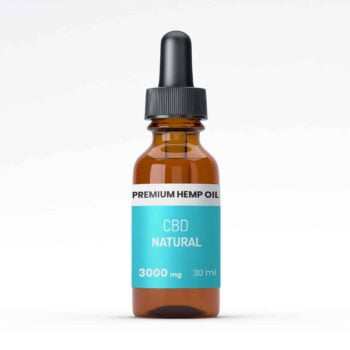
- CBD oil is a hemp extract in a carrier oil. Our oils are broad spectrum and contain several cannabinoids and terpenes in addition to CBD.
- Liniment is a cream that is massaged into the skin over muscles and joints, often with cooling and warming ingredients.
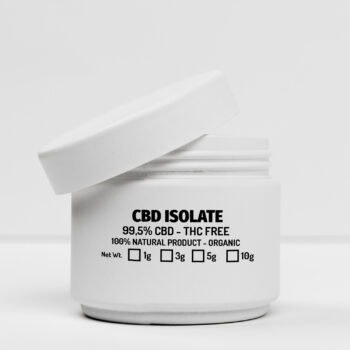
- CBD isolate is pure CBD without other cannabinoids, which makes it the obvious choice for anyone who is drug tested.
How much CBD the body absorbs varies a lot between product forms. You can read what the research says about this in
CBD Bioavailability: Why How You Take It Matters.
CBD is generally well tolerated, but it can affect how the body breaks down certain medicines. Anyone taking medication should therefore consult their doctor. CBD products are not recommended during pregnancy or breastfeeding.
Further down the page you will find our CBD oil, our liniment and our CBD isolate.
Is CBD a banned substance in sport?
No. WADA removed CBD from its prohibited list in 2018. Other cannabinoids such as THC, CBG and CBN are, however, prohibited in competition, so athletes who are tested should choose pure CBD isolate and check the lab report.
Does CBD help with muscle soreness?
The research is not conclusive. Some studies have found small effects on muscle damage markers and strength in the days after heavy training, while others have found no difference compared with placebo.
What is the difference between CBD oil, liniment and isolate?
CBD oil is a broad-spectrum hemp extract in a carrier oil, liniment is a cream for the skin over muscles and joints, and isolate is pure CBD without other cannabinoids.
Does CBD affect performance?
Studies on runners suggest that low to moderate doses of CBD neither improve nor impair performance.
Can you use CBD cream after training?
Yes. CBD creams and liniments are massaged into the skin over the muscles you have trained. Our liniment also contains menthol and camphor, which give a cooling and warming sensation.
Sources
- Kasper, A. M. et al. (2020). High Prevalence of Cannabidiol Use Within Male Professional Rugby Union and League Players: A Quest for Pain Relief and Enhanced Recovery. International Journal of Sport Nutrition and Exercise Metabolism, 30(5), 315–322.
- Isenmann, E. et al. (2021). Effects of Cannabidiol Supplementation on Skeletal Muscle Regeneration after Intensive Resistance Training. Nutrients, 13(9), 3028.
- Isenmann, E. et al. (2024). Influence of short-term chronic oral cannabidiol application on muscle recovery and performance after an intensive training protocol. Journal of the International Society of Sports Nutrition, 21(1), 2337252.
- Cochrane-Snyman, K. C. et al. (2021). The Effects of Cannabidiol Oil on Noninvasive Measures of Muscle Damage in Men. Medicine & Science in Sports & Exercise, 53(7), 1460–1472.
- Crossland, B. W. et al. (2022). Acute Supplementation with Cannabidiol Does Not Attenuate Inflammation or Improve Measures of Performance following Strenuous Exercise. Healthcare, 10(6), 1133.
- Sahinovic, A. et al. (2022). Effects of Cannabidiol on Exercise Physiology and Bioenergetics: A Randomised Controlled Pilot Trial. Sports Medicine – Open, 8, 27.
- Sahinovic, A. et al. (2025). The Acute Effects of Cannabidiol on Physiological and Subjective Responses to Endurance Exercise: A Dose-Ranging Randomised Controlled Crossover Trial. Sports Medicine – Open, 11, 96.
- Mendes, A. et al. (2026). Topical application of cannabidiol for muscle recovery after exercise-induced muscle damage: a randomized, double-blinded pilot study. Journal of Cannabis Research, 8, 63.
- McCartney, D. et al. (2020). Cannabidiol and Sports Performance: a Narrative Review of Relevant Evidence and Recommendations for Future Research. Sports Medicine – Open, 6, 27.
- Antidoping Sverige. S8. Cannabinoider.
- USADA. Athletes: 6 Things to Know About Cannabidiol.