Liniment is one of the oldest ways of caring for tired muscles and stiff joints. You massage it into the skin, feel it cool first and then warm, and for many people it is a natural part of recovery after training or a long day. But what exactly is liniment, what happens in the skin when you use it and what does research say about the ingredients? We also go through the pitfalls few people know about, and explain why we developed our own muscle and joint cream as a modern liniment.
This article is for information only and describes liniment and what research says about common ingredients. Our Muscle & Joint Cream is a cosmetic product, not a medicine. It is not intended to diagnose, treat or prevent any disease. If you have pain that does not go away, or an injury, talk to a doctor or other healthcare professional.
Key facts
- Liniment is a rub that is massaged into the skin, often with cooling or warming ingredients such as menthol, camphor and methyl salicylate.
- The feeling of cold and warmth comes from receptors in the skin that react to the ingredients, a discovery that was awarded the Nobel Prize in 2021.
- There are studies on ingredients such as menthol, arnica and CBD, but most are small and more research is needed.
- Methyl salicylate and camphor can be dangerous if swallowed, and methyl salicylate can affect blood-thinning medicines.
- Our Muscle & Joint Cream is a modern liniment with seven active ingredients, including CBD, arnica and menthol.
What is liniment?
The word liniment comes from the Latin linere, meaning to smear or anoint. A liniment is something you rub into the skin, and what sets it apart from an ordinary skin cream is its purpose. A skin cream is mainly meant to moisturise and care for the skin, while a liniment is made to be massaged in over muscles and joints and give a clear feeling of cold or warmth.
In the past, liniments were usually thin and liquid, often based on alcohol or oil. Today the word is used more broadly, and liniments come as liquids, gels, balms and creams. Many people know the word from the stable, as liniment has long been used on horses. In France, liniment usually means something entirely different, namely liniment oléo-calcaire, a mix of oil and limewater used when changing nappies.
The history of liniment
Liniments have been used for centuries, but in the 19th century they became really big. In the US, a range of so-called patent medicines were sold as liniments, and several of them started out as remedies for horses before being marketed to people. Sloan’s Liniment, which contained chilli pepper among other things, is one of the best-known examples.
Not all liniments of the time were harmless. A.B.C. Liniment, sold in Britain until the 1930s, contained aconite, belladonna and chloroform and caused several poisonings. This history shows why it matters to know what a liniment contains, something that still applies today.
How does liniment work?
Most of what you feel when you use a liniment comes from nerve endings in the skin. Menthol activates the cold receptor TRPM8, the same receptor that reacts when you are cold. That is why menthol feels cold even though the temperature of the skin does not drop. The discovery of the body’s temperature receptors was awarded the Nobel Prize in Physiology or Medicine in 2021. Ingredients such as camphor and methyl salicylate instead give a warming feeling and can make the skin slightly red.
A common explanation for why cold, warmth and massage can feel good on sore muscles is the gate control theory, put forward by Ronald Melzack and Patrick Wall in 1965. According to the theory, signals from touch and temperature can affect how strongly other signals from the same area are perceived, much like when you instinctively rub a spot you have bumped. The massage itself when you rub in the liniment is therefore part of the experience.
Common ingredients and what research says
Liniments can contain very different things. Here are the most common ingredients and what studies show. Keep in mind that the research concerns individual ingredients and preparations, not a specific product.
Menthol
Menthol provides the characteristic cooling. In a small study from 2012, 16 people were given muscle soreness in the arm and then treated with either a gel containing 3.5 percent menthol or ice. Participants who received menthol felt less discomfort than those who received ice.
Arnica
Arnica is a yellow flower from the European mountains that has long been used externally for bruises and sprains. The European Medicines Agency (EMA) classifies arnica flower as a traditional herbal medicine for external use, based on long-standing use. In a study of 204 people with osteoarthritis of the hands, an arnica gel worked as well as an ibuprofen gel after three weeks. Another small study from 2022 of ten trained men found that a mud pack with menthol and arnica led to less muscle soreness and faster recovery of strength after heavy leg training, compared with placebo.
Camphor
Camphor has been used in liniments and balms for hundreds of years and gives a feeling of both warmth and cold. Camphor is used on the skin but is poisonous if swallowed, especially for small children.
Methyl salicylate and wintergreen oil
Methyl salicylate is the main component of wintergreen oil and is chemically related to acetylsalicylic acid, the active substance in Aspirin. It gives a warming feeling and the typical scent many people associate with liniment. The substance is partly absorbed through the skin, which is the background to some of the pitfalls further down.
CBD
CBD, or cannabidiol, is one of the most studied cannabinoids in hemp. In a randomised study from 2022, 18 people with osteoarthritis at the base of the thumb used a cream with CBD or a cream without CBD for two weeks each. During the CBD period, participants reported less pain and better hand function, and no side effects were seen. The study is small, and more and larger studies are needed.
In cannabis research there is talk of the entourage effect, the idea that the plant’s different compounds can reinforce each other and work better together than on their own. For products used on the skin this is still little studied, but it is one of the reasons many modern liniments combine CBD with several other plant-based ingredients.
Pitfalls: what you should know
Liniment feels like a harmless everyday product, and for the vast majority of people it is. But some of the most common ingredients are strong substances, and there are things few people know about.
- Never swallow liniment. Methyl salicylate and camphor are poisonous if swallowed, and even small amounts can cause serious poisoning in children. Always keep liniment out of reach of children.
- Not for small children. In the EU, cosmetic products for children under six may not contain methyl salicylate, with toothpaste as the only exception. The EMA does not recommend arnica for children under twelve.
- Blood-thinning medicines. Methyl salicylate can be absorbed through the skin and increase the effect of blood thinners such as warfarin. There are cases where values rose sharply after daily use of a gel with methyl salicylate. If you take blood thinners, talk to a doctor or pharmacist first.
- Allergy. If you are sensitive to salicylates, such as acetylsalicylic acid, or to plants in the daisy family, which arnica belongs to, you should avoid products with these ingredients.
- Not on damaged skin. Do not use liniment on wounds, grazes or irritated skin, and avoid the eyes and mucous membranes. Wash your hands afterwards.
- No extra heat on top. Do not put a heating pad or tight bandage on top. The US Food and Drug Administration (FDA) has warned of rare cases of burns from muscle and joint products with menthol and methyl salicylate. A liniment should feel warm or cold, never painful.
- Horse liniment is for horses. Liniments for animals can contain other substances and higher concentrations than products for people, and should not be used on yourself.
If you get redness, itching, blisters or a burning feeling that does not go away, stop using the product. And if you have pain that does not get better, or swelling after an injury, seek medical care rather than just rubbing something in.
Liniment, Tiger Balm or a pain-relief gel?
Tiger Balm is one of the world’s best-known balms and contains mainly camphor and menthol together with essential oils such as cajuput and clove oil. It is a strong and concentrated balm.
Pain-relief gels from the pharmacy, for example with diclofenac or ibuprofen, are something else. They are approved medicines with an active substance that is absorbed into the tissue and affects inflammation. Cosmetic muscle and joint creams are not medicines. Under the EU Cosmetics Regulation, a cosmetic product is mainly meant to clean, perfume, protect or keep the body in good condition. That is why we describe our cream by how it feels and how it is used, not as a remedy for pain or disease.
Our Muscle & Joint Cream: a modern liniment

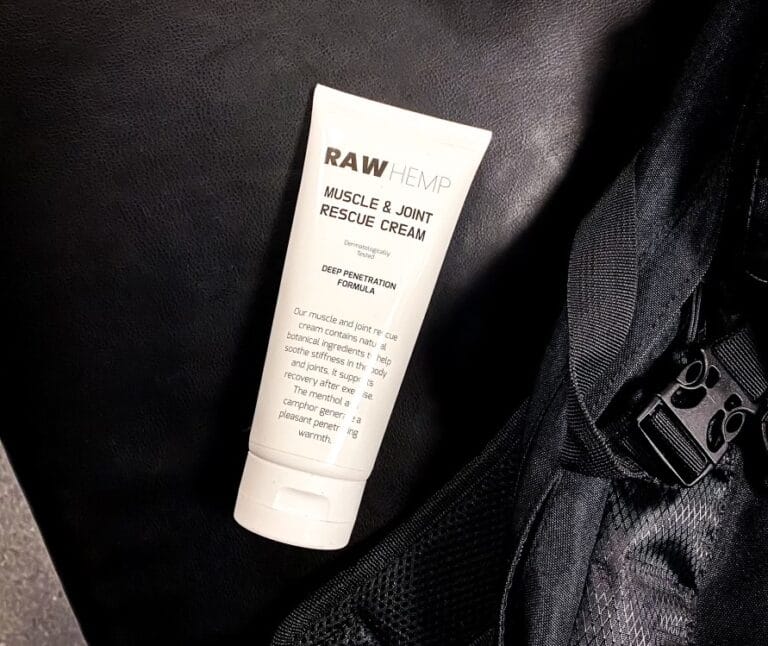
We developed Muscle & Joint Cream to bring the best of the classic liniment into a cream that is pleasant to use. It contains seven active ingredients: CBD, arnica, devil’s claw, L-glutamine, wintergreen oil, menthol and camphor. Each 200 ml pack contains 250 mg CBD.
Just like a liniment, the cream first gives a cooling feeling as you massage it in, which then turns into a pleasant warmth. It absorbs quickly, is not sticky and is moisturising. Many people use it as part of their recovery, before or after training or in the evening when their muscles feel tired.
One of the people who uses the cream the most is MMA fighter Pannie Kianzad, who has had several fights in the UFC and is a Raw Hemp ambassador. In a sport where the body takes heavy strain every week, recovery is a big part of training, and the cream is part of her routine.
As the cream contains wintergreen oil, camphor and arnica, the same advice applies as for other liniments: do not use it on children or on damaged skin, and talk to a doctor if you take blood-thinning medicines. If you want to read more about how CBD and traditional ingredients are combined, read our article on CBD liniment that warms and cools, or see our full range of CBD liniments and muscle rubs.
What is liniment?
Liniment is a rub that is massaged into the skin over muscles and joints. It often contains ingredients that give a cooling or warming feeling, such as menthol, camphor and methyl salicylate. The word comes from the Latin linere, meaning to smear or anoint.
Why does liniment feel cold first and then warm?
Menthol activates the cold receptor TRPM8 in the skin and gives a cooling feeling, while ingredients such as camphor and methyl salicylate give a warming feeling. When both are in the same product, the cold is often felt first and the warmth after a while.
Is liniment dangerous?
Used on the skin as directed, liniment is safe for most adults. But ingredients such as methyl salicylate and camphor are poisonous if swallowed, methyl salicylate can affect blood-thinning medicines, and liniment should not be used on small children or on damaged skin.
Can you use horse liniment on yourself?
No. Liniments for horses are made for animals and can contain other substances and higher concentrations than products for people. Use products intended for people.
Sources
- Online Etymology Dictionary. Liniment.
- Wikipedia. Liniment.
- Melzack, R. and Wall, P. D. (1965). Pain mechanisms: a new theory. Science, 150, 971–979.
- McKemy, D. D., Neuhausser, W. M. and Julius, D. (2002). Identification of a cold receptor reveals a general role for TRP channels in thermosensation. Nature, 416, 52–58.
- The Nobel Foundation (2021). The Nobel Prize in Physiology or Medicine 2021.
- Johar, P. et al. (2012). A comparison of topical menthol to ice on pain, evoked tetanic and voluntary force during delayed onset muscle soreness. International Journal of Sports Physical Therapy, 7, 314–322.
- European Medicines Agency (2014). Community herbal monograph on Arnica montana L., flos.
- Widrig, R. et al. (2007). Choosing between NSAID and arnica for topical treatment of hand osteoarthritis in a randomised, double-blind study. Rheumatology International, 27, 585–591.
- Bartolomei, S. et al. (2022). Mud Pack With Menthol and Arnica Montana Accelerates Recovery Following a High-Volume Resistance Training Session for Lower Body in Trained Men. Journal of Strength and Conditioning Research, 36, 1909–1915.
- Heineman, J. T. et al. (2022). A Randomized Controlled Trial of Topical Cannabidiol for the Treatment of Thumb Basal Joint Arthritis. Journal of Hand Surgery, 47, 611–620.
- Chan, T. Y. (1996). Potential dangers from topical preparations containing methyl salicylate. Human & Experimental Toxicology, 15, 747–750.
- Joss, J. D. and LeBlond, R. F. (2000). Potentiation of warfarin anticoagulation associated with topical methyl salicylate. Annals of Pharmacotherapy, 34, 729–733.
- Manoguerra, A. S. et al. (2006). Camphor Poisoning: an evidence-based practice guideline for out-of-hospital management. Clinical Toxicology, 44, 357–370.
- Medscape (2012). FDA Warns of Burns From Topical Pain Relievers.
- European Commission (2022). Commission Regulation (EU) 2022/1531 amending the Cosmetics Regulation, including on methyl salicylate.
- European Parliament and Council (2009). Regulation (EC) No 1223/2009 on cosmetic products.