

Functional mushrooms is an umbrella term for mushrooms that people have used for more than food. Lion’s Mane, chaga, reishi and cordyceps are the best known, and today they are sold as powders, extracts and tinctures all over the world. But what kind of mushrooms are they, what do they contain and what does research actually know? Here is a factual guide, without the hype.
At a glance
- Functional mushrooms is not a scientific term but an umbrella name for mushrooms used for something other than their flavour.
- People have carried mushrooms for reasons other than food for more than 5,000 years. Ötzi the Iceman had two kinds of bracket fungi in his kit.
- The most studied compounds are beta-glucans, a type of polysaccharide, along with triterpenes and other compounds unique to each species.
- Most research has been done in laboratories and on animals. Studies in humans are few and often small.
- Products made from fruiting bodies differ from those made from mycelium, and the extraction method matters too.
What are functional mushrooms?
The word functional is used for foods thought to have a function beyond simply filling you up. For mushrooms, it refers to species with a long tradition in folk medicine, especially in Asia, Russia and the Nordic countries. They are sometimes also called medicinal mushrooms. Most of them are bracket fungi or other wood-dwelling fungi that are tough, bitter or woody, and so are not used as ordinary edible mushrooms. Instead, they are dried, ground and extracted.
Four species dominate the market, and they are also the four in our range:
| Mushroom | Latin name | Grows on | Known for |
|---|---|---|---|
| Lion’s Mane | Hericium erinaceus | Broadleaf trees, mainly beech and oak | Erinacines and hericenones |
| Chaga | Inonotus obliquus | Birch | Dark pigments and betulinic acid |
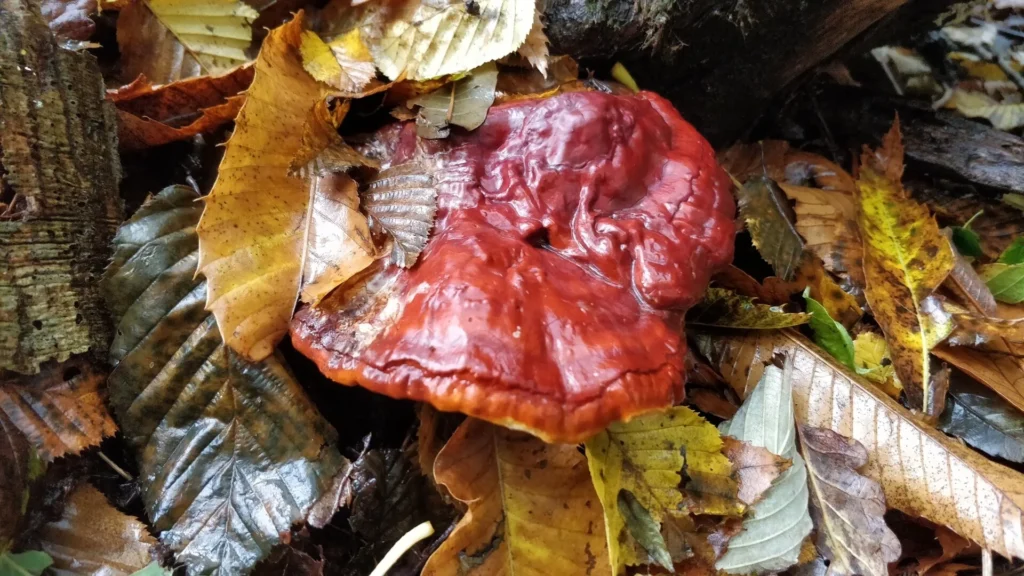
| Reishi | Ganoderma lucidum | Broadleaf trees and stumps | Bitter triterpenes |
| Cordyceps | Cordyceps militaris | Insect pupae, cultivated on substrate | Cordycepin |
A tradition thousands of years old
When Ötzi the Iceman was found in the Alps in 1991, he was carrying two kinds of fungi. One was tinder fungus, used to start fires. The other was birch polypore, threaded onto a leather strap. The researchers who examined the finds argued that the birch polypore was hardly meant as tinder and may have served another purpose for him. Ötzi lived just over 5,000 years ago.
In China, reishi, known there as lingzhi, has been depicted in art and writings for centuries as a symbol of long life. In Japan, Lion’s Mane is called yamabushitake, after the mountain monks whose robes the mushroom resembles. In Russia, Finland and the Baltic states, chaga has long been simmered into a dark drink, and cordyceps from Tibet has been one of the most expensive natural products in the world.
What do the mushrooms contain?
The compound most often highlighted is beta-glucan. Beta-glucans are long chains of glucose that make up the mushroom’s cell walls. A large review of polysaccharides from more than 650 mushroom species showed that most of the biologically active polysaccharides belong to this very group. Beta-glucans are found in many mushrooms, including ordinary edible ones, and are among the most studied compounds in the field.
Beyond beta-glucans, each species has its own compounds. Lion’s Mane contains erinacines and hericenones, reishi contains bitter triterpenes, chaga is rich in dark pigments and cordyceps contains cordycepin. These compounds are what make the species interesting to researchers, and what sets them apart from one another.
Fruiting body or mycelium?
What we usually call a mushroom is the fruiting body, the part that grows in order to spread spores. The rest of the fungus is the mycelium, a network of thin threads in the soil or in the wood. Both can be used in products, but they are not the same thing.
Mycelium is often grown on grain, such as rice or oats, and is sometimes sold together with it. In that case, part of the product may be starch from the grain rather than mushroom. Researchers have developed methods to tell beta-glucans apart from starch precisely because they are so easy to confuse. A good rule of thumb is therefore to check what a product is made from and how much beta-glucan it contains, if this is stated.
How mushroom extracts are made
Mushroom cell walls are made of chitin, the same tough material found in insect shells. That is why mushrooms are usually extracted rather than simply ground. There are two main methods, and they draw out different compounds:
- Hot water extraction. The mushroom is boiled or steeped in hot water. This dissolves the water-soluble polysaccharides, including the beta-glucans. The water is then evaporated, leaving a powder.
- Alcohol extraction. Alcohol dissolves compounds that do not dissolve in water, such as the triterpenes in reishi and chaga.
- Dual extraction. Many producers combine both methods to capture both the water-soluble and the alcohol-soluble compounds.
The result is sold either as a powder, where the extract has been dried, or as a tincture, where the extract is dissolved in a liquid. The powder is concentrated and often tastes earthy or bitter, while the tincture is ready to use.
What does the research say?
There are thousands of studies on functional mushrooms, but most have been carried out on cells or animals. Studies in humans are far fewer, often small and sometimes of varying quality. The results also differ between species:
- A Japanese study from 2009 gave 30 older people with mild cognitive impairment either Lion’s Mane or a placebo for 16 weeks. The group that received the mushroom scored better on a cognitive test, but the improvement disappeared once they stopped.
- A Cochrane systematic review from 2015 found no reliable evidence that reishi affects blood sugar, blood pressure or cholesterol.
- For cordyceps and physical performance, the results are mixed. One study saw improvements after three weeks, while another found no effect in well-trained cyclists.
The conclusion is that there is plenty of interest, but the research is not strong enough to say that the mushrooms have a particular effect. That is why our articles report what the studies actually show, both when the results are positive and when they are not.
Good to know
Quality. Check whether a product is made from fruiting bodies or mycelium, how it has been extracted and whether the beta-glucan content is stated.
Chaga and oxalate. Chaga contains a lot of oxalate. There is a published case report of kidney damage in a person who had taken large amounts of chaga powder for six months. That is a reason to be moderate.
Medication. If you take medication, are pregnant or have a medical condition, it is wise to talk to a healthcare professional before starting any food supplement.
If you want to learn more about each mushroom, we have in-depth articles on Lion’s Mane, chaga, reishi and cordyceps.
You will find our extracts and tinctures under functional mushrooms in our shop.
What are functional mushrooms?
It is an umbrella term for mushrooms used for something other than their flavour, such as Lion’s Mane, chaga, reishi and cordyceps. Most have a long tradition in folk medicine in Asia, Russia and the Nordic countries.
Which are the most common functional mushrooms?
Lion’s Mane, chaga, reishi and cordyceps are the four that dominate the market. Each species contains beta-glucans as well as its own compounds, such as erinacines in Lion’s Mane and triterpenes in reishi.
What is the difference between fruiting body and mycelium?
The fruiting body is the visible mushroom, while the mycelium is the network of threads beneath the surface. Mycelium is often grown on grain, in which case the product may contain starch. That is why it is worth checking what a product is made from.
How are mushroom extracts made?
The mushrooms are extracted in hot water, in alcohol or with both methods. Hot water dissolves polysaccharides such as beta-glucans, while alcohol dissolves compounds such as triterpenes.
What does research say about functional mushrooms?
Most studies have been done on cells and animals. Studies in humans are few and small, and the results vary between species. The research is not yet strong enough to say that the mushrooms have a particular effect.
Sources
- Peintner, U., Pöder, R. and Pümpel, T. (1998). The iceman’s fungi. Mycological Research, 102, 1153–1162.
- Wasser, S. P. (2002). Medicinal mushrooms as a source of antitumor and immunomodulating polysaccharides. Applied Microbiology and Biotechnology, 60, 258–274.
- McCleary, B. V. and Draga, A. (2016). Measurement of β-Glucan in Mushrooms and Mycelial Products. Journal of AOAC International, 99, 364–373.
- Mori, K. et al. (2009). Improving effects of the mushroom Yamabushitake (Hericium erinaceus) on mild cognitive impairment. Phytotherapy Research, 23, 367–372.
- Klupp, N. L. et al. (2015). Ganoderma lucidum mushroom for the treatment of cardiovascular risk factors. Cochrane Database of Systematic Reviews.
- Hirsch, K. R. et al. (2017). Cordyceps militaris Improves Tolerance to High-Intensity Exercise After Acute and Chronic Supplementation. Journal of Dietary Supplements, 14, 42–53.
- Parcell, A. C. et al. (2004). Cordyceps Sinensis (CordyMax Cs-4) Supplementation Does Not Improve Endurance Exercise Performance. International Journal of Sport Nutrition and Exercise Metabolism, 14, 236–242.
- Peng, H. and Shahidi, F. (2020). Bioactive compounds and bioactive properties of chaga (Inonotus obliquus) mushroom: a review. Journal of Food Bioactives, 12, 9–75.
- Olatunji, O. J. et al. (2018). The genus Cordyceps: An extensive review of its traditional uses, phytochemistry and pharmacology. Fitoterapia, 129, 293–316.
- Kikuchi, Y. et al. (2014). Chaga mushroom-induced oxalate nephropathy. Clinical Nephrology, 81, 440–444.


