

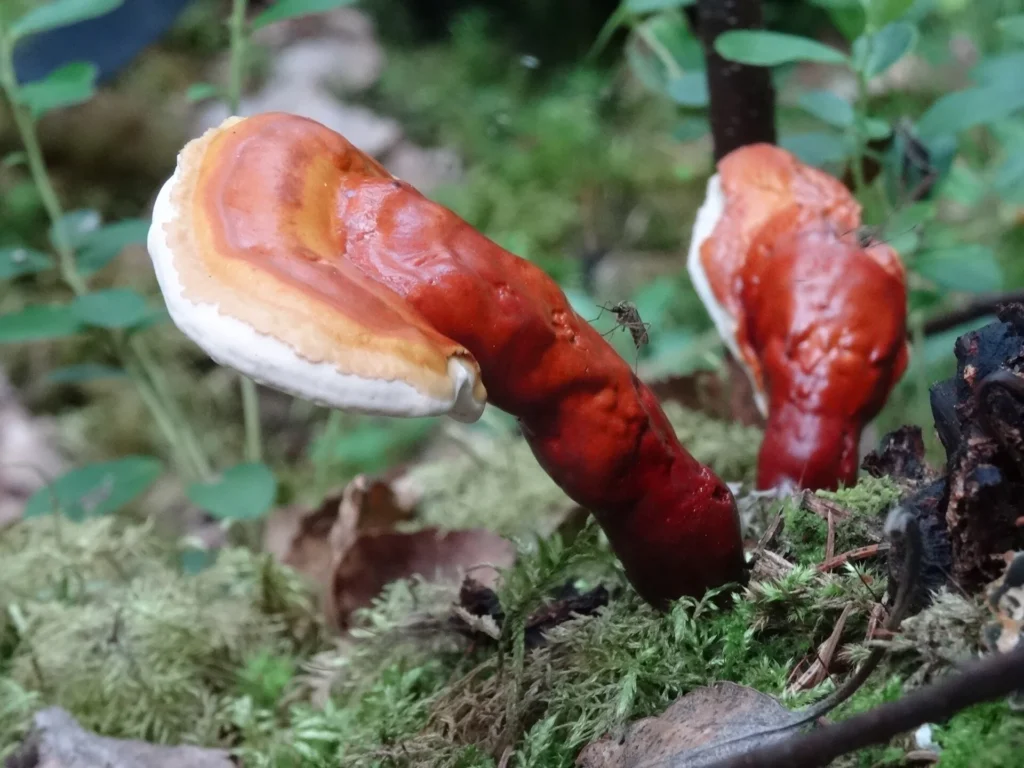
Reishi is the mushroom with the glossy, reddish-brown cap that looks as if it has been lacquered. In China it is called lingzhi and has for centuries been depicted as a symbol of long life. Today reishi is one of the best-selling functional mushrooms, often with big promises about stress and sleep. Here we go through what reishi is, what it contains and what studies in humans actually show.
At a glance
- Reishi is the Japanese name. In Chinese it is called lingzhi, and in Latin usually Ganoderma lucidum.
- According to DNA studies, the Asian lingzhi used in traditional medicine is a different species from the European Ganoderma lucidum.
- Reishi contains bitter triterpenes, including ganoderic acids, and polysaccharides such as beta-glucans.
- There are a number of studies in humans, but a 2025 review rated the quality of the evidence as very low.
- The mushroom is woody and bitter, so it is used as an extract, powder or tincture rather than as a culinary mushroom.
What is reishi?
Reishi is a bracket fungus, a wood-decaying mushroom that grows on dead or weakened broadleaf trees and stumps. It has a kidney-shaped to round cap with a shiny, lacquer-like surface in red and brown, often with a paler edge. The mushroom is hard and woody, so it is not eaten as an ordinary culinary mushroom.
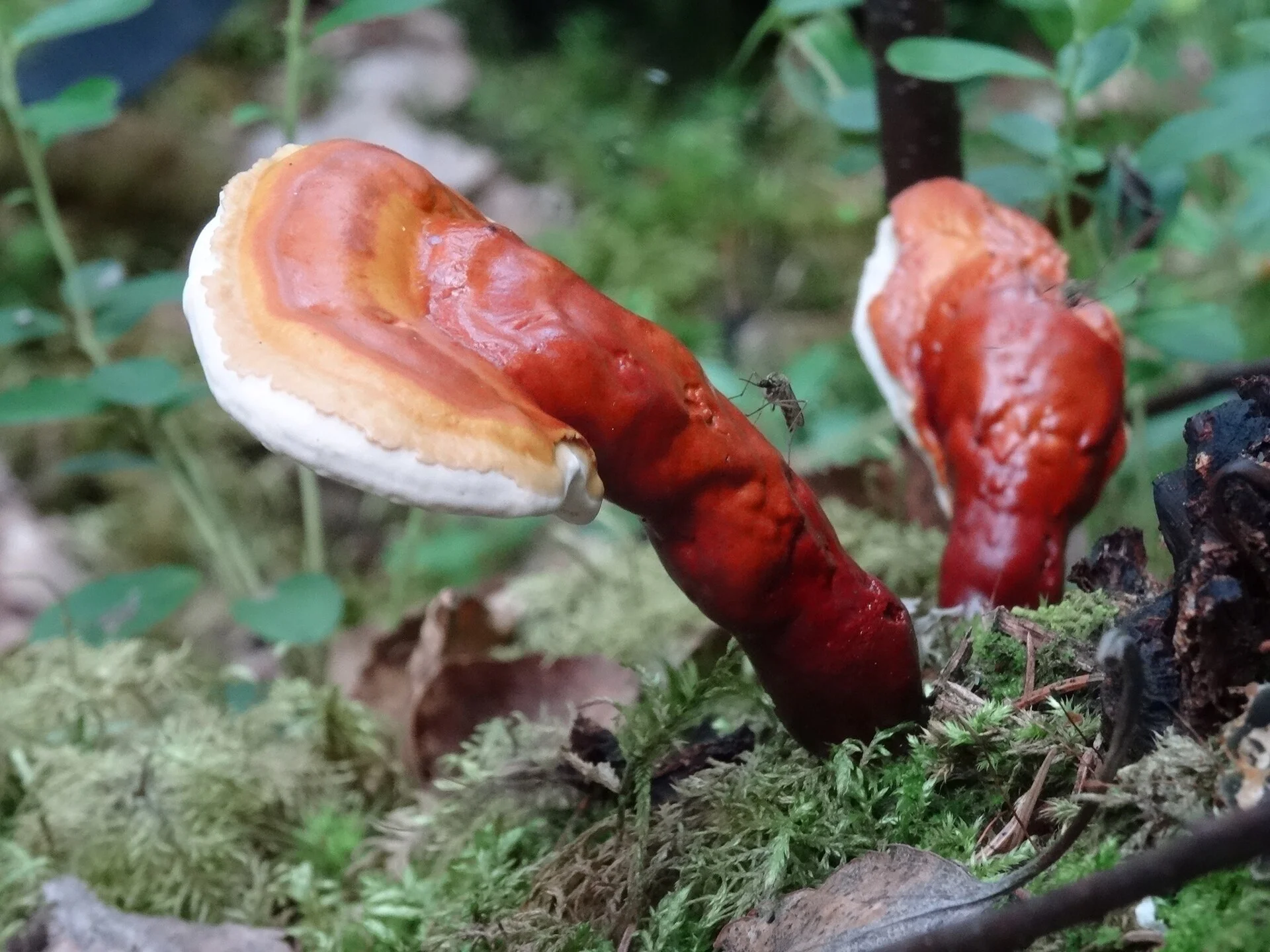
The names can be confusing. For a long time, Ganoderma lucidum was used as the name for both the European species and the Asian lingzhi. In 2012, researchers used DNA analysis to show that the lingzhi cultivated and used in China is a separate species, which was named Ganoderma lingzhi. Many products are nevertheless still sold under the name Ganoderma lucidum.
Today almost all reishi on the market is cultivated, on logs or sawdust. You can read more about how mushroom extracts are made, and the difference between fruiting body and mycelium, in our guide to functional mushrooms.
What does reishi contain?
The two groups of compounds most often highlighted in reishi are:
- Triterpenes. Mainly ganoderic acids, which give the mushroom its very bitter taste. They dissolve best in alcohol.
- Polysaccharides. Including beta-glucans, which dissolve in hot water.
Since the compounds dissolve in different liquids, the extraction method makes a big difference to what a reishi product contains. That is why many reishi extracts are made as dual extracts, using both hot water and alcohol.
What does research say about reishi?
Reishi is one of the most studied functional mushrooms, and unlike several others there are some studies in humans. The results, however, are mixed:
Fatigue and well-being (2005)
In a Chinese study, 132 people diagnosed with neurasthenia, a condition involving long-lasting fatigue, received either a polysaccharide extract of reishi or a placebo for eight weeks. The reishi group rated their fatigue as lower and their well-being as higher than the placebo group. It is a single study and has not been repeated in the same form.
Blood pressure, blood sugar and blood lipids (2015)
A systematic review from Cochrane went through controlled studies on reishi and risk factors for cardiovascular disease. The researchers found no support for reishi affecting blood pressure, blood sugar or blood lipids.
A review of 17 studies (2025)
A 2025 meta-analysis pooled 17 randomised studies with a total of 971 participants. A few measures, such as BMI and resting heart rate, changed slightly, while most others, such as blood pressure, blood sugar, blood lipids and inflammatory markers, were not affected. The researchers rated the quality of the evidence as very low for all outcomes.
Reishi is often marketed for stress and sleep. However, there are no sufficiently large and well-designed studies in humans showing such effects, so those claims are based mainly on tradition and animal studies.
Side effects and safety
In the controlled studies, reishi has generally been well tolerated, and the 2025 meta-analysis saw no effect on liver values. There are, however, isolated case reports of liver effects after taking reishi powder, in one case combined with alcohol.
If you take medication, are pregnant or have a medical condition, it is wise to talk to a healthcare professional before starting reishi or any other food supplement.
If you want to read about other mushrooms, we have also written about Lion’s Mane, chaga and cordyceps.
You will find our reishi extract and tincture under functional mushrooms in our shop.
What is reishi?
Reishi, or lingzhi, is a wood-decaying mushroom with a glossy, reddish-brown cap. It has been used in traditional medicine in East Asia for centuries and is sold today as an extract, powder and tincture.
Is reishi the same as Ganoderma lucidum?
Not quite. Reishi is usually sold as Ganoderma lucidum, but DNA studies have shown that the Asian lingzhi most often cultivated for supplements is a separate species, Ganoderma lingzhi.
What does reishi contain?
Reishi contains bitter triterpenes such as ganoderic acids and polysaccharides such as beta-glucans, among other things.
What does research say about reishi?
There are a number of studies in humans, but the results are mixed. A Cochrane review found no effect on blood pressure, blood sugar or blood lipids, and a 2025 meta-analysis rated the quality of the evidence as very low.
Does reishi have side effects?
Reishi has generally been well tolerated in studies, but there are isolated case reports of liver effects. Talk to a healthcare professional if you take medication or have a medical condition.
Sources
- Cao, Y., Wu, S.-H. & Dai, Y.-C. (2012). Species clarification of the prize medicinal Ganoderma mushroom “Lingzhi”. Fungal Diversity, 56, 49–62.
- Tang, W. et al. (2005). A randomized, double-blind and placebo-controlled study of a Ganoderma lucidum polysaccharide extract in neurasthenia. Journal of Medicinal Food, 8(1), 53–58.
- Klupp, N. L. et al. (2015). Ganoderma lucidum mushroom for the treatment of cardiovascular risk factors. Cochrane Database of Systematic Reviews, CD007259.
- Jafari, A. et al. (2025). The Nutritional Significance of Ganoderma lucidum on Human Health: A GRADE-Assessed Systematic Review and Meta-Analysis of Clinical Trials. Food Science & Nutrition, 13(6), e70423.
- Guedikian, R. et al. (2023). Ganoderma lingzhi (Reishi Mushroom)-Induced Acute Liver Injury in the Setting of Alcohol Use: A Case Report and Review of the Literature. Cureus, 15(9), e45953.


