

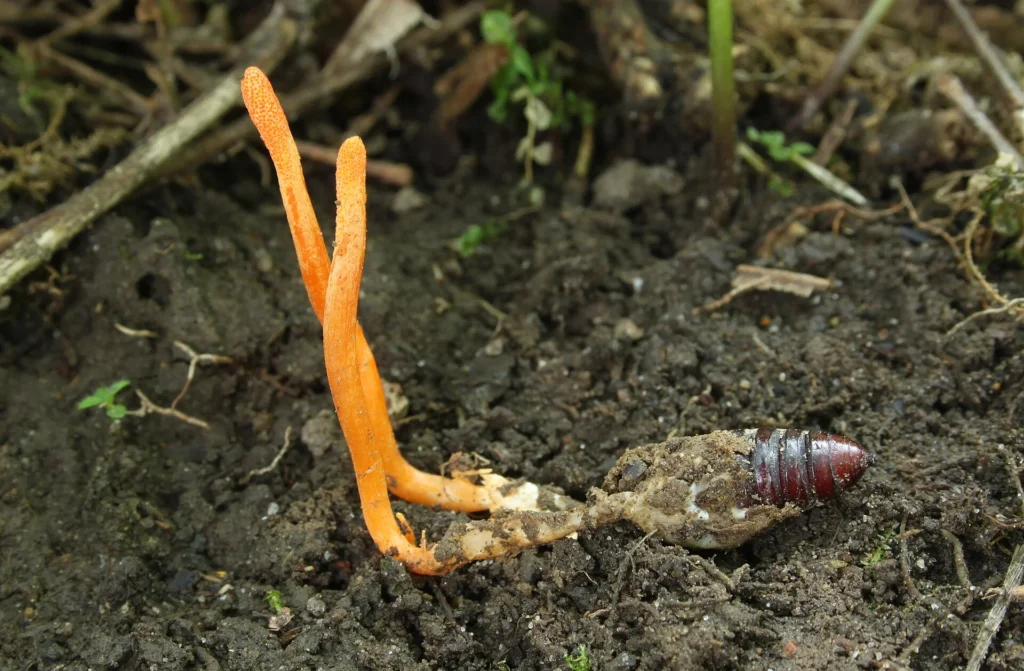
Cordyceps is perhaps the strangest of all functional mushrooms. In nature it grows on insects, and the wild Tibetan species has been one of the most expensive natural products in the world. Today cordyceps is popular among people who train, and since the TV series The Last of Us, many wonder whether the fungus can infect humans. Here we go through what cordyceps is, which species are found in products and what the studies show.
At a glance
- Cordyceps is a collective name for fungi that parasitise insects. The two species used in food supplements are Ophiocordyceps sinensis and Cordyceps militaris.
- The wild Tibetan species is very expensive. Most products instead contain cultivated Cordyceps militaris or mycelium grown in tanks.
- Cordyceps militaris contains the compound cordycepin, which has been studied extensively in laboratories.
- Studies on cordyceps and exercise show mixed results.
- Cordyceps cannot infect humans. Our body temperature is too high for these fungi.
What is cordyceps?
Cordyceps are fungi that attack insects, usually larvae or pupae. The fungus grows inside the host and eventually forms a fruiting body, a slender club that sticks up out of the insect. There are hundreds of species, and in recent years researchers have divided them into several genera.
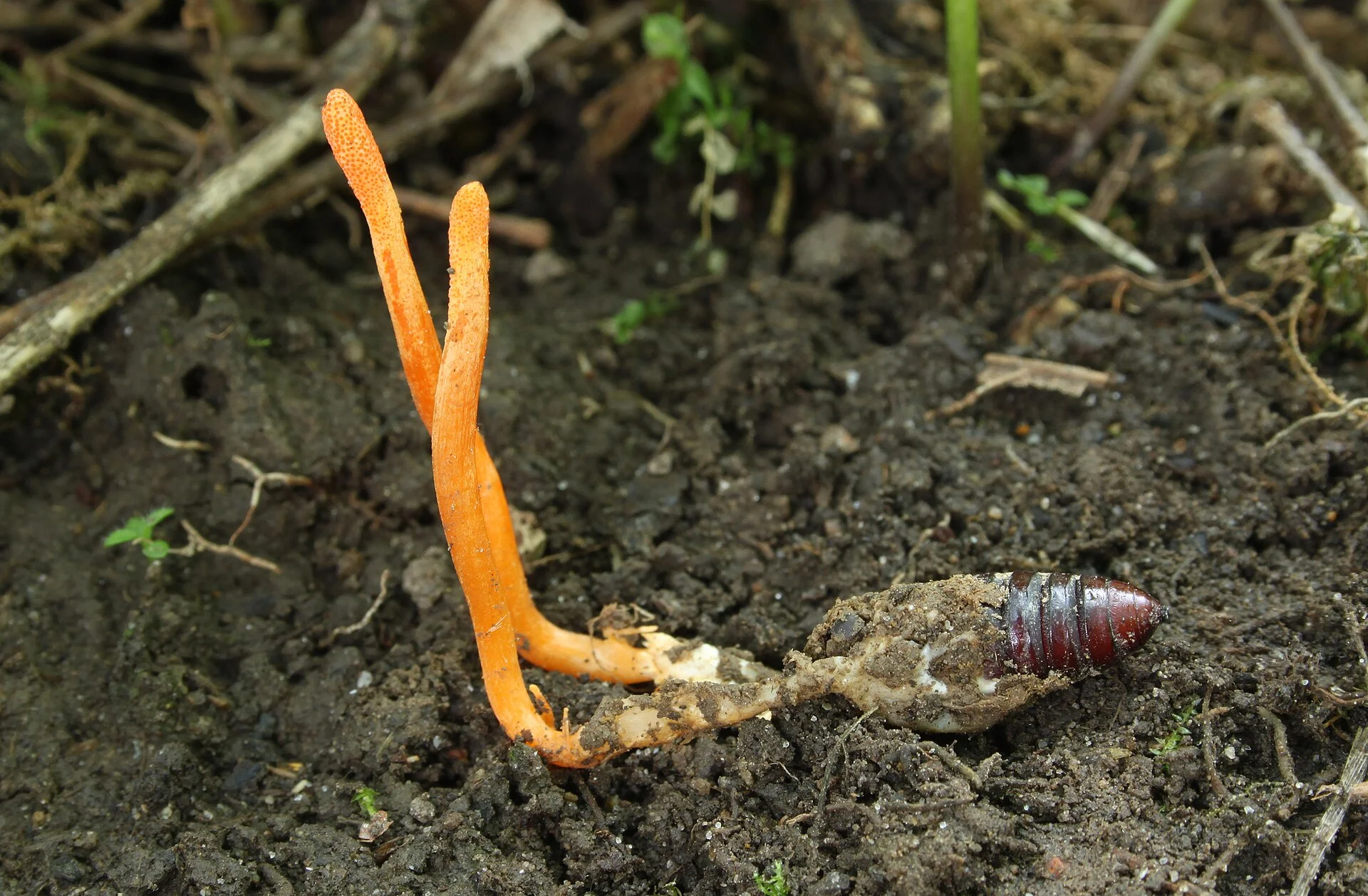
Two species are of interest when it comes to food supplements:
- Ophiocordyceps sinensis. The classic Tibetan cordyceps, formerly called Cordyceps sinensis. It grows on moth larvae at high altitudes on the Tibetan Plateau and in the Himalayas and is collected by hand. It is rare and very expensive.
- Cordyceps militaris. An orange club fungus that grows on pupae in the soil, including in Northern Europe. It can be cultivated on rice or other grains, for example, and it is the species found in most products today.
You can read more about the difference between fruiting body and mycelium, and how mushroom extracts are made, in our guide to functional mushrooms.
What does cordyceps contain?
The compound most often mentioned is cordycepin, found mainly in Cordyceps militaris. Cordycepin resembles the building block adenosine and has been studied extensively in cells and animals. In addition, cordyceps contains polysaccharides, sterols and other nucleosides, among other things. A large 2018 research review listed over 200 different compounds isolated from various cordyceps species.
Cordyceps and exercise: what do the studies say?
Cordyceps is often marketed for endurance and exercise. This is what some of the most cited studies have shown:
Trained cyclists (2004)
In an American study, 22 trained cyclists received a cordyceps preparation or a placebo for five weeks. The researchers saw no difference in oxygen uptake, ventilatory threshold or time in a time trial.
Young adults and high-intensity exercise (2017)
In another American study, 28 young adults received a mushroom blend containing Cordyceps militaris or a placebo. After one week there was no difference. A smaller group continued for three weeks, and their maximal oxygen uptake then improved compared with placebo. Since the product was a blend of several mushrooms, it is not possible to say what was due to cordyceps specifically.
A review of studies in athletes (2025)
A 2025 meta-analysis pooled randomised studies in athletes. For cordyceps of the sinensis type, the researchers found a small improvement in endurance, but the result was right on the borderline of statistical significance and was based on a small number of studies.
Overall, it is not possible to say that cordyceps has a reliable effect on performance. The results vary, and the studies use different species and products.
Can cordyceps infect humans?
No. In the TV series and game The Last of Us, a mutated cordyceps spreads to humans, and in reality there are related fungi that take over the behaviour of ants. But these fungi are specialised in insects. Mycologist Bryn Dentinger of the University of Utah explains that our body temperature is so high that most such organisms cannot survive in the body, and that no cordyceps has so far been able to infect humans.
Good to know
Check the species. Check whether a product contains Cordyceps militaris or mycelium of another species, and whether it is made from fruiting bodies or mycelium.
Safety. If you take medication, are pregnant or have a medical condition, it is wise to talk to a healthcare professional before starting cordyceps or any other food supplement.
If you want to read about other mushrooms, we have also written about Lion’s Mane, chaga and reishi.
You will find our cordyceps extract and tincture under functional mushrooms in our shop.
What is cordyceps?
Cordyceps are fungi that grow on insects, usually larvae or pupae. The two species used in food supplements are Ophiocordyceps sinensis and Cordyceps militaris.
What is the difference between Cordyceps sinensis and Cordyceps militaris?
Sinensis, now called Ophiocordyceps sinensis, grows wild on the Tibetan Plateau and is very expensive. Militaris can be cultivated and is the species found in most products.
Can cordyceps infect humans?
No. Cordyceps are specialised in insects and cannot cope with human body temperature. The fungus in The Last of Us is fiction.
Does cordyceps help with exercise?
The results are mixed. Some studies have seen small improvements in endurance or oxygen uptake, while others have seen no effect at all.
What is cordycepin?
Cordycepin is a compound found mainly in Cordyceps militaris. It resembles adenosine and has been studied extensively in laboratories and in animals.
Sources
- Olatunji, O. J. et al. (2018). The genus Cordyceps: An extensive review of its traditional uses, phytochemistry and pharmacology. Fitoterapia, 129, 293–316.
- Sung, G.-H. et al. (2007). Phylogenetic classification of Cordyceps and the clavicipitaceous fungi. Studies in Mycology, 57, 5–59.
- Parcell, A. C. et al. (2004). Cordyceps Sinensis (CordyMax Cs-4) supplementation does not improve endurance exercise performance. International Journal of Sport Nutrition and Exercise Metabolism, 14(2), 236–242.
- Hirsch, K. R. et al. (2017). Cordyceps militaris Improves Tolerance to High-Intensity Exercise After Acute and Chronic Supplementation. Journal of Dietary Supplements, 14(1), 42–53.
- Shu, M.-Y. et al. (2025). Effects of fungal supplementation on endurance, immune function, and hematological profiles in adult athletes: a systematic review and meta-analysis. Frontiers in Nutrition, 12, 1670416.
- NPR (2023). Ophiocordyceps, the fungus from ‘The Last Of Us,’ is real. But is it as deadly?


