

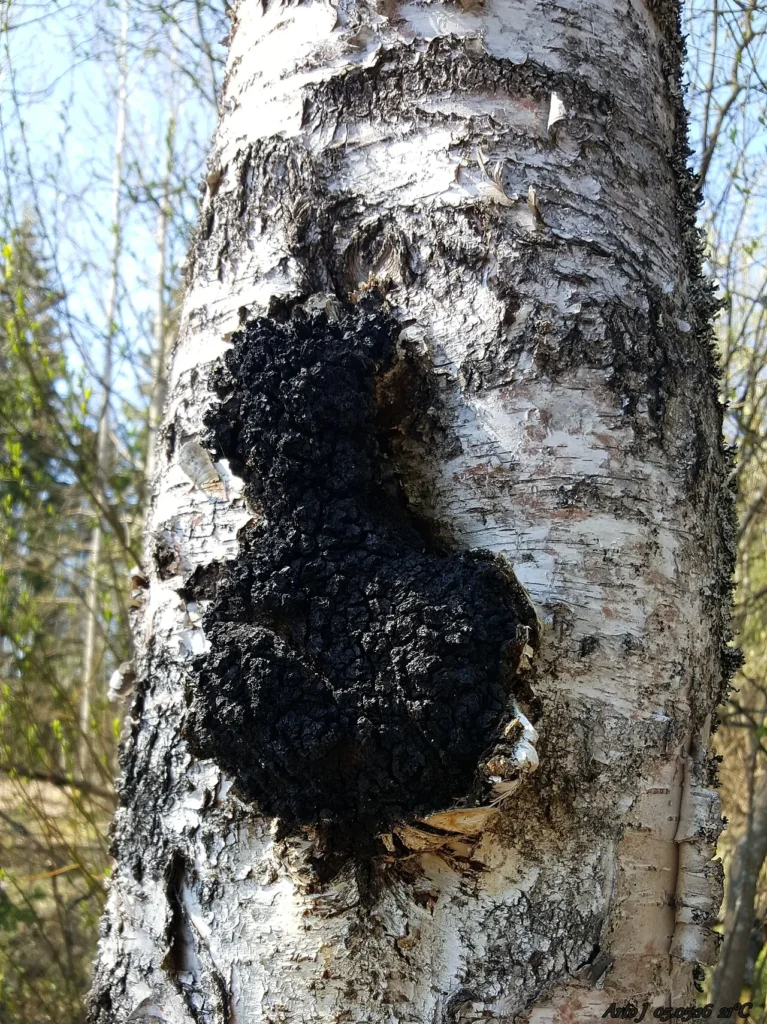
Chaga is the black, cracked lump that grows on birch trunks and looks like burnt wood. In Russia and Finland it has long been simmered into a dark drink, and today it is sold all over the world as chaga tea, powder and extract. Here we go through what chaga really is, how to recognise it, what it contains and what research knows, including what you should know about oxalate.
At a glance
- Chaga is known in Latin as Inonotus obliquus. It grows mainly on birch.
- The black lump is not the fungus’s fruiting body but a sterile mass of mycelium, a so-called sclerotium.
- Chaga is anchored in the wood and has to be cut from the tree, so you need the landowner’s permission to harvest it.
- Chaga contains dark pigments (melanin), triterpenes and polysaccharides, among other things. Almost all research has been done on cells and animals.
- Chaga contains a lot of oxalate, and there are published cases of kidney damage after long-term high intake.
What is chaga?
Chaga is a fungus that attacks living broadleaf trees, in the Nordic countries almost always birch. It enters through wounds in the bark and then grows inside the trunk for many years. What you see on the outside is a black, cracked growth with a rust-brown, cork-like interior.
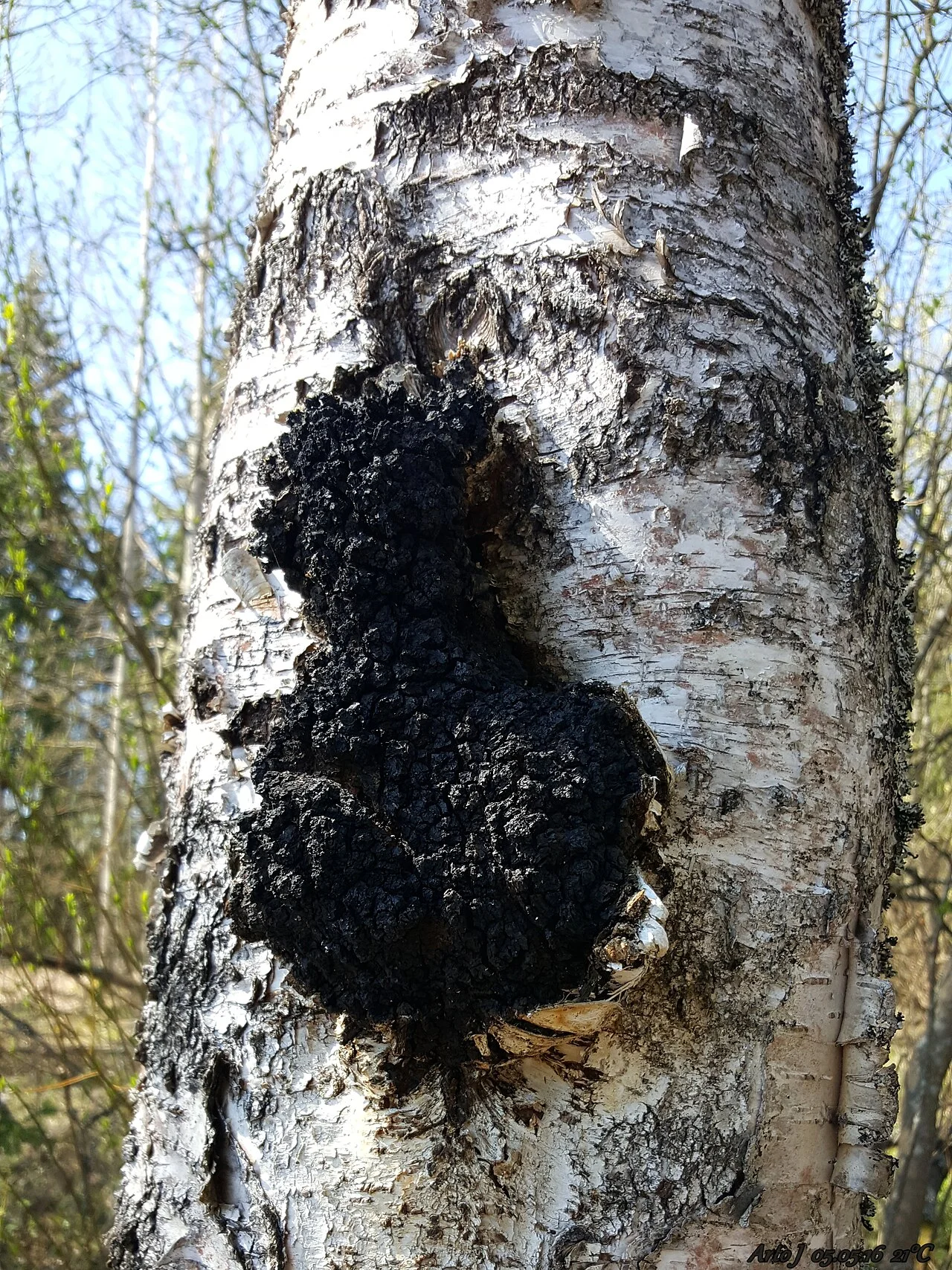
The black lump looks like a mushroom but is not one in the usual sense. It is a sclerotium, a sterile mass of tightly interwoven mycelium that is black from large amounts of melanin. The fungus’s real fruiting body, the one that spreads spores, only forms once the tree or part of it has died. It then grows hidden between the bark and the wood and is rarely seen.
Chaga grows slowly, and an infected tree can live for decades with the fungus in its trunk. You can read more about the difference between fruiting body and mycelium, and how mushroom extracts are made, in our guide to functional mushrooms.
How to recognise chaga
Chaga is easy to recognise once you know what to look for, but it is sometimes confused with other things on birch trunks:
- Chaga. Irregular, coal-black and deeply cracked on the outside. The inside is rusty yellow to brown and crumbly or cork-like.
- Burls. Growths on the trunk that are covered in bark and consist of hard wood all the way through.
- Tinder fungus. A grey, hoof-shaped bracket with pores on the underside. It is a true fruiting body and looks completely different.
Can you pick chaga?
Not without permission. Chaga is firmly anchored in the wood and has to be cut from the tree, which means harvesting it damages a living tree. In Sweden, for example, the right of public access lets you pick mushrooms in the forest but does not cover chaga, so the landowner’s permission is required.
Chaga tea and chaga coffee: a long tradition
Chaga has been used in folk medicine in Siberia and Russia since at least the 16th century. The Khanty people of western Siberia cut chaga into small pieces and simmered it in water to make tea. In Finland, where the fungus is called pakuri, a research review describes how soldiers used chaga as a coffee substitute during the Second World War when coffee ran out.
The drink turns dark, almost like black tea, with an earthy and slightly bitter taste. Chaga contains no caffeine, which is one reason it is sold today as an alternative to coffee.
What does chaga contain?
Researchers have found several groups of compounds in chaga:
- Melanin. The dark pigment that gives chaga its black colour.
- Triterpenes. Including inotodiol and betulinic acid. The betulinic acid comes partly from the birch the fungus grows on.
- Polysaccharides. Including beta-glucans, the same type of compounds found in other functional mushrooms.
- Polyphenols. Plant compounds often studied in the laboratory for their antioxidant properties.
The fact that betulinic acid comes from the host tree is one reason why wild chaga from birch differs from chaga grown in a laboratory.
What does research say about chaga?
There are many studies on chaga, but almost all of them have been done on cells in test tubes or on animals. Controlled studies in humans are largely lacking. Several recent research reviews state that clinical studies are needed before anything can be said about how chaga affects people.
This does not mean chaga is uninteresting, but it does mean that many claims about chaga found online go further than the research shows.
Oxalate: the most important thing to know about chaga
Chaga contains very high levels of oxalate, a substance that in large amounts can form crystals in the kidneys. In 2014, Japanese doctors described the case of a 72-year-old woman who had taken four to five teaspoons of chaga powder a day for six months and developed kidney damage so severe that she needed dialysis. In 2022, a similar case was published from South Korea.
These are few cases, but they show that more is not better. If you have kidney disease, take medication, are pregnant or have a medical condition, it is wise to talk to a healthcare professional before using chaga.
Wild or cultivated chaga?
Most of the chaga sold is wild-harvested from birch trees. Growing demand has raised questions about how much can be harvested sustainably. In Finland, researchers are therefore trying to cultivate chaga by inoculating the fungus into living birches.
It turned out to be easier said than done. In a Finnish trial, 679 birches were inoculated. Four to five years later, an average of 79 percent of the trees were infected, but only about 6 percent had visible conks. The researchers concluded that chaga forms slowly even when inoculation succeeds.
If you want to read about other mushrooms, we have also written about Lion’s Mane, reishi and cordyceps.
You will find our chaga extract and tincture under functional mushrooms in our shop.
What is chaga?
Chaga (Inonotus obliquus) is a fungus that grows on birch. The black lump on the trunk is a sterile sclerotium of mycelium, not a fruiting body. It is traditionally used to make tea.
What is chaga called in other languages?
Chaga is the Russian name used internationally. In Finnish it is called pakuri or pakurikääpä, and in Swedish sprängticka.
Can you pick chaga?
Not without the landowner’s permission. Chaga is anchored in the wood and has to be cut from a living tree. In Sweden, the right of public access does not cover chaga.
Does chaga contain caffeine?
No, chaga contains no caffeine. That is one reason chaga tea is sometimes used as an alternative to coffee.
Can chaga be harmful?
Chaga contains a lot of oxalate. There are published cases of kidney damage in people who took large amounts of chaga powder over a long period. Talk to a healthcare professional if you have kidney disease or take medication.
Sources
- Ern, P. T. Y. et al. (2024). Therapeutic properties of Inonotus obliquus (Chaga mushroom): A review. Mycology, 15(2), 144–161.
- Fordjour, E. et al. (2023). Chaga mushroom: a super-fungus with countless facets and untapped potential. Frontiers in Pharmacology, 14, 1273786.
- Kikuchi, Y. et al. (2014). Chaga mushroom-induced oxalate nephropathy. Clinical Nephrology, 81(6), 440–444.
- Kwon, O. et al. (2022). Chaga mushroom-induced oxalate nephropathy that clinically manifested as nephrotic syndrome: A case report. Medicine, 101(10), e28997.
- Miina, J. et al. (2021). Inoculation success of Inonotus obliquus in living birch (Betula spp.). Forest Ecology and Management, 492, 119244.
- Peng, H. & Shahidi, F. (2020). Bioactive compounds and bioactive properties of chaga (Inonotus obliquus) mushroom: a review. Journal of Food Bioactives, 12, 9–75.
- Svampkonsulenternas Riksförbund. Allemansrätten och svamp (The right of public access and mushrooms, in Swedish).


